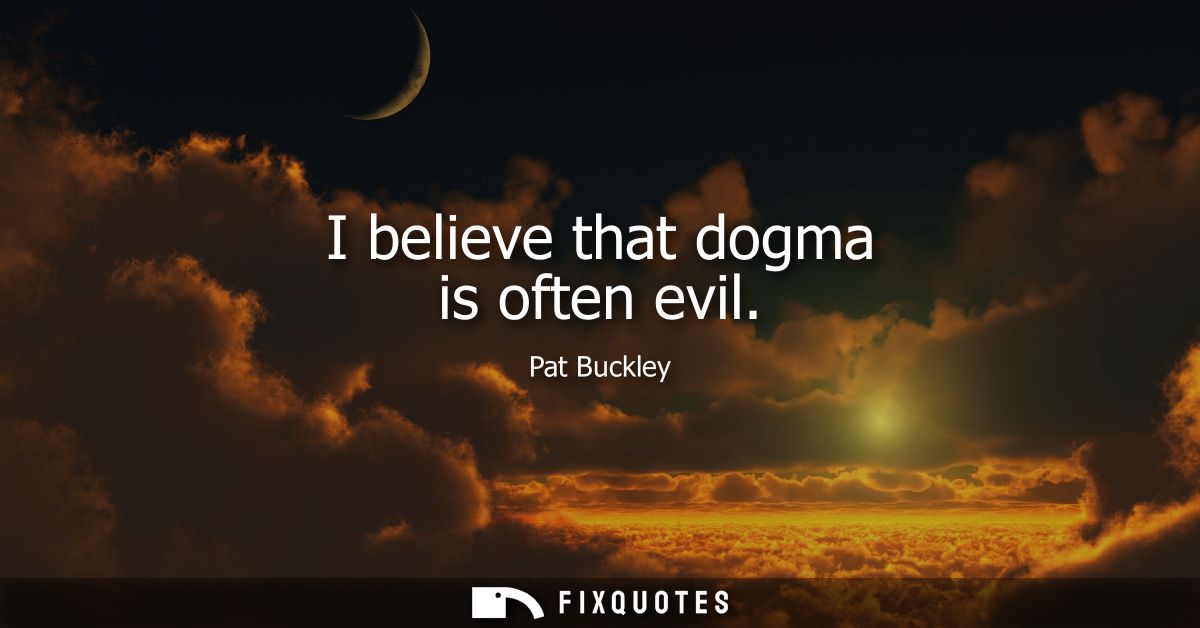
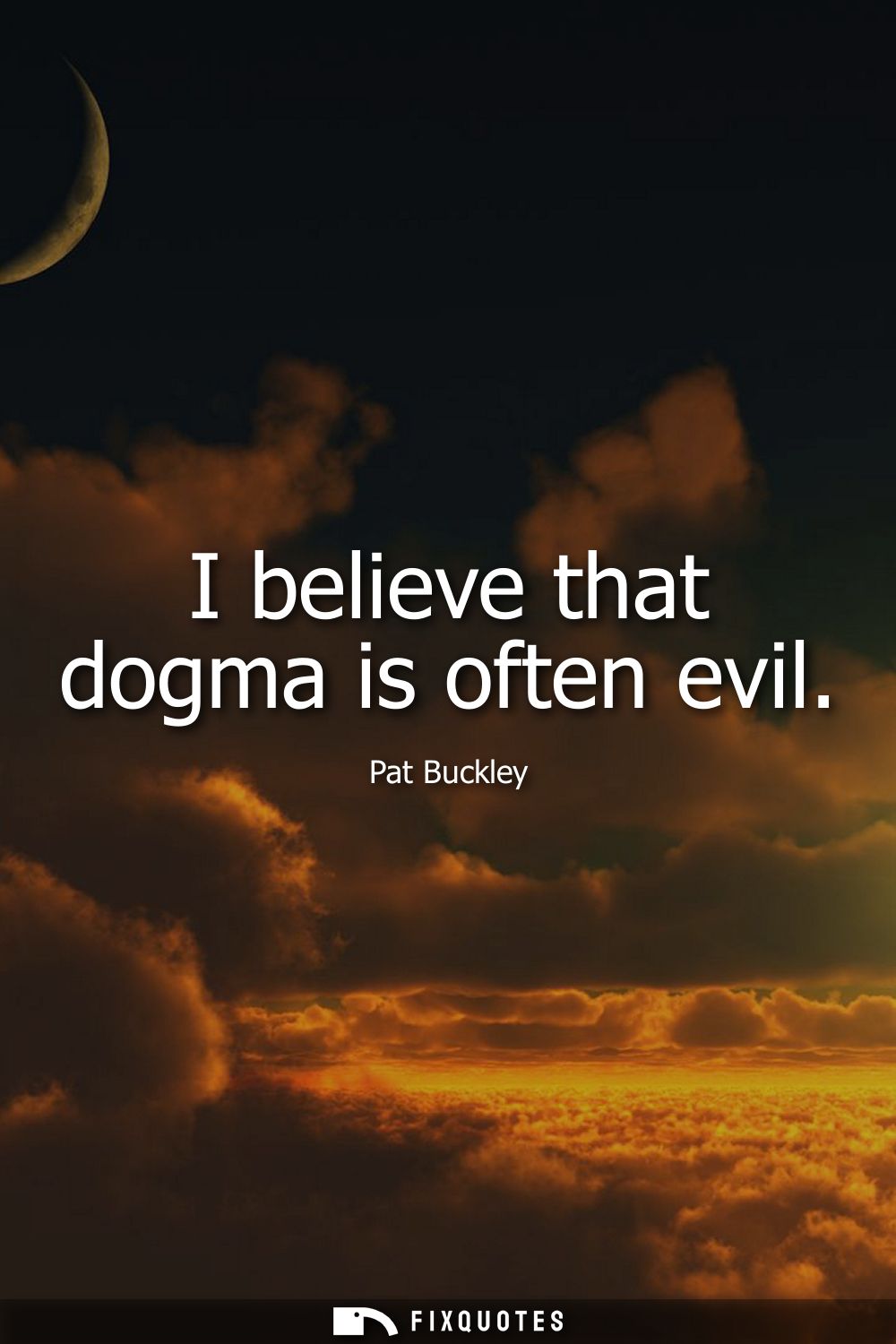
"I believe that dogma is often evil"
About this Quote
A clergyman calling dogma “often evil” is a small act of detonation inside a profession built to guard doctrine. Pat Buckley’s line works because it refuses the expected hedge. He doesn’t say dogma can be misused; he pins a moral charge to the thing itself, then softens it only slightly with “often.” That single adverb is tactical: it signals he’s not rejecting faith, just the kind of certainty that turns belief into a weapon.
The intent reads pastoral and political at once. Pastoral, because “dogma” isn’t an abstract enemy; it’s the machinery that can keep people trapped in shame, silence, or fear when lived experience doesn’t fit the approved script. Political, because Buckley’s likely audience isn’t atheists but co-believers and church authorities: the gatekeepers who confuse unity with obedience. By naming dogma as “evil,” he flips the church’s usual moral geometry. The danger isn’t temptation outside the walls; it’s rigidity inside them.
Subtext: he’s arguing for conscience as a higher authority than institutional certainty. In religious history, reformers rarely win by attacking God; they win by attacking the systems that claim to speak for God without remainder. The line compresses that tradition into eight words: a warning that when doctrine stops being a guide and becomes an identity badge, it starts demanding casualties - empathy, inquiry, sometimes human dignity. In that sense, the quote isn’t anti-religious; it’s a demand that religion remain accountable to the people it touches.
The intent reads pastoral and political at once. Pastoral, because “dogma” isn’t an abstract enemy; it’s the machinery that can keep people trapped in shame, silence, or fear when lived experience doesn’t fit the approved script. Political, because Buckley’s likely audience isn’t atheists but co-believers and church authorities: the gatekeepers who confuse unity with obedience. By naming dogma as “evil,” he flips the church’s usual moral geometry. The danger isn’t temptation outside the walls; it’s rigidity inside them.
Subtext: he’s arguing for conscience as a higher authority than institutional certainty. In religious history, reformers rarely win by attacking God; they win by attacking the systems that claim to speak for God without remainder. The line compresses that tradition into eight words: a warning that when doctrine stops being a guide and becomes an identity badge, it starts demanding casualties - empathy, inquiry, sometimes human dignity. In that sense, the quote isn’t anti-religious; it’s a demand that religion remain accountable to the people it touches.
Quote Details
| Topic | Ethics & Morality |
|---|---|
| Source | Help us find the source |
| Cite |
Citation Formats
APA Style (7th ed.)
Buckley, Pat. (2026, January 16). I believe that dogma is often evil. FixQuotes. https://fixquotes.com/quotes/i-believe-that-dogma-is-often-evil-109060/
Chicago Style
Buckley, Pat. "I believe that dogma is often evil." FixQuotes. January 16, 2026. https://fixquotes.com/quotes/i-believe-that-dogma-is-often-evil-109060/.
MLA Style (9th ed.)
"I believe that dogma is often evil." FixQuotes, 16 Jan. 2026, https://fixquotes.com/quotes/i-believe-that-dogma-is-often-evil-109060/. Accessed 12 Feb. 2026.
More Quotes by Pat
Add to List