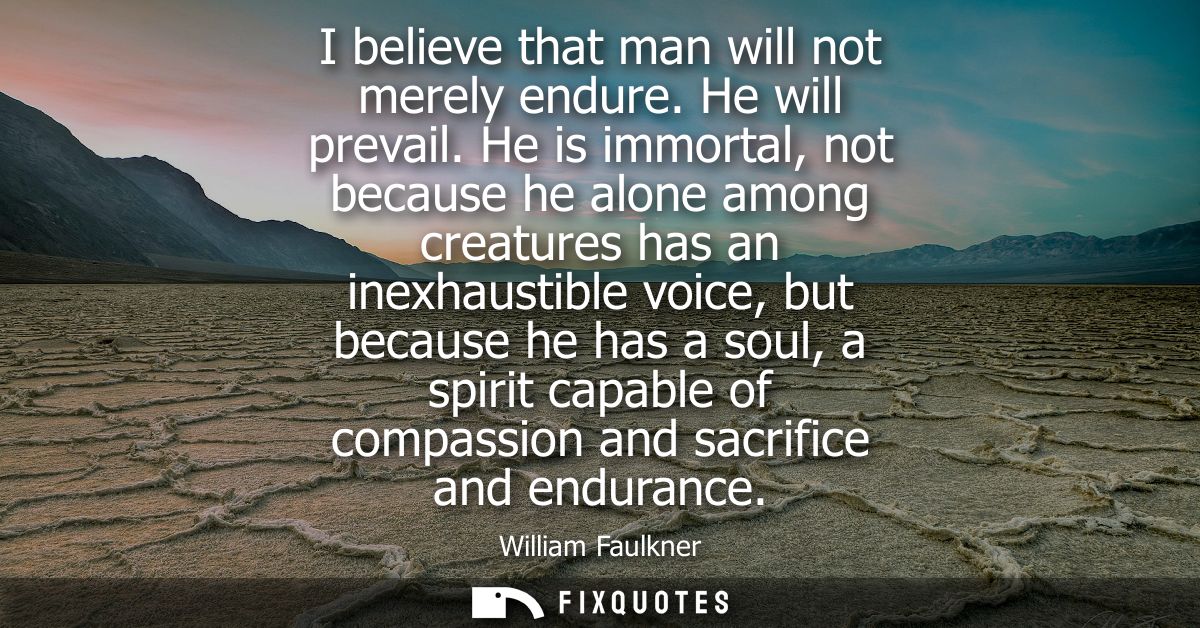
"I believe that man will not merely endure. He will prevail. He is immortal, not because he alone among creatures has an inexhaustible voice, but because he has a soul, a spirit capable of compassion and sacrifice and endurance"
About this Quote
The craft is in the pivot. He starts with “endure,” a word that admits misery as the baseline, then upgrades to “prevail,” which smuggles in agency. Endurance is passive survival; prevailing suggests moral and historical momentum. Faulkner’s South-haunted fiction never lets us forget how long cruelty can persist, which makes the insistence on prevailing feel earned rather than sentimental.
The subtext sharpens when he dismisses “voice” as the reason for immortality. For a writer to downplay language is a sly rebuke to the era’s faith in rhetoric, propaganda, and public performance. He’s telling other artists, and maybe himself, that eloquence isn’t redemption. “Soul” and “spirit” are not churchy abstractions here; they’re a checklist of behaviors: compassion, sacrifice, endurance. He defines the human not by intelligence or dominance, but by the capacity to take on pain voluntarily for someone else.
It’s also a subtle warning to his fellow storytellers: stop fetishizing despair. If the writer’s job is to name terror, it’s also to testify that something in us keeps choosing connection over surrender.
Quote Details
| Topic | Resilience |
|---|---|
| Source | William Faulkner — Nobel Lecture (Nobel Prize in Literature 1949), acceptance speech published 1950; contains the passage beginning “I believe that man will not merely endure…” (NobelPrize.org). |
| Cite |
Citation Formats
APA Style (7th ed.)
Faulkner, William. (2026, January 18). I believe that man will not merely endure. He will prevail. He is immortal, not because he alone among creatures has an inexhaustible voice, but because he has a soul, a spirit capable of compassion and sacrifice and endurance. FixQuotes. https://fixquotes.com/quotes/i-believe-that-man-will-not-merely-endure-he-will-2424/
Chicago Style
Faulkner, William. "I believe that man will not merely endure. He will prevail. He is immortal, not because he alone among creatures has an inexhaustible voice, but because he has a soul, a spirit capable of compassion and sacrifice and endurance." FixQuotes. January 18, 2026. https://fixquotes.com/quotes/i-believe-that-man-will-not-merely-endure-he-will-2424/.
MLA Style (9th ed.)
"I believe that man will not merely endure. He will prevail. He is immortal, not because he alone among creatures has an inexhaustible voice, but because he has a soul, a spirit capable of compassion and sacrifice and endurance." FixQuotes, 18 Jan. 2026, https://fixquotes.com/quotes/i-believe-that-man-will-not-merely-endure-he-will-2424/. Accessed 1 Apr. 2026.