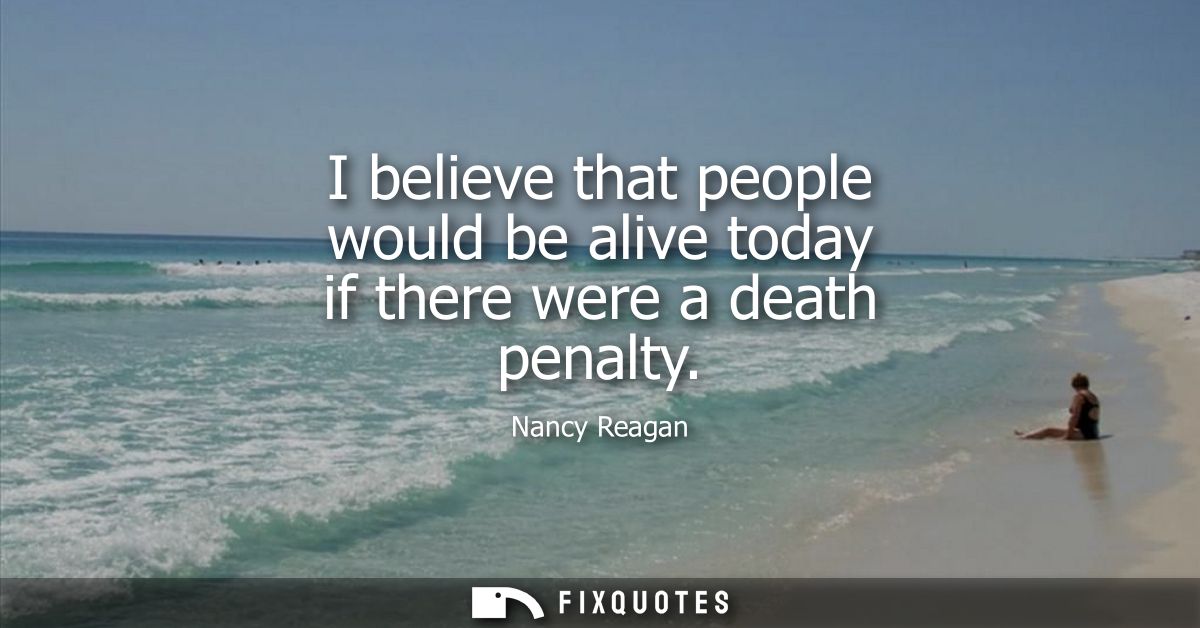
"I believe that people would be alive today if there were a death penalty"
About this Quote
The intent is deterrence talk with the volume turned up. “I believe” is a softener that pretends humility while smuggling in a hard claim: executions prevent murders. The subtext is harsher. If you oppose the death penalty, the sentence implies, you’re not merely idealistic; you’re complicit in future deaths. It’s an argument designed to end debate by moving the terrain from justice to survival.
Context is key: the late Cold War and post-1970s crime politics, when “law and order” became a central language of governance and toughness was marketed as clarity. As First Lady, Reagan wasn’t passing legislation, but she was part of the administration’s broader cultural project: recasting conservatism as common sense and moral hygiene. The quote’s power comes from its inversion. It uses the grammar of empathy to justify an instrument of violence, turning the death penalty into a pro-life posture without ever acknowledging the ethical cost, the risk of wrongful convictions, or the state’s own capacity for error.
Quote Details
| Topic | Justice |
|---|---|
| Source | Help us find the source |
| Cite |
Citation Formats
APA Style (7th ed.)
Reagan, Nancy. (2026, January 14). I believe that people would be alive today if there were a death penalty. FixQuotes. https://fixquotes.com/quotes/i-believe-that-people-would-be-alive-today-if-15641/
Chicago Style
Reagan, Nancy. "I believe that people would be alive today if there were a death penalty." FixQuotes. January 14, 2026. https://fixquotes.com/quotes/i-believe-that-people-would-be-alive-today-if-15641/.
MLA Style (9th ed.)
"I believe that people would be alive today if there were a death penalty." FixQuotes, 14 Jan. 2026, https://fixquotes.com/quotes/i-believe-that-people-would-be-alive-today-if-15641/. Accessed 7 Feb. 2026.