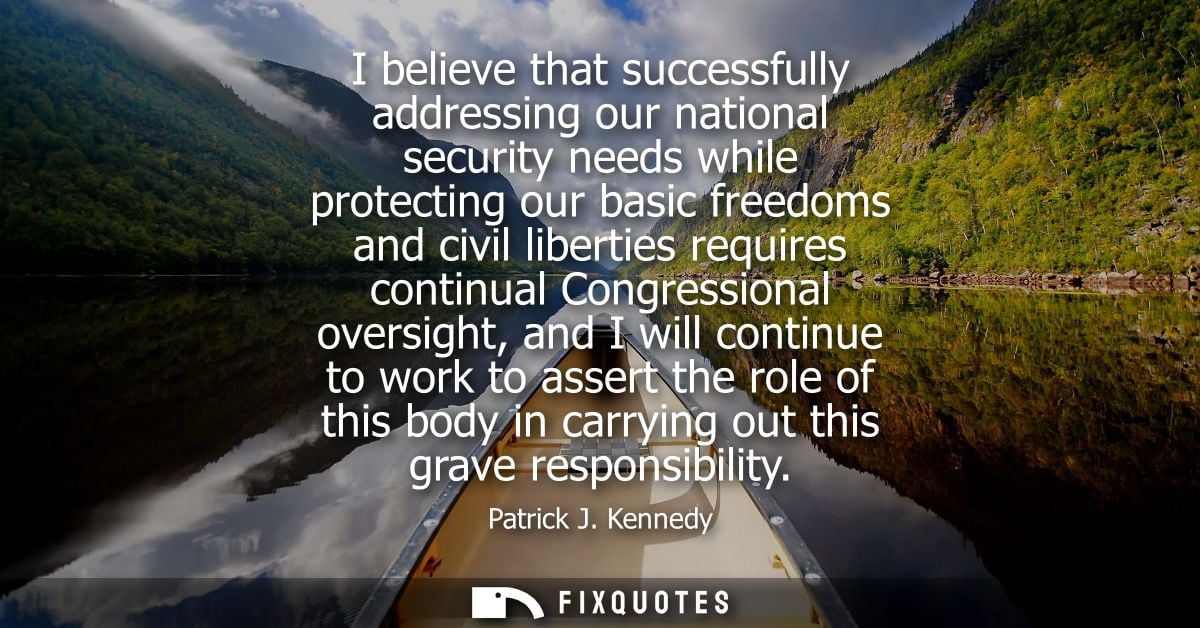
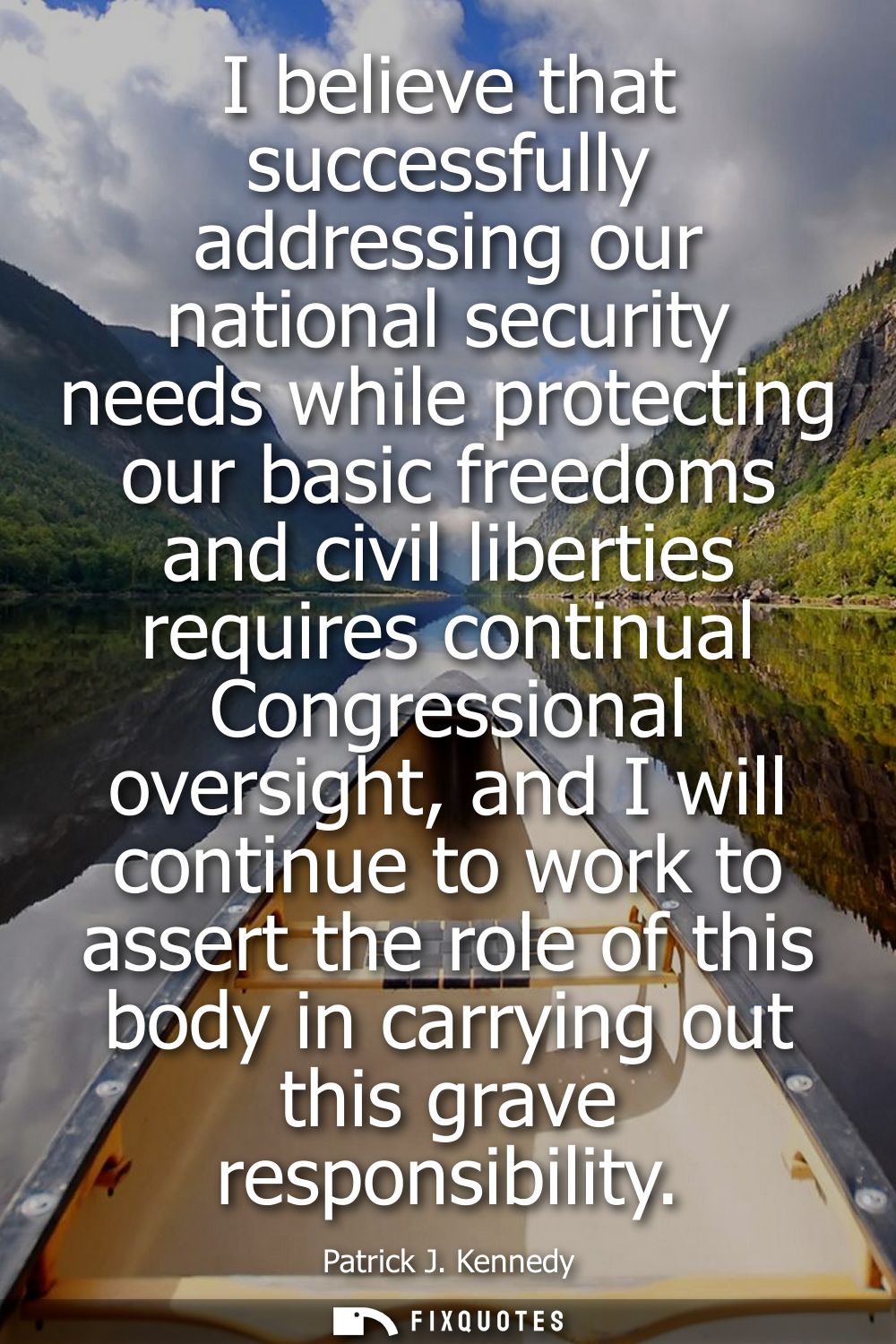
"I believe that successfully addressing our national security needs while protecting our basic freedoms and civil liberties requires continual Congressional oversight, and I will continue to work to assert the role of this body in carrying out this grave responsibility"
About this Quote
The subtext is a quiet rebuke of executive branch overreach. Oversight is invoked here not as routine committee work but as a corrective, implying that without persistent pressure the national security apparatus naturally drifts toward secrecy and expanded powers. Kennedy s phrase protecting our basic freedoms and civil liberties also functions as a coalition-builder: it nods to post-9/11 anxieties about the Patriot Act era, warrantless surveillance, and classified legal interpretations, while avoiding the politically risky step of naming specific abuses.
Notice the self-positioning: I will continue to work to assert the role of this body. That is both institutional patriotism and a campaign-ready claim of seriousness. Congress is cast as a moral check, not a partisan battlefield, and responsibility is called grave to elevate oversight from paperwork to duty. The rhetoric aims to reassure two audiences at once: constituents who fear terrorism and constituents who fear government. The promise is not an outcome, but a posture: democratic friction as the price of security.
Quote Details
| Topic | Freedom |
|---|---|
| Source | Help us find the source |
| Cite |
Citation Formats
APA Style (7th ed.)
Kennedy, Patrick J. (2026, January 17). I believe that successfully addressing our national security needs while protecting our basic freedoms and civil liberties requires continual Congressional oversight, and I will continue to work to assert the role of this body in carrying out this grave responsibility. FixQuotes. https://fixquotes.com/quotes/i-believe-that-successfully-addressing-our-52111/
Chicago Style
Kennedy, Patrick J. "I believe that successfully addressing our national security needs while protecting our basic freedoms and civil liberties requires continual Congressional oversight, and I will continue to work to assert the role of this body in carrying out this grave responsibility." FixQuotes. January 17, 2026. https://fixquotes.com/quotes/i-believe-that-successfully-addressing-our-52111/.
MLA Style (9th ed.)
"I believe that successfully addressing our national security needs while protecting our basic freedoms and civil liberties requires continual Congressional oversight, and I will continue to work to assert the role of this body in carrying out this grave responsibility." FixQuotes, 17 Jan. 2026, https://fixquotes.com/quotes/i-believe-that-successfully-addressing-our-52111/. Accessed 26 Mar. 2026.