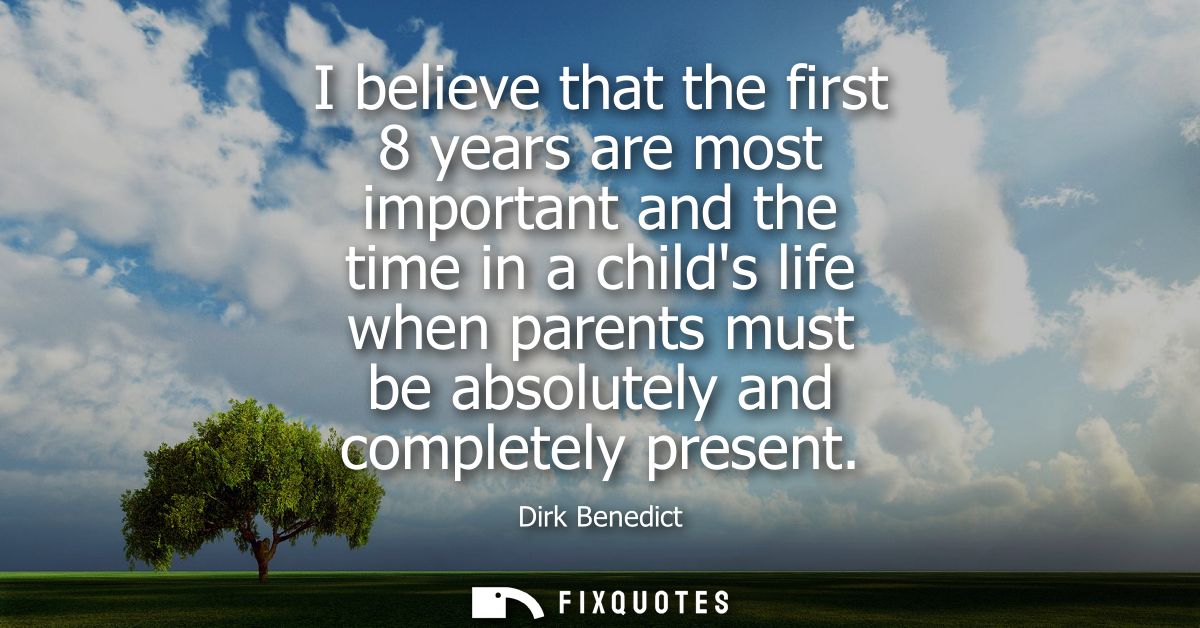
"I believe that the first 8 years are most important, and the time in a child's life when parents must be absolutely and completely present"
About this Quote
The intent is less sentimental than urgent. Benedict isn't praising parenting in general; he's drawing a boundary around it, arguing that early childhood isn't merely foundational but formative in ways that later repair can't fully undo. The subtext is a critique of the cultural script that treats parenting as something you can optimize later, once life calms down. It rarely does.
Context matters: Benedict comes from a generation that watched family structures shift, two-income households become default, and "quality time" replace plain time. His wording rejects the bargain that a few curated moments can stand in for sustained attention. There's also a slightly uncompromising, almost masculine bluntness to it - presence as duty, not self-care - suggesting that love isn't just felt, it's practiced with your calendar. The line works because it makes absence sound like a choice, not an accident, and that stings in exactly the way good cultural advice often does.
Quote Details
| Topic | Parenting |
|---|---|
| Source | Help us find the source |
| Cite |
Citation Formats
APA Style (7th ed.)
Benedict, Dirk. (2026, February 19). I believe that the first 8 years are most important, and the time in a child's life when parents must be absolutely and completely present. FixQuotes. https://fixquotes.com/quotes/i-believe-that-the-first-8-years-are-most-57085/
Chicago Style
Benedict, Dirk. "I believe that the first 8 years are most important, and the time in a child's life when parents must be absolutely and completely present." FixQuotes. February 19, 2026. https://fixquotes.com/quotes/i-believe-that-the-first-8-years-are-most-57085/.
MLA Style (9th ed.)
"I believe that the first 8 years are most important, and the time in a child's life when parents must be absolutely and completely present." FixQuotes, 19 Feb. 2026, https://fixquotes.com/quotes/i-believe-that-the-first-8-years-are-most-57085/. Accessed 7 Apr. 2026.