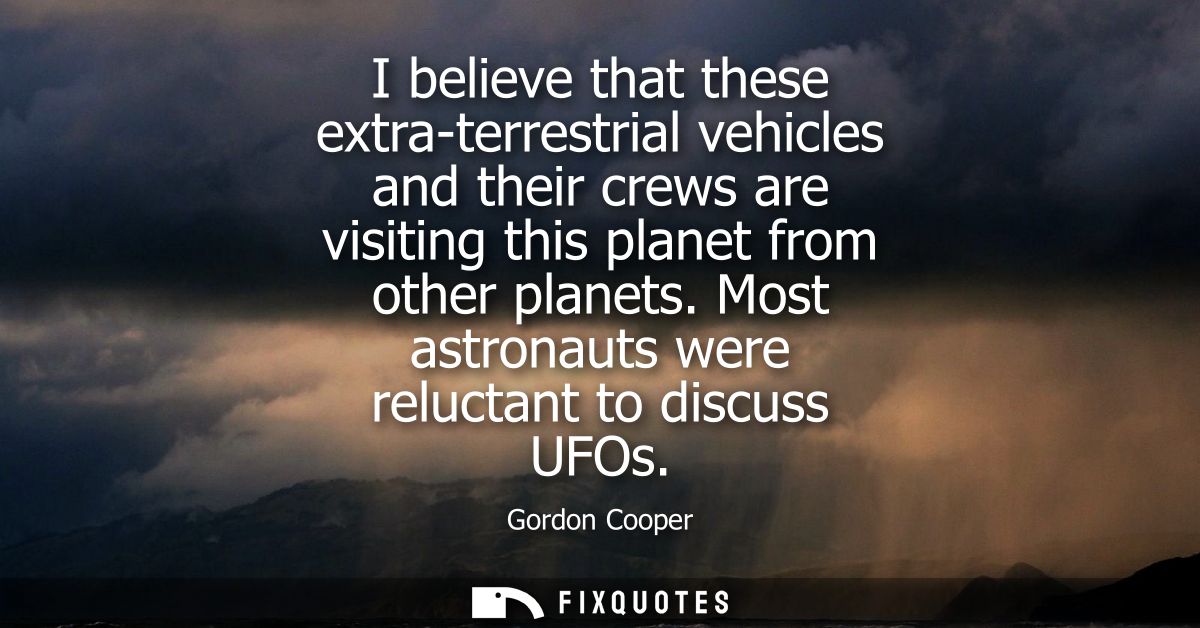
"I believe that these extra-terrestrial vehicles and their crews are visiting this planet from other planets. Most astronauts were reluctant to discuss UFOs"
About this Quote
Coming from an astronaut, this isn’t fringe theater; it’s a credentialed breach in the wall between official calm and private suspicion. Gordon Cooper’s wording is careful in a way that actually sharpens the provocation. He doesn’t say he “saw something” or “can’t explain it.” He offers belief with specifics: “vehicles,” “crews,” “other planets.” That concrete language borrows the authority of engineering, as if the UFO question is less about mysticism than hardware and logistics.
The second sentence is the real tell. “Most astronauts were reluctant” shifts the claim from a lone confession to a culture of silence. Cooper is describing an ecosystem: disciplined professionals whose careers depend on seeming rational, unflappable, and aligned with institutional messaging. In the Cold War-era space program, perception mattered almost as much as telemetry. NASA wasn’t just doing science; it was selling competence, control, and American modernity. UFO talk threatened that brand by inviting ridicule, political scrutiny, or the suggestion that the skies (and therefore the nation) weren’t fully knowable.
His intent reads less like tabloid bait than a challenge to the boundary of acceptable speech. The subtext is reputational risk: if astronauts aren’t talking, it’s not because nothing happened, but because the costs of talking are high. Cooper’s quote functions as both testimony and pressure tactic, asking the public to consider that “no comment” can be a strategy, not a conclusion.
The second sentence is the real tell. “Most astronauts were reluctant” shifts the claim from a lone confession to a culture of silence. Cooper is describing an ecosystem: disciplined professionals whose careers depend on seeming rational, unflappable, and aligned with institutional messaging. In the Cold War-era space program, perception mattered almost as much as telemetry. NASA wasn’t just doing science; it was selling competence, control, and American modernity. UFO talk threatened that brand by inviting ridicule, political scrutiny, or the suggestion that the skies (and therefore the nation) weren’t fully knowable.
His intent reads less like tabloid bait than a challenge to the boundary of acceptable speech. The subtext is reputational risk: if astronauts aren’t talking, it’s not because nothing happened, but because the costs of talking are high. Cooper’s quote functions as both testimony and pressure tactic, asking the public to consider that “no comment” can be a strategy, not a conclusion.
Quote Details
| Topic | Science |
|---|
More Quotes by Gordon
Add to List