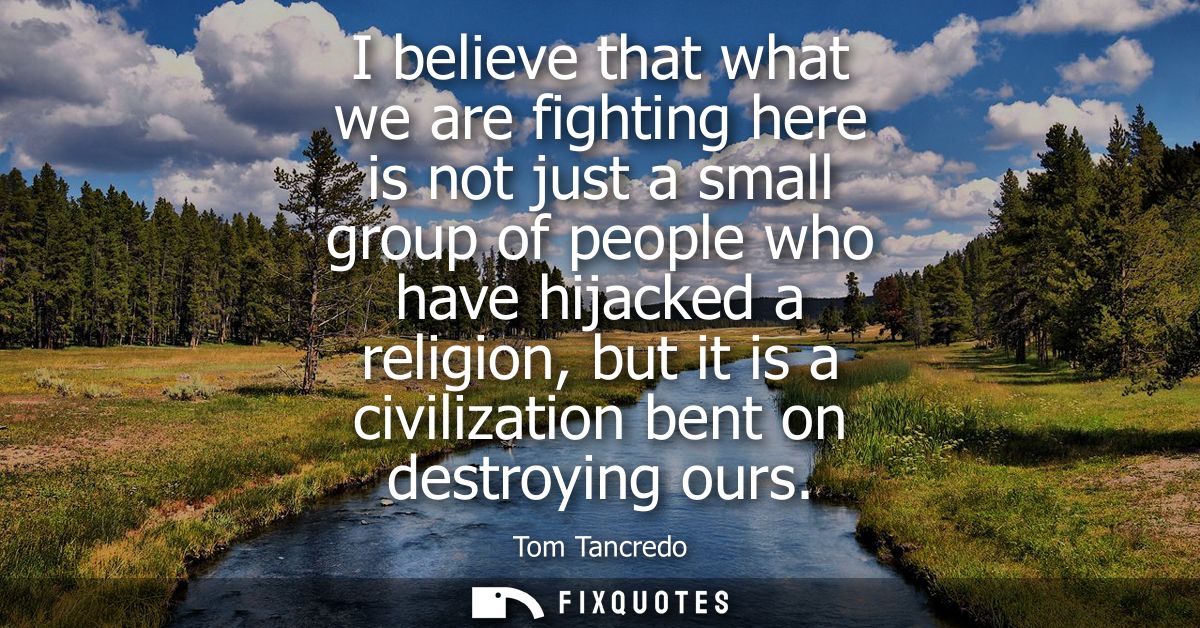
"I believe that what we are fighting here is not just a small group of people who have hijacked a religion, but it is a civilization bent on destroying ours"
About this Quote
The intent is clear: widen the circle of suspicion. “Hijacked a religion” is a concession meant to sound reasonable before the real move: collapsing distinctions between Islam, Islamism, and terrorism. It’s a rhetorical trap that invites the listener to feel sophisticated for considering nuance, then punishes them for it by insisting nuance is naive. “Our civilization” is doing double duty as comfort and boundary marker, implying shared values while implying who doesn’t belong.
The subtext is less about foreign battlefields than domestic permission. If the threat is a whole civilization, then extraordinary responses feel proportionate: aggressive surveillance, immigration restriction, cultural tests of loyalty. It also functions as a political accelerant: fear scales better than facts, and “civilization” language turns a messy problem into a simple us-versus-them story.
Context matters. Tancredo built a brand on hardline immigration politics, and this framing fits the mid-2000s moment when terrorism anxiety, Iraq-era disillusionment, and “clash of civilizations” rhetoric fused into a durable campaign theme: security as identity, and identity as policy.
Quote Details
| Topic | War |
|---|---|
| Source | Help us find the source |
| Cite |
Citation Formats
APA Style (7th ed.)
Tancredo, Tom. (2026, January 16). I believe that what we are fighting here is not just a small group of people who have hijacked a religion, but it is a civilization bent on destroying ours. FixQuotes. https://fixquotes.com/quotes/i-believe-that-what-we-are-fighting-here-is-not-99428/
Chicago Style
Tancredo, Tom. "I believe that what we are fighting here is not just a small group of people who have hijacked a religion, but it is a civilization bent on destroying ours." FixQuotes. January 16, 2026. https://fixquotes.com/quotes/i-believe-that-what-we-are-fighting-here-is-not-99428/.
MLA Style (9th ed.)
"I believe that what we are fighting here is not just a small group of people who have hijacked a religion, but it is a civilization bent on destroying ours." FixQuotes, 16 Jan. 2026, https://fixquotes.com/quotes/i-believe-that-what-we-are-fighting-here-is-not-99428/. Accessed 25 Mar. 2026.