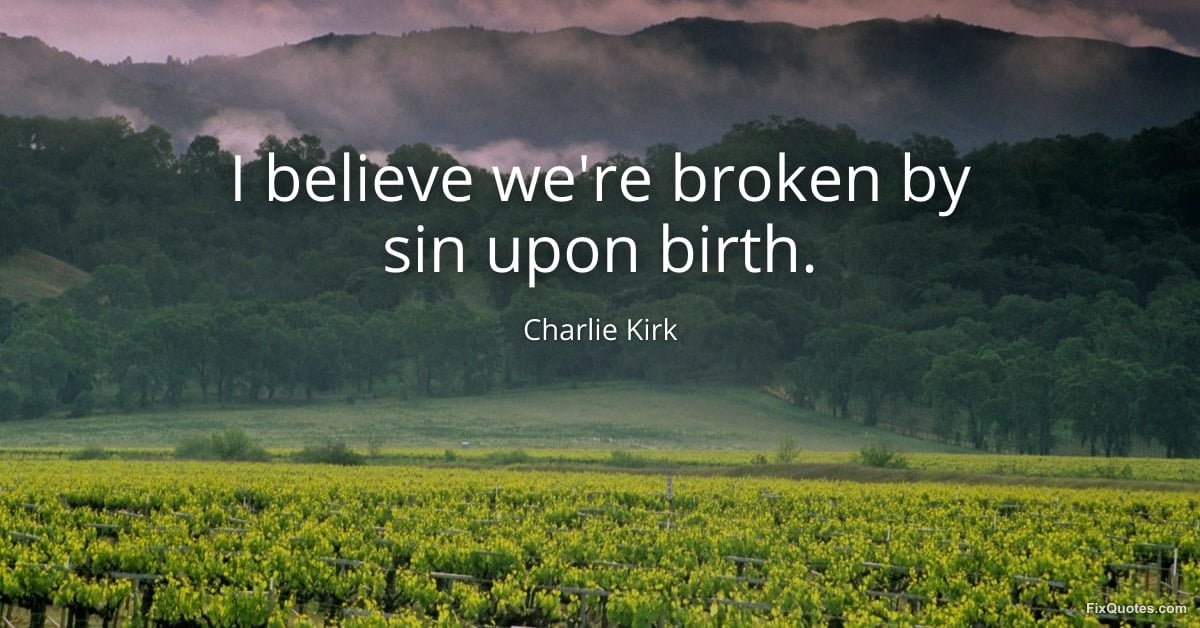
"I believe we're broken by sin upon birth"
About this Quote
There’s a calculated bleakness in “I believe we’re broken by sin upon birth” that does political work before it does spiritual work. It’s not just a theological claim about original sin; it’s a framing device that pre-loads the debate with a verdict: people can’t be trusted, self-rule is fragile, and moral drift is the default setting. Say that out loud and you’ve already made a case for authority - for gatekeepers, constraints, and a hard-edged version of “values” that reads less like personal faith and more like civic policy.
The key move is the word “broken.” It’s mechanical, not poetic. Broken things don’t just need guidance; they need repair, discipline, reassembly. That metaphor quietly shifts compassion into correction. It also turns social problems into symptoms of a deeper defect rather than failures of systems, economics, or history - a pivot that conveniently deprioritizes structural critique. If the root issue is spiritual fracture, then politics becomes triage: restrict, punish, restore, repeat.
In contemporary American culture-war rhetoric, this idea functions as a shortcut to a whole worldview: skepticism of secular progress, suspicion of moral pluralism, and an insistence that liberty without a transcendent moral framework becomes license. It’s also a subtle inoculation against utopian promises. If humans are “broken” at the factory, then any project that imagines perfectibility starts sounding naive, even dangerous.
The line’s power is its preemptive simplicity. It collapses messy arguments about why people act as they do into a single origin story, then uses that story to justify a politics of moral policing dressed as realism.
The key move is the word “broken.” It’s mechanical, not poetic. Broken things don’t just need guidance; they need repair, discipline, reassembly. That metaphor quietly shifts compassion into correction. It also turns social problems into symptoms of a deeper defect rather than failures of systems, economics, or history - a pivot that conveniently deprioritizes structural critique. If the root issue is spiritual fracture, then politics becomes triage: restrict, punish, restore, repeat.
In contemporary American culture-war rhetoric, this idea functions as a shortcut to a whole worldview: skepticism of secular progress, suspicion of moral pluralism, and an insistence that liberty without a transcendent moral framework becomes license. It’s also a subtle inoculation against utopian promises. If humans are “broken” at the factory, then any project that imagines perfectibility starts sounding naive, even dangerous.
The line’s power is its preemptive simplicity. It collapses messy arguments about why people act as they do into a single origin story, then uses that story to justify a politics of moral policing dressed as realism.
Quote Details
| Topic | Faith |
|---|---|
| Source | Help us find the source |
| Cite |
Citation Formats
APA Style (7th ed.)
Kirk, Charlie. (2026, January 13). I believe we're broken by sin upon birth. FixQuotes. https://fixquotes.com/quotes/i-believe-were-broken-by-sin-upon-birth-173215/
Chicago Style
Kirk, Charlie. "I believe we're broken by sin upon birth." FixQuotes. January 13, 2026. https://fixquotes.com/quotes/i-believe-were-broken-by-sin-upon-birth-173215/.
MLA Style (9th ed.)
"I believe we're broken by sin upon birth." FixQuotes, 13 Jan. 2026, https://fixquotes.com/quotes/i-believe-were-broken-by-sin-upon-birth-173215/. Accessed 12 Feb. 2026.
More Quotes by Charlie
Add to List