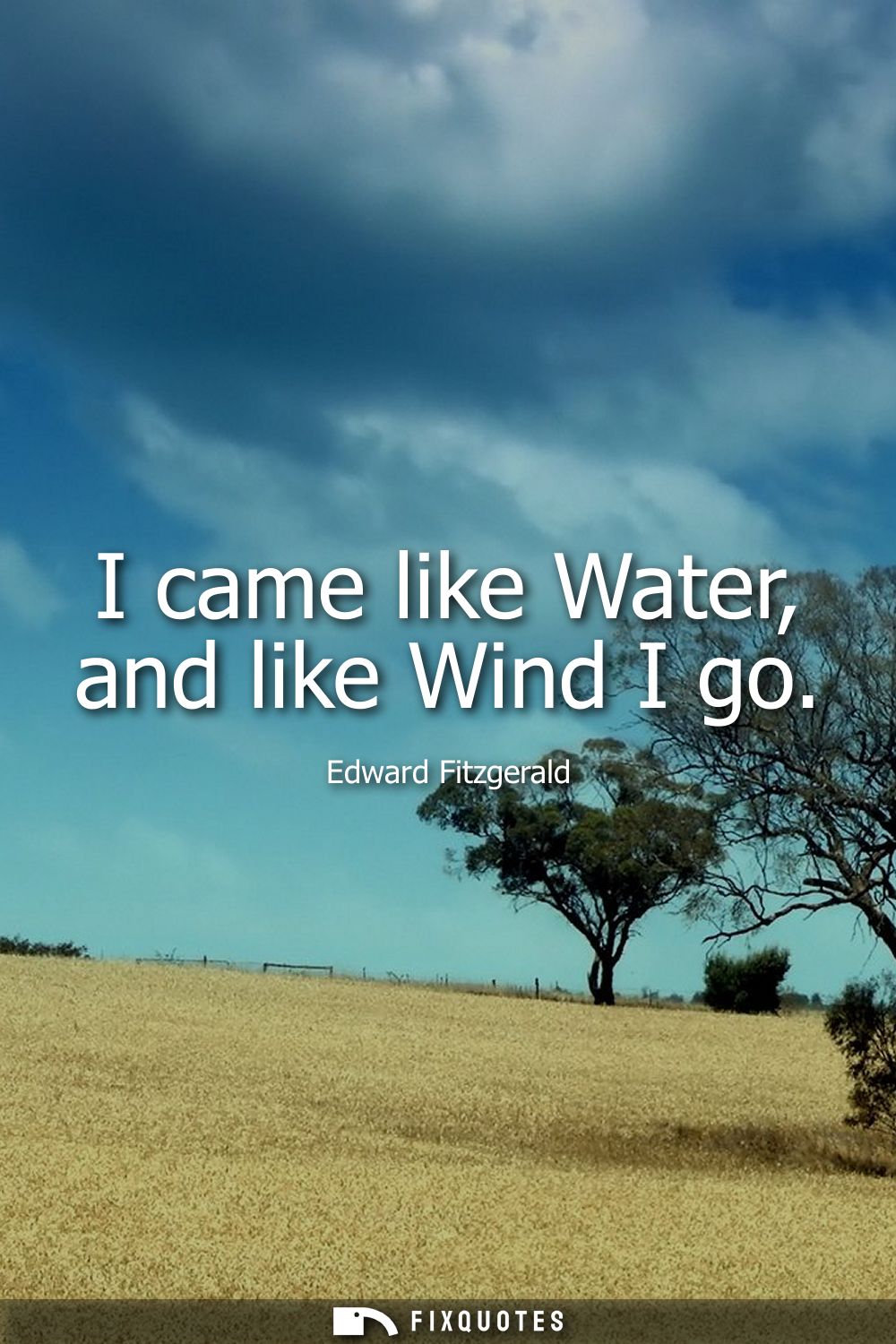
"I came like Water, and like Wind I go"
About this Quote
It’s a goodbye that refuses the dignity of permanence. “I came like Water, and like Wind I go” compresses a whole metaphysics into two elemental similes: arrival as something poured, departure as something vanished. Water implies shape-taking, contingency, the way a self is formed by whatever vessel - family, class, era - happens to contain it. Wind implies the opposite: motion without capture, a force you can feel but can’t keep. Fitzgerald’s genius here is not sentiment but evasiveness. The speaker doesn’t claim a heroic narrative, doesn’t argue for legacy, doesn’t even ask to be remembered. He frames existence as a brief weather event.
The line’s subtext is resignation with a smirk. It’s not melodrama; it’s anti-melodrama, a quiet refusal of Victorian earnestness and its obsession with moral accounting. Fitzgerald is best known for translating and reinventing The Rubaiyat of Omar Khayyam, and this couplet-like phrasing carries that Persian-inflected fatalism: life arrives without consultation and exits without appeal. The parallel structure (“I came... I go”) gives the sentence a ceremonial balance, then the elements strip that ceremony down to physics. No soul-rending confession, just a clean report from nature’s perspective.
Context matters because Fitzgerald’s “translation” is also an act of authorial ventriloquism: he’s channeling Khayyam to articulate his own skepticism about providence and progress. The line works because it sounds like a proverb - inevitable, simple, and slightly chilling - while quietly mocking the human hope that we’re anything but temporary.
The line’s subtext is resignation with a smirk. It’s not melodrama; it’s anti-melodrama, a quiet refusal of Victorian earnestness and its obsession with moral accounting. Fitzgerald is best known for translating and reinventing The Rubaiyat of Omar Khayyam, and this couplet-like phrasing carries that Persian-inflected fatalism: life arrives without consultation and exits without appeal. The parallel structure (“I came... I go”) gives the sentence a ceremonial balance, then the elements strip that ceremony down to physics. No soul-rending confession, just a clean report from nature’s perspective.
Context matters because Fitzgerald’s “translation” is also an act of authorial ventriloquism: he’s channeling Khayyam to articulate his own skepticism about providence and progress. The line works because it sounds like a proverb - inevitable, simple, and slightly chilling - while quietly mocking the human hope that we’re anything but temporary.
Quote Details
| Topic | Mortality |
|---|---|
| Source | Line from Edward FitzGerald's translation 'The Rubáiyát of Omar Khayyám' (public-domain). Contains the line: "I came like Water, and like Wind I go". |
| Cite |
Citation Formats
APA Style (7th ed.)
Fitzgerald, Edward. (2026, January 14). I came like Water, and like Wind I go. FixQuotes. https://fixquotes.com/quotes/i-came-like-water-and-like-wind-i-go-61064/
Chicago Style
Fitzgerald, Edward. "I came like Water, and like Wind I go." FixQuotes. January 14, 2026. https://fixquotes.com/quotes/i-came-like-water-and-like-wind-i-go-61064/.
MLA Style (9th ed.)
"I came like Water, and like Wind I go." FixQuotes, 14 Jan. 2026, https://fixquotes.com/quotes/i-came-like-water-and-like-wind-i-go-61064/. Accessed 21 Mar. 2026.
More Quotes by Edward
Add to List