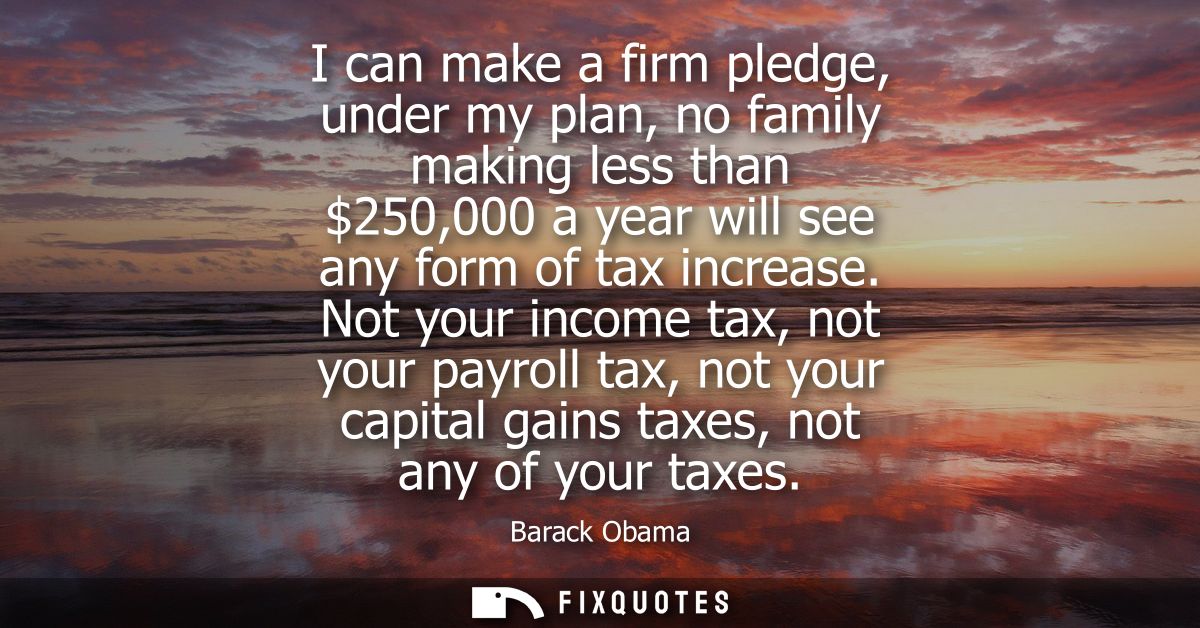
"I can make a firm pledge, under my plan, no family making less than $250,000 a year will see any form of tax increase. Not your income tax, not your payroll tax, not your capital gains taxes, not any of your taxes"
About this Quote
The subtext is a careful triangulation. By drawing a bright line at $250,000, Obama casts “tax increases” as something that happens to other people, implicitly legitimizing redistribution while shielding the coalition he needs to govern. It’s also a defensive maneuver against a durable Republican attack: Democrats as tax-and-spend liberals itching to reach into ordinary paychecks. “Any form” is doing heavy lifting, signaling that even indirect or technical changes won’t sneak through the back door.
The context matters because the pledge is both policy and theater. After years of wage stagnation and a financial crisis that made government feel either complicit or incompetent, trust was brittle. Absolute language (“no family,” “any of your taxes”) tries to rebuild credibility with certainty. It also creates a trap: modern tax policy is messy, and “no increase” is the kind of clean vow that collides with realities like inflation, reform, and unintended ripple effects. That tension - between governing complexity and campaign clarity - is the real engine of the line.
Quote Details
| Topic | Money |
|---|---|
| Source | Help us find the source |
| Cite |
Citation Formats
APA Style (7th ed.)
Obama, Barack. (2026, January 17). I can make a firm pledge, under my plan, no family making less than $250,000 a year will see any form of tax increase. Not your income tax, not your payroll tax, not your capital gains taxes, not any of your taxes. FixQuotes. https://fixquotes.com/quotes/i-can-make-a-firm-pledge-under-my-plan-no-family-27987/
Chicago Style
Obama, Barack. "I can make a firm pledge, under my plan, no family making less than $250,000 a year will see any form of tax increase. Not your income tax, not your payroll tax, not your capital gains taxes, not any of your taxes." FixQuotes. January 17, 2026. https://fixquotes.com/quotes/i-can-make-a-firm-pledge-under-my-plan-no-family-27987/.
MLA Style (9th ed.)
"I can make a firm pledge, under my plan, no family making less than $250,000 a year will see any form of tax increase. Not your income tax, not your payroll tax, not your capital gains taxes, not any of your taxes." FixQuotes, 17 Jan. 2026, https://fixquotes.com/quotes/i-can-make-a-firm-pledge-under-my-plan-no-family-27987/. Accessed 8 Apr. 2026.