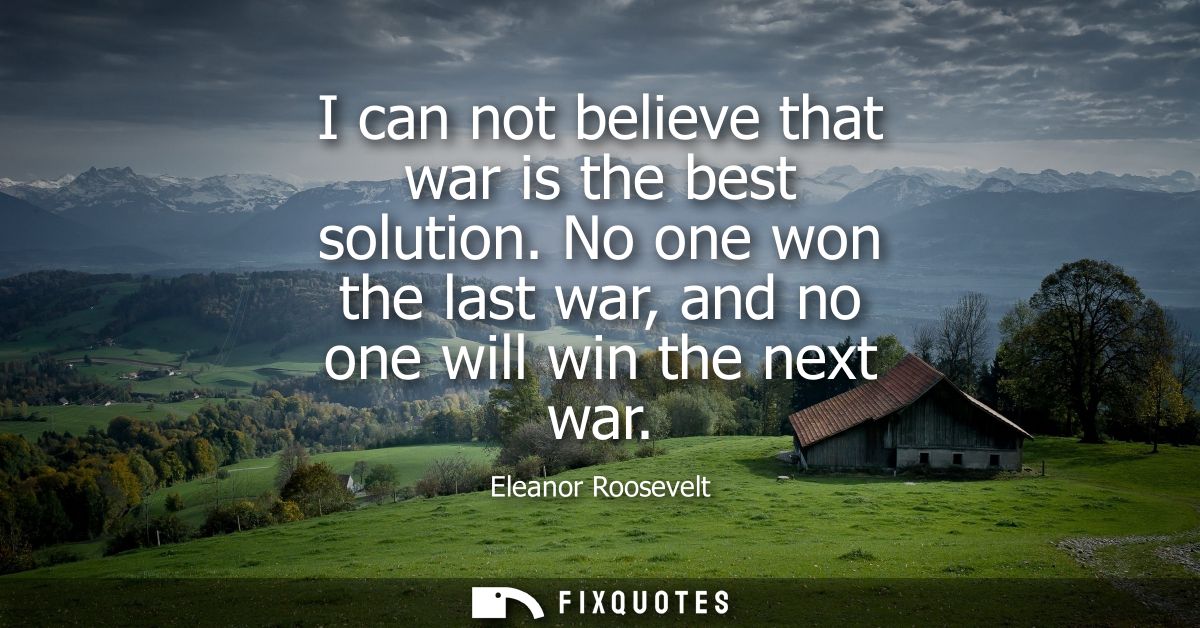
"I can not believe that war is the best solution. No one won the last war, and no one will win the next war"
About this Quote
Then she detonates the word everyone in wartime politics relies on: “won.” “No one won the last war” is less a historical claim than a rebuke of selective memory. World War I ended with maps redrawn and parades thrown, but also with mass trauma, economic wreckage, and the seeds of the next catastrophe. By calling it unwinnable, she’s challenging a whole machinery of justification: if war cannot deliver its promised closure, the sacrifice stops being noble and starts looking like a policy failure.
The subtext is also gendered and political. As First Lady, she couldn’t command armies, but she could reframe the moral terms of debate. Her language anticipates the postwar human-rights era she helped build: security isn’t measured by conquest but by whether ordinary lives can resume without being conscripted into somebody else’s “solution.”
Context matters: she’s speaking from a century that watched industrial warfare turn bodies into statistics. The line about the “next war” reads like a warning against the seductive cycle of retaliation - and, coming from the late 1930s into the 1940s and then the nuclear age, it lands as a prophecy.
Quote Details
| Topic | Peace |
|---|---|
| Source | Help us find the source |
| Cite |
Citation Formats
APA Style (7th ed.)
Roosevelt, Eleanor. (2026, January 18). I can not believe that war is the best solution. No one won the last war, and no one will win the next war. FixQuotes. https://fixquotes.com/quotes/i-can-not-believe-that-war-is-the-best-solution-16893/
Chicago Style
Roosevelt, Eleanor. "I can not believe that war is the best solution. No one won the last war, and no one will win the next war." FixQuotes. January 18, 2026. https://fixquotes.com/quotes/i-can-not-believe-that-war-is-the-best-solution-16893/.
MLA Style (9th ed.)
"I can not believe that war is the best solution. No one won the last war, and no one will win the next war." FixQuotes, 18 Jan. 2026, https://fixquotes.com/quotes/i-can-not-believe-that-war-is-the-best-solution-16893/. Accessed 30 Mar. 2026.