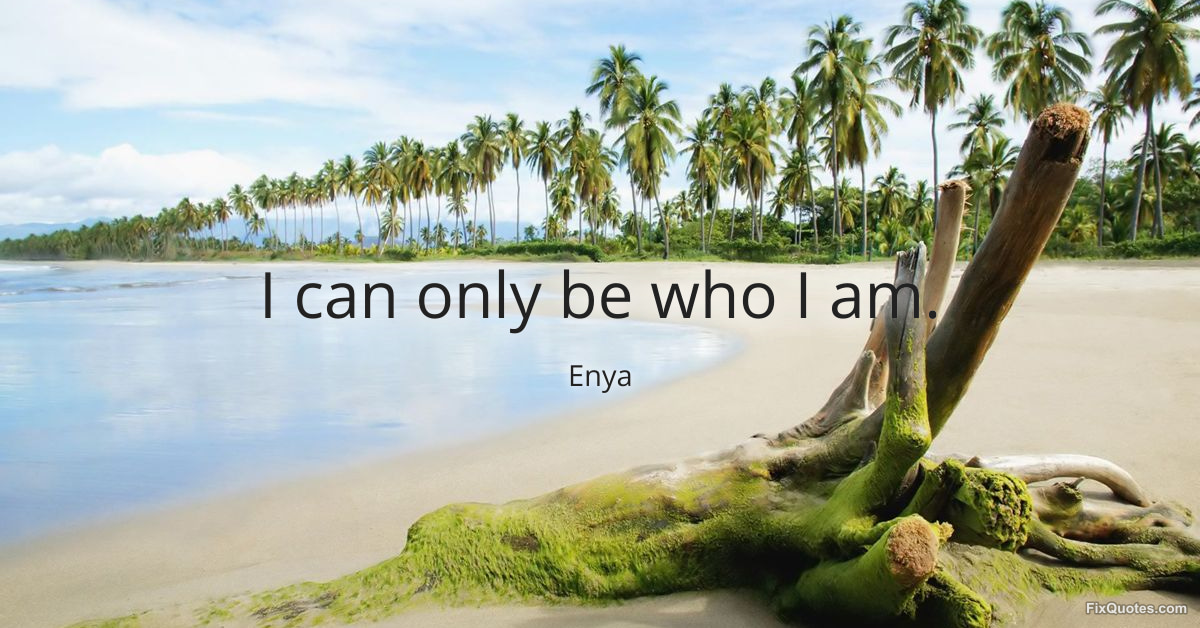
"I can only be who I am"
About this Quote
A line this small can feel like a shrug, until you hear the world Enya built around it. "I can only be who I am" lands as both boundary and benediction: a refusal to perform an identity on demand, delivered with the quiet certainty of someone who’s spent a career being misunderstood as background music. The intent isn’t defiance in the rock-star sense; it’s steadiness. It’s what you say when the pressure to be louder, more public, more legible starts to sound like static.
The subtext is a negotiation with fame’s most exhausting demand: access. Enya’s public persona has long been conspicuously private, her work famously insulated from the confessional economy that turns artists into content. That context matters. In an industry that rewards overexposure and constant reinvention, she’s treated continuity as a creative ethic. The sentence reads like a soft veto on the interview question behind every interview question: Who are you really? It answers: the version you already have.
Culturally, it also plays as self-defense against the flattening that happens to women artists who don’t fit easy archetypes. Enya has been framed as ethereal, monastic, otherworldly - categories that can sound like compliments while still reducing a person to an aesthetic. This line reclaims plain humanity. Not myth, not brand, not fantasy soundtrack. Just a self, insisting that authenticity can be calm, repetitive, even stubborn - and that choosing not to evolve on command is its own kind of power.
The subtext is a negotiation with fame’s most exhausting demand: access. Enya’s public persona has long been conspicuously private, her work famously insulated from the confessional economy that turns artists into content. That context matters. In an industry that rewards overexposure and constant reinvention, she’s treated continuity as a creative ethic. The sentence reads like a soft veto on the interview question behind every interview question: Who are you really? It answers: the version you already have.
Culturally, it also plays as self-defense against the flattening that happens to women artists who don’t fit easy archetypes. Enya has been framed as ethereal, monastic, otherworldly - categories that can sound like compliments while still reducing a person to an aesthetic. This line reclaims plain humanity. Not myth, not brand, not fantasy soundtrack. Just a self, insisting that authenticity can be calm, repetitive, even stubborn - and that choosing not to evolve on command is its own kind of power.
Quote Details
| Topic | Self-Love |
|---|---|
| Source | Help us find the source |
| Cite |
Citation Formats
APA Style (7th ed.)
Enya. (2026, January 17). I can only be who I am. FixQuotes. https://fixquotes.com/quotes/i-can-only-be-who-i-am-58703/
Chicago Style
Enya. "I can only be who I am." FixQuotes. January 17, 2026. https://fixquotes.com/quotes/i-can-only-be-who-i-am-58703/.
MLA Style (9th ed.)
"I can only be who I am." FixQuotes, 17 Jan. 2026, https://fixquotes.com/quotes/i-can-only-be-who-i-am-58703/. Accessed 2 Apr. 2026.
More Quotes by Enya
Add to List