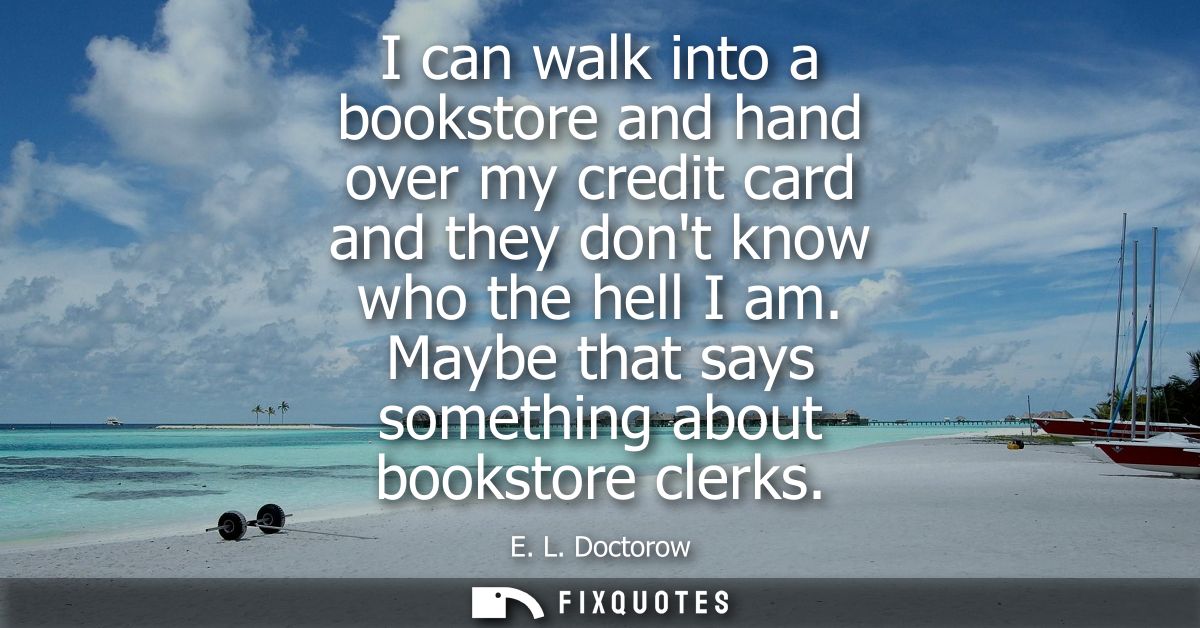
"I can walk into a bookstore and hand over my credit card and they don't know who the hell I am. Maybe that says something about bookstore clerks"
About this Quote
The intent is double-edged. On one side, it’s a wink at the writer’s secret desire to be recognized in the one place where recognition should be automatic: among books. On the other, it punctures that desire with democratic realism. Bookstores, even at their most reverent, are retail. The clerk’s job is to move inventory, not to genuflect before the byline. Doctorow lets the joke do the moral work: if a major novelist can pass as a nobody in the temple of literature, then the “temple” was always a shop.
Context matters. Doctorow came up in an era when literary authority still carried a kind of civic weight, yet he lived long enough to watch authorship get crowded out by more legible forms of celebrity. The line reads like a veteran watching the prestige hierarchy wobble: the name on the cover matters, but mostly to the market, not to the person ringing you up. That tension is his real subject - how art can be culturally canonical and socially invisible at the same time.
Quote Details
| Topic | Witty One-Liners |
|---|---|
| Source | Help us find the source |
| Cite |
Citation Formats
APA Style (7th ed.)
Doctorow, E. L. (2026, January 15). I can walk into a bookstore and hand over my credit card and they don't know who the hell I am. Maybe that says something about bookstore clerks. FixQuotes. https://fixquotes.com/quotes/i-can-walk-into-a-bookstore-and-hand-over-my-143217/
Chicago Style
Doctorow, E. L. "I can walk into a bookstore and hand over my credit card and they don't know who the hell I am. Maybe that says something about bookstore clerks." FixQuotes. January 15, 2026. https://fixquotes.com/quotes/i-can-walk-into-a-bookstore-and-hand-over-my-143217/.
MLA Style (9th ed.)
"I can walk into a bookstore and hand over my credit card and they don't know who the hell I am. Maybe that says something about bookstore clerks." FixQuotes, 15 Jan. 2026, https://fixquotes.com/quotes/i-can-walk-into-a-bookstore-and-hand-over-my-143217/. Accessed 21 Feb. 2026.