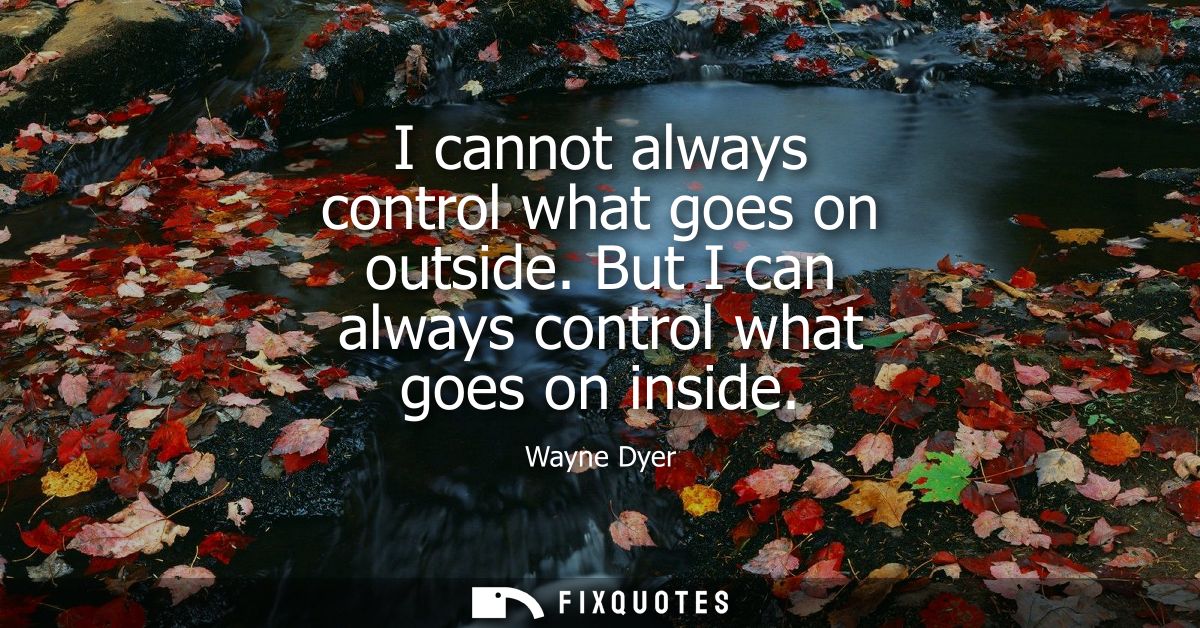
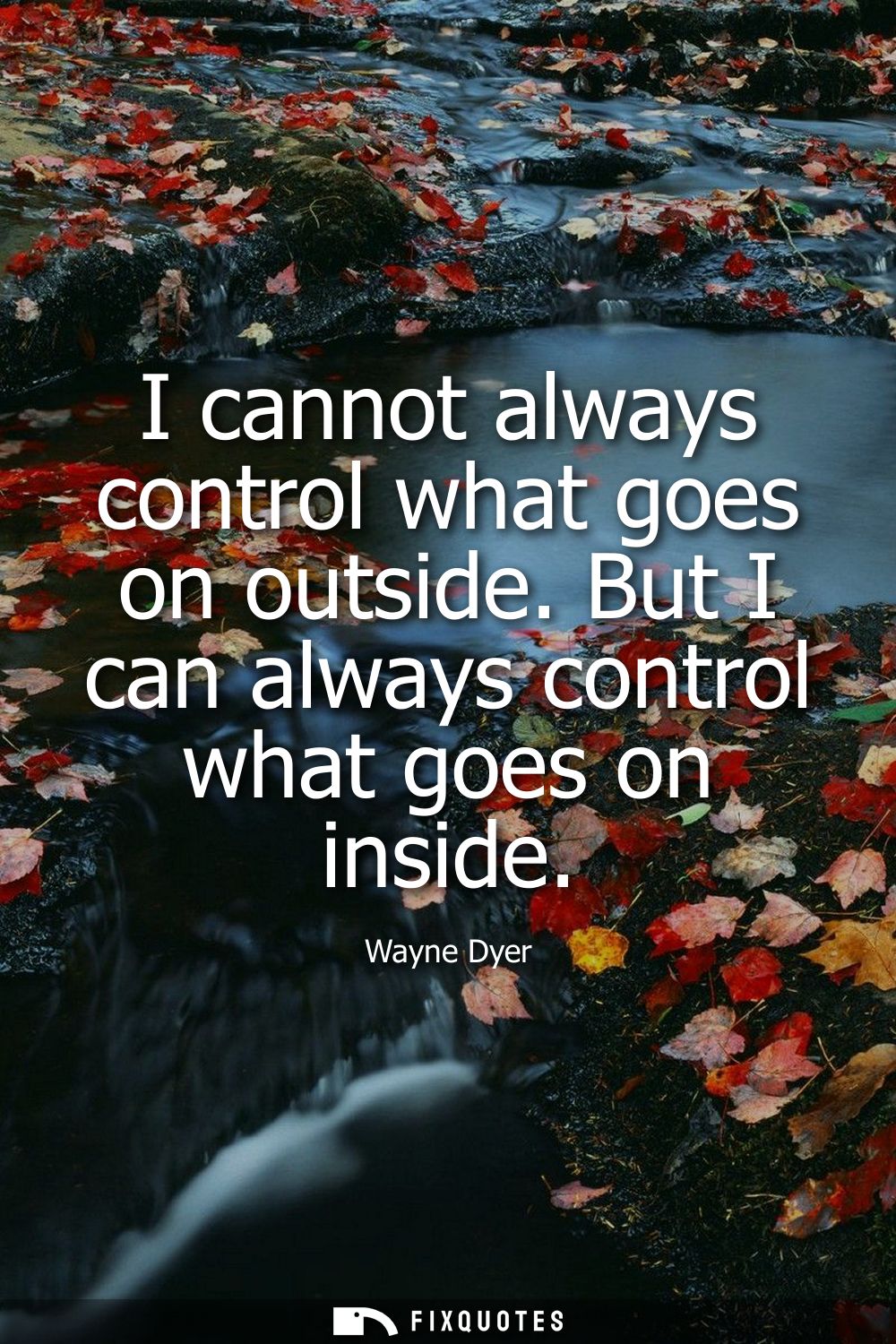
"I cannot always control what goes on outside. But I can always control what goes on inside"
About this Quote
The subtext is a cultural counterspell to modern overwhelm. In late-20th-century American self-help, the world is framed as noisy, chaotic, and fundamentally uncontrollable; the self becomes the last stable jurisdiction. That’s why “outside” and “inside” are so bluntly spatial: it’s a map anyone can read. Dyer is selling an internal border where you can still pass laws.
The intent isn’t just serenity; it’s responsibility. If your interior is “always” controllable, then your reactions, resentments, and spirals become choices, not inevitabilities. That can be liberating, and also mildly accusatory: if you’re suffering, the quote implies, you may be governing poorly.
Psychology-adjacent but distinctly pop-Stoic, it borrows the posture of ancient philosophy and translates it into a late-capitalist coping tool: you may not own the weather, but you can still own the forecast in your head.
Quote Details
| Topic | Self-Discipline |
|---|---|
| Source | Help us find the source |
| Cite |
Citation Formats
APA Style (7th ed.)
Dyer, Wayne. (2026, January 18). I cannot always control what goes on outside. But I can always control what goes on inside. FixQuotes. https://fixquotes.com/quotes/i-cannot-always-control-what-goes-on-outside-but-2310/
Chicago Style
Dyer, Wayne. "I cannot always control what goes on outside. But I can always control what goes on inside." FixQuotes. January 18, 2026. https://fixquotes.com/quotes/i-cannot-always-control-what-goes-on-outside-but-2310/.
MLA Style (9th ed.)
"I cannot always control what goes on outside. But I can always control what goes on inside." FixQuotes, 18 Jan. 2026, https://fixquotes.com/quotes/i-cannot-always-control-what-goes-on-outside-but-2310/. Accessed 12 Feb. 2026.