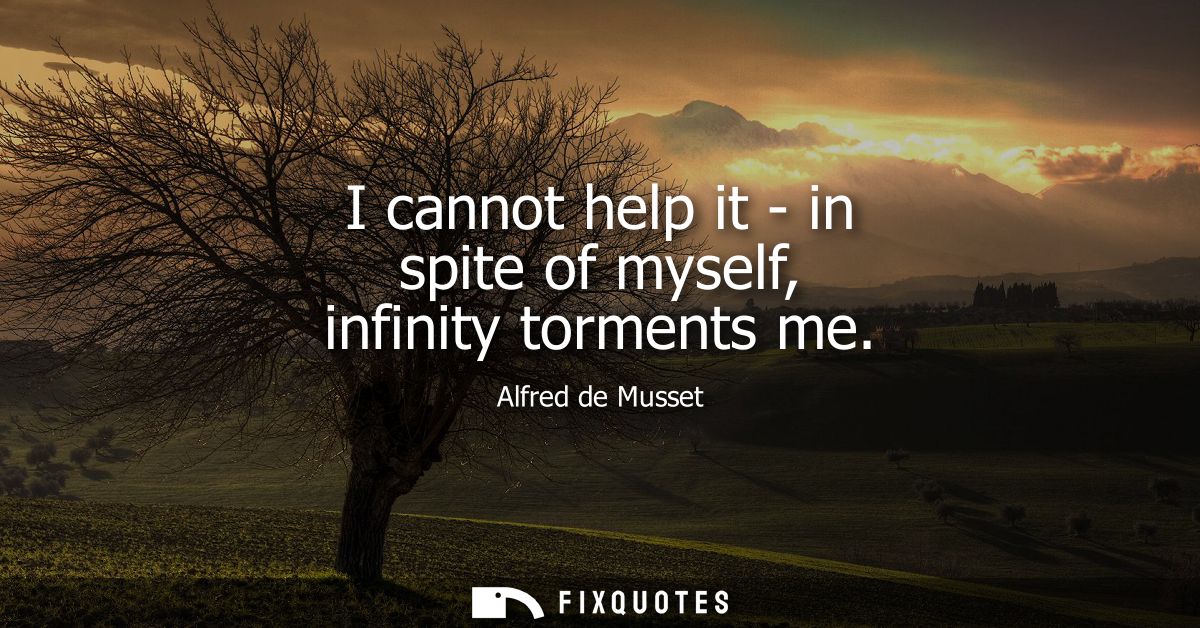
"I cannot help it - in spite of myself, infinity torments me"
About this Quote
Infinity here isn’t a starry-eyed abstraction; it’s an invasive thought, the kind that doesn’t elevate so much as itch. De Musset frames the line like a confession of compulsion: “I cannot help it” and “in spite of myself” double-lock the idea that this isn’t chosen melancholy. It’s an affliction. The genius is that “infinity” becomes less metaphysics than symptom, a word for the mind’s refusal to stay within the comforting fences of daily scale. He’s describing the moment the horizon won’t behave.
As a Romantic-era writer, de Musset is speaking from a culture intoxicated by the sublime and newly unsettled by modernity’s expanded measurements: bigger history, bigger science, bigger doubt. Infinity, once the safe property of theology, starts showing up as an existential pressure. The torment isn’t just fear of endlessness; it’s the mismatch between human equipment and cosmic scope. A finite body with infinite appetite, a finite life with infinite questions. That tension is the Romantic engine.
The phrasing also carries a quiet self-indictment. He wants to be practical, maybe even happy, but his imagination keeps defecting. “Infinity” can read as God, death, desire, art itself - anything that refuses closure. The line works because it makes the grandest concept intimate and humiliating: not a revelation, but a recurring disturbance. De Musset isn’t asking to be consoled; he’s admitting that some minds are built to be haunted by what they can’t contain.
As a Romantic-era writer, de Musset is speaking from a culture intoxicated by the sublime and newly unsettled by modernity’s expanded measurements: bigger history, bigger science, bigger doubt. Infinity, once the safe property of theology, starts showing up as an existential pressure. The torment isn’t just fear of endlessness; it’s the mismatch between human equipment and cosmic scope. A finite body with infinite appetite, a finite life with infinite questions. That tension is the Romantic engine.
The phrasing also carries a quiet self-indictment. He wants to be practical, maybe even happy, but his imagination keeps defecting. “Infinity” can read as God, death, desire, art itself - anything that refuses closure. The line works because it makes the grandest concept intimate and humiliating: not a revelation, but a recurring disturbance. De Musset isn’t asking to be consoled; he’s admitting that some minds are built to be haunted by what they can’t contain.
Quote Details
| Topic | Deep |
|---|---|
| Source | Help us find the source |
| Cite |
Citation Formats
APA Style (7th ed.)
Musset, Alfred de. (2026, January 15). I cannot help it - in spite of myself, infinity torments me. FixQuotes. https://fixquotes.com/quotes/i-cannot-help-it-in-spite-of-myself-infinity-144719/
Chicago Style
Musset, Alfred de. "I cannot help it - in spite of myself, infinity torments me." FixQuotes. January 15, 2026. https://fixquotes.com/quotes/i-cannot-help-it-in-spite-of-myself-infinity-144719/.
MLA Style (9th ed.)
"I cannot help it - in spite of myself, infinity torments me." FixQuotes, 15 Jan. 2026, https://fixquotes.com/quotes/i-cannot-help-it-in-spite-of-myself-infinity-144719/. Accessed 12 Feb. 2026.
More Quotes by Alfred
Add to List