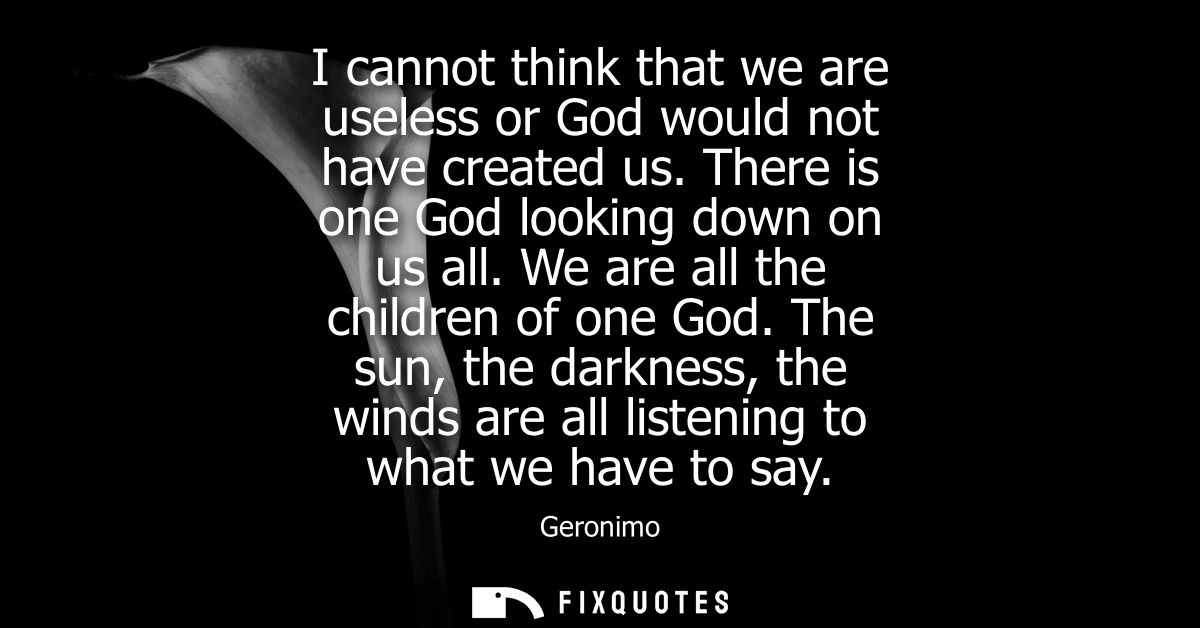
"I cannot think that we are useless or God would not have created us. There is one God looking down on us all. We are all the children of one God. The sun, the darkness, the winds are all listening to what we have to say"
About this Quote
The line "There is one God looking down on us all" flattens the hierarchy the U.S. military and federal policy tried to impose. One God means no God-sanctioned caste system where "civilized" nations sit closer to the divine than the conquered. "We are all the children of one God" sounds conciliatory, but the subtext is confrontational: if we're siblings, then what you've done to us is not conquest, it's kin-violence.
Then the quote pivots into something more culturally specific and rhetorically canny: "The sun, the darkness, the winds are all listening". That isn't quaint nature-poetry; it's a courtroom. Geronimo calls witnesses older than any treaty and larger than any border. In a world where Apache testimony was routinely dismissed and agreements were broken, he relocates accountability to the elements - an audience that cannot be bribed, deported, or silenced.
Context matters: Geronimo spent years as a prisoner of war and a public spectacle, paraded at fairs and photographed as an emblem of "the last hostile Indian". These sentences push back against that reduction. They claim moral personhood, spiritual equality, and a cosmos attentive enough to remember what governments try to erase.
Quote Details
| Topic | God |
|---|---|
| Source | Help us find the source |
| Cite |
Citation Formats
APA Style (7th ed.)
Geronimo. (2026, January 14). I cannot think that we are useless or God would not have created us. There is one God looking down on us all. We are all the children of one God. The sun, the darkness, the winds are all listening to what we have to say. FixQuotes. https://fixquotes.com/quotes/i-cannot-think-that-we-are-useless-or-god-would-161891/
Chicago Style
Geronimo. "I cannot think that we are useless or God would not have created us. There is one God looking down on us all. We are all the children of one God. The sun, the darkness, the winds are all listening to what we have to say." FixQuotes. January 14, 2026. https://fixquotes.com/quotes/i-cannot-think-that-we-are-useless-or-god-would-161891/.
MLA Style (9th ed.)
"I cannot think that we are useless or God would not have created us. There is one God looking down on us all. We are all the children of one God. The sun, the darkness, the winds are all listening to what we have to say." FixQuotes, 14 Jan. 2026, https://fixquotes.com/quotes/i-cannot-think-that-we-are-useless-or-god-would-161891/. Accessed 12 Feb. 2026.