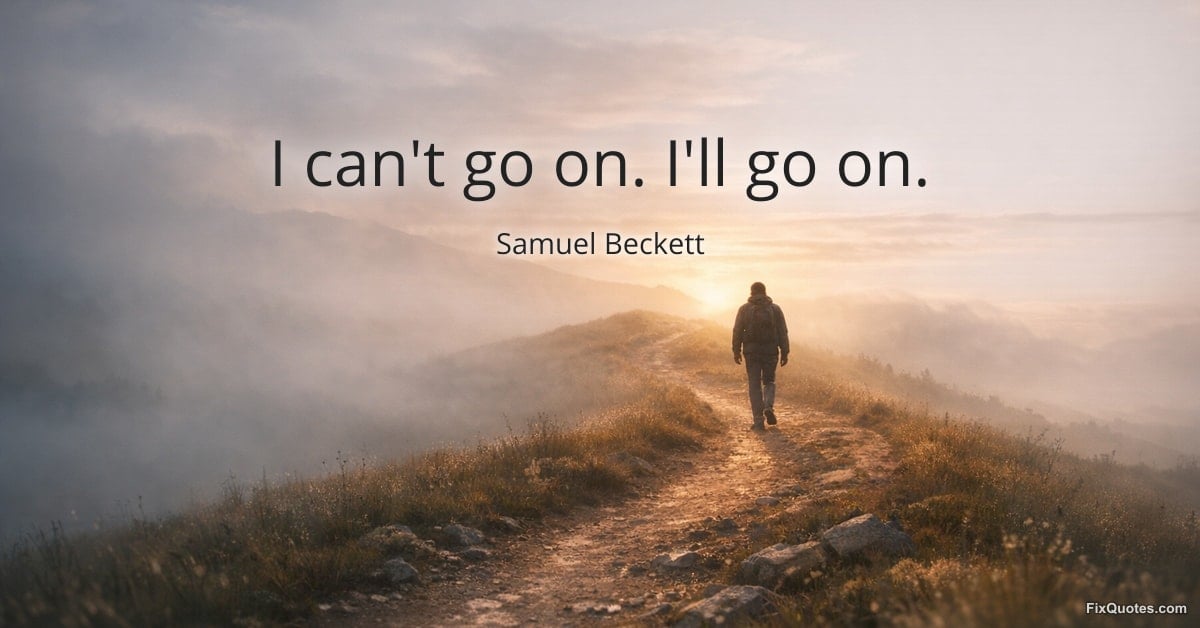
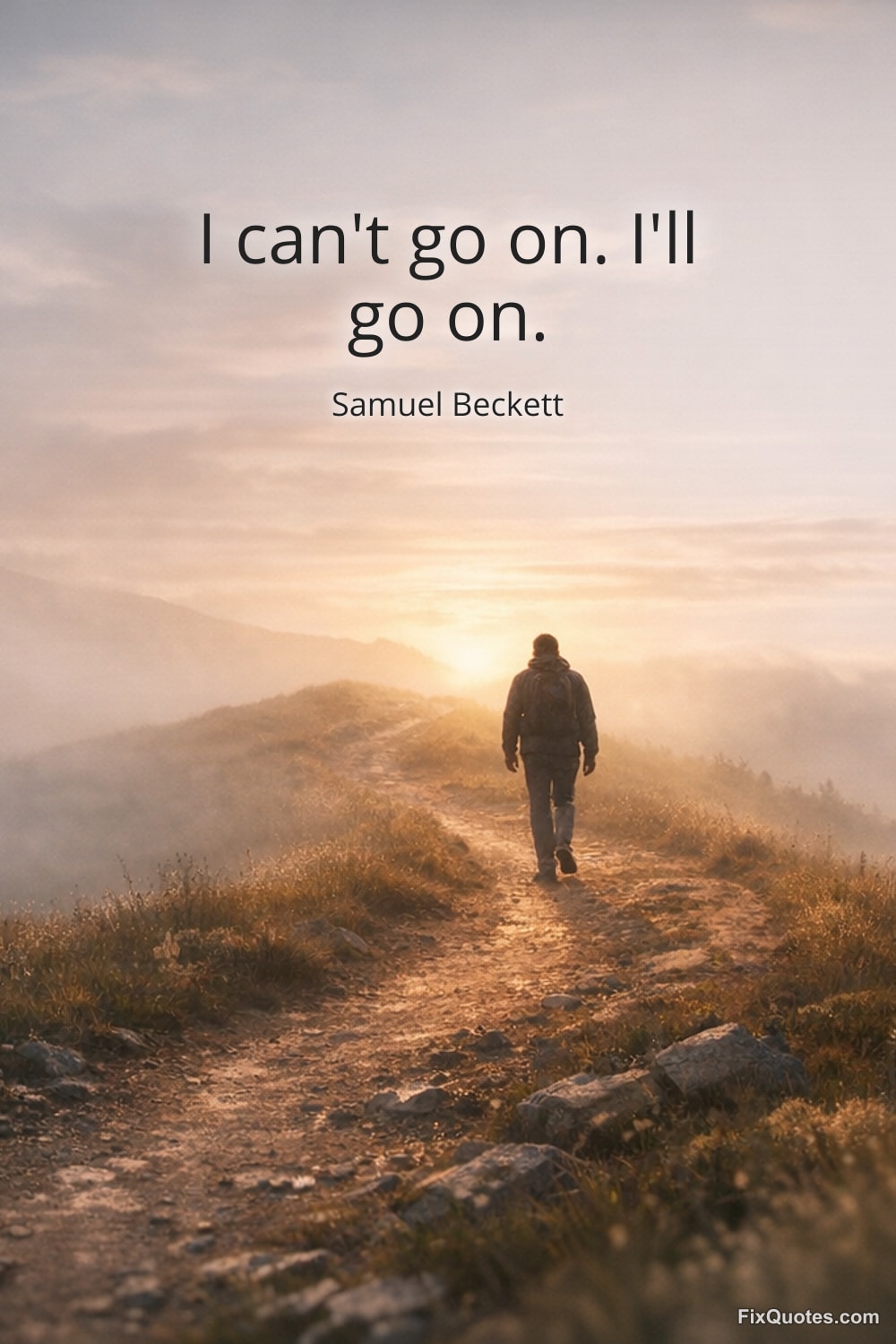
"I can't go on. I'll go on"
About this Quote
A full existential collapse, followed by a shrug that becomes a manifesto. Beckett’s "I can’t go on. I’ll go on" is funny in the way a trapdoor is funny: the punchline is that there is no exit. The line stages failure as a condition, not an event. First comes the honest admission that the self is spent - language exhausted, meaning thinned out, hope revealed as a mechanical reflex. Then the second sentence arrives like an involuntary twitch. Not courage, not inspiration: continuation as compulsion.
Its genius is grammatical. Two short clauses, no ornament, no explanation. The period is a guillotine. Beckett lets "can’t" stand without negotiation, then violates it immediately. The contradiction isn’t a mistake; it’s the human operating system. We narrate despair with certainty and keep living anyway, not because we’ve resolved anything but because the body, the habit, the mind’s momentum pushes forward.
Context sharpens the cruelty. Beckett writes out of the postwar rubble of European confidence, where grand stories - progress, God, rational mastery - sound like bad propaganda. In his plays and prose, characters are trapped in routines, banter, and dead time, talking to prove they still exist. This line, from The Unnamable, is the distilled version of that predicament: the voice can’t finish, can’t begin, can’t stop. It continues because stopping would require a meaning decisive enough to end the sentence. Beckett denies that mercy, leaving only the bleakest kind of persistence: not hope, but default.
Its genius is grammatical. Two short clauses, no ornament, no explanation. The period is a guillotine. Beckett lets "can’t" stand without negotiation, then violates it immediately. The contradiction isn’t a mistake; it’s the human operating system. We narrate despair with certainty and keep living anyway, not because we’ve resolved anything but because the body, the habit, the mind’s momentum pushes forward.
Context sharpens the cruelty. Beckett writes out of the postwar rubble of European confidence, where grand stories - progress, God, rational mastery - sound like bad propaganda. In his plays and prose, characters are trapped in routines, banter, and dead time, talking to prove they still exist. This line, from The Unnamable, is the distilled version of that predicament: the voice can’t finish, can’t begin, can’t stop. It continues because stopping would require a meaning decisive enough to end the sentence. Beckett denies that mercy, leaving only the bleakest kind of persistence: not hope, but default.
Quote Details
| Topic | Perseverance |
|---|---|
| Source | Unverified source: L'Innommable (Samuel Beckett, 1953)
Evidence: The quote is the closing line(s) of Samuel Beckett’s novel, originally written/published in French as L'Innommable (1953). The original French reads: “il faut continuer, je ne peux pas continuer, je vais continuer.” Beckett later translated it into English as “you must go on, I can’t go on, I’ll ... Other candidates (2) Samuel Beckett (Samuel Beckett) compilation95.0% know in the silence you dont know you must go on i cant go on ill go on texts f I Can't Go On, I'll Go On (Samuel Beckett, 2007) compilation14.3% A Samuel Beckett Reader Samuel Beckett. illogical , of proceeding on the assumption that the empirical mind can get t... |
| Cite |
Citation Formats
APA Style (7th ed.)
Beckett, Samuel. (2026, February 1). I can't go on. I'll go on. FixQuotes. https://fixquotes.com/quotes/i-cant-go-on-ill-go-on-1701/
Chicago Style
Beckett, Samuel. "I can't go on. I'll go on." FixQuotes. February 1, 2026. https://fixquotes.com/quotes/i-cant-go-on-ill-go-on-1701/.
MLA Style (9th ed.)
"I can't go on. I'll go on." FixQuotes, 1 Feb. 2026, https://fixquotes.com/quotes/i-cant-go-on-ill-go-on-1701/. Accessed 29 Mar. 2026.
More Quotes by Samuel
Add to List