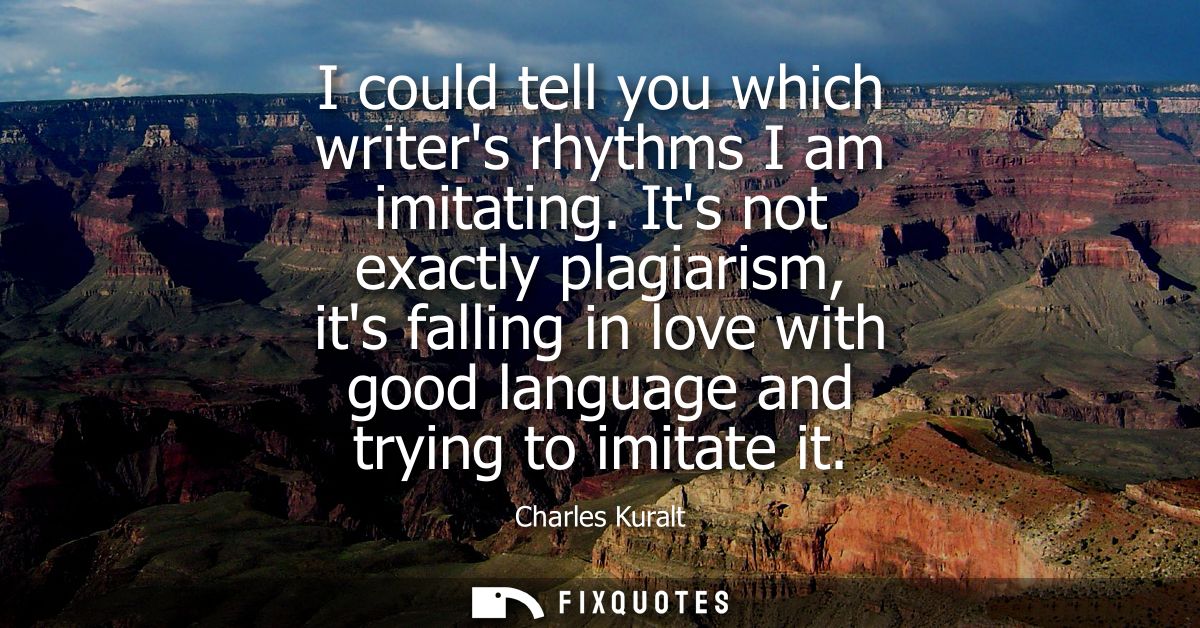
"I could tell you which writer's rhythms I am imitating. It's not exactly plagiarism, it's falling in love with good language and trying to imitate it"
About this Quote
The subtext is a quiet rebuke to the mythology of the lone genius. Good writing, Kuralt implies, is learned the old-fashioned way: by reading closely enough that the music gets under your skin. “Rhythms” matters here. He’s not claiming other people’s facts or ideas; he’s admitting to mimicking cadence, sentence temperature, the way a paragraph breathes. That’s where influence actually lives, and he’s honest about it.
Contextually, it’s also a newsroom argument. Journalism prizes clarity and speed, yet it’s full of stylists who built their voices by echoing earlier ones until the echo became their own. Kuralt’s line draws the ethical boundary in a human way: imitation as apprenticeship, not appropriation. It’s a reminder that voice isn’t invented so much as earned through attentive, slightly audacious love.
Quote Details
| Topic | Writing |
|---|---|
| Source | Help us find the source |
| Cite |
Citation Formats
APA Style (7th ed.)
Kuralt, Charles. (2026, January 17). I could tell you which writer's rhythms I am imitating. It's not exactly plagiarism, it's falling in love with good language and trying to imitate it. FixQuotes. https://fixquotes.com/quotes/i-could-tell-you-which-writers-rhythms-i-am-42487/
Chicago Style
Kuralt, Charles. "I could tell you which writer's rhythms I am imitating. It's not exactly plagiarism, it's falling in love with good language and trying to imitate it." FixQuotes. January 17, 2026. https://fixquotes.com/quotes/i-could-tell-you-which-writers-rhythms-i-am-42487/.
MLA Style (9th ed.)
"I could tell you which writer's rhythms I am imitating. It's not exactly plagiarism, it's falling in love with good language and trying to imitate it." FixQuotes, 17 Jan. 2026, https://fixquotes.com/quotes/i-could-tell-you-which-writers-rhythms-i-am-42487/. Accessed 19 Mar. 2026.