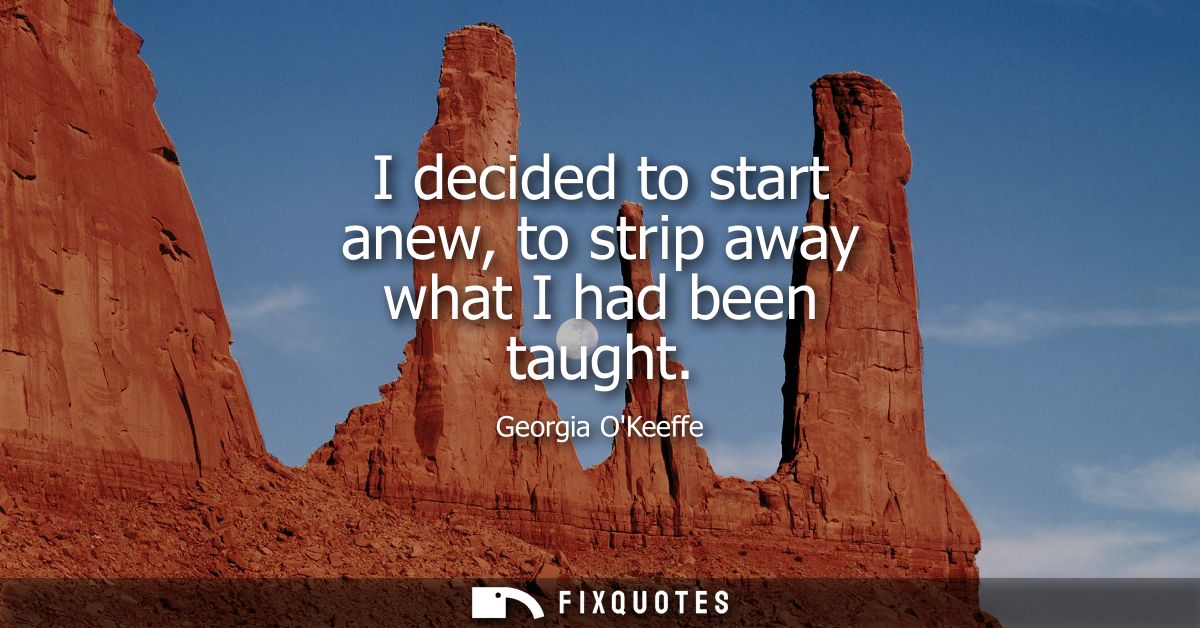
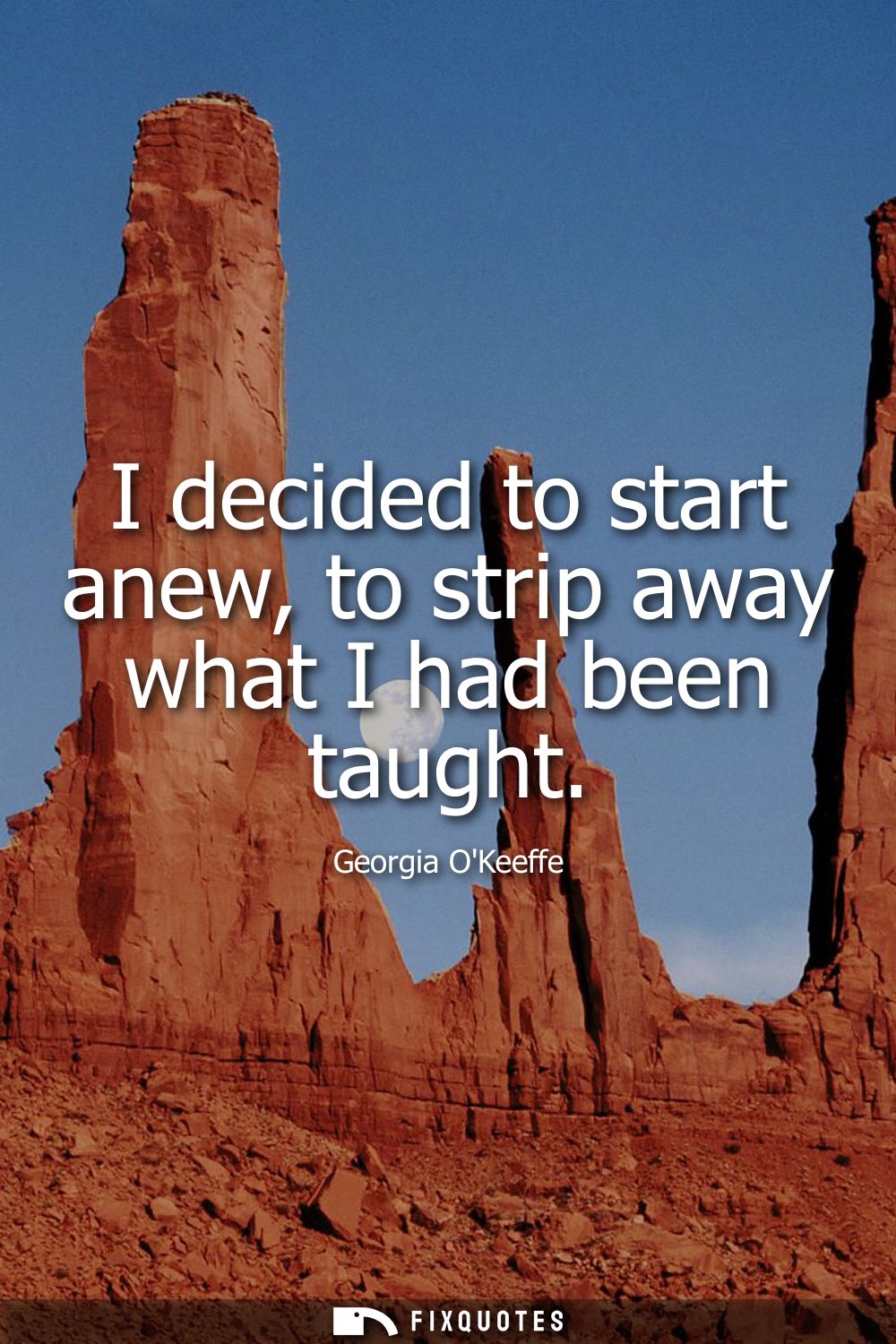
"I decided to start anew, to strip away what I had been taught"
About this Quote
A clean break can be an aesthetic stance as much as a life choice, and O'Keeffe frames it with the brisk authority of someone who’s done apologizing for her own eye. "Start anew" isn’t the gentle reset of self-help language; it reads like a studio decision: scrape the canvas, clear the palette, rebuild the world from first principles. The more provocative clause is the next one. To "strip away what I had been taught" casts instruction not as nourishment but as accumulation - a film over perception that has to be removed to see sharply again.
In O'Keeffe’s context, that subtext has teeth. She trained in a period when American art education leaned hard on European models, polite realism, and the obedient reproduction of approved subjects. For a woman artist, "what I had been taught" also meant a narrower set of permissions: how big to think, what to paint, how loudly to exist in public. Her career is basically a long argument with those constraints, from the early abstractions that rejected academic rendering to the later, iconic forms that insist a single flower, bone, or horizon can be monumental without narrative alibis.
The line works because it’s both disciplined and defiant. O'Keeffe isn’t romanticizing ignorance; she’s describing a selective unlearning, the deliberate demolition required for an original style. The intent is freedom, but the method is subtraction: fewer inherited rules, more direct seeing.
In O'Keeffe’s context, that subtext has teeth. She trained in a period when American art education leaned hard on European models, polite realism, and the obedient reproduction of approved subjects. For a woman artist, "what I had been taught" also meant a narrower set of permissions: how big to think, what to paint, how loudly to exist in public. Her career is basically a long argument with those constraints, from the early abstractions that rejected academic rendering to the later, iconic forms that insist a single flower, bone, or horizon can be monumental without narrative alibis.
The line works because it’s both disciplined and defiant. O'Keeffe isn’t romanticizing ignorance; she’s describing a selective unlearning, the deliberate demolition required for an original style. The intent is freedom, but the method is subtraction: fewer inherited rules, more direct seeing.
Quote Details
| Topic | Reinvention |
|---|---|
| Source | Help us find the source |
| Cite |
Citation Formats
APA Style (7th ed.)
O'Keeffe, Georgia. (2026, January 18). I decided to start anew, to strip away what I had been taught. FixQuotes. https://fixquotes.com/quotes/i-decided-to-start-anew-to-strip-away-what-i-had-16220/
Chicago Style
O'Keeffe, Georgia. "I decided to start anew, to strip away what I had been taught." FixQuotes. January 18, 2026. https://fixquotes.com/quotes/i-decided-to-start-anew-to-strip-away-what-i-had-16220/.
MLA Style (9th ed.)
"I decided to start anew, to strip away what I had been taught." FixQuotes, 18 Jan. 2026, https://fixquotes.com/quotes/i-decided-to-start-anew-to-strip-away-what-i-had-16220/. Accessed 12 Feb. 2026.
More Quotes by Georgia
Add to List