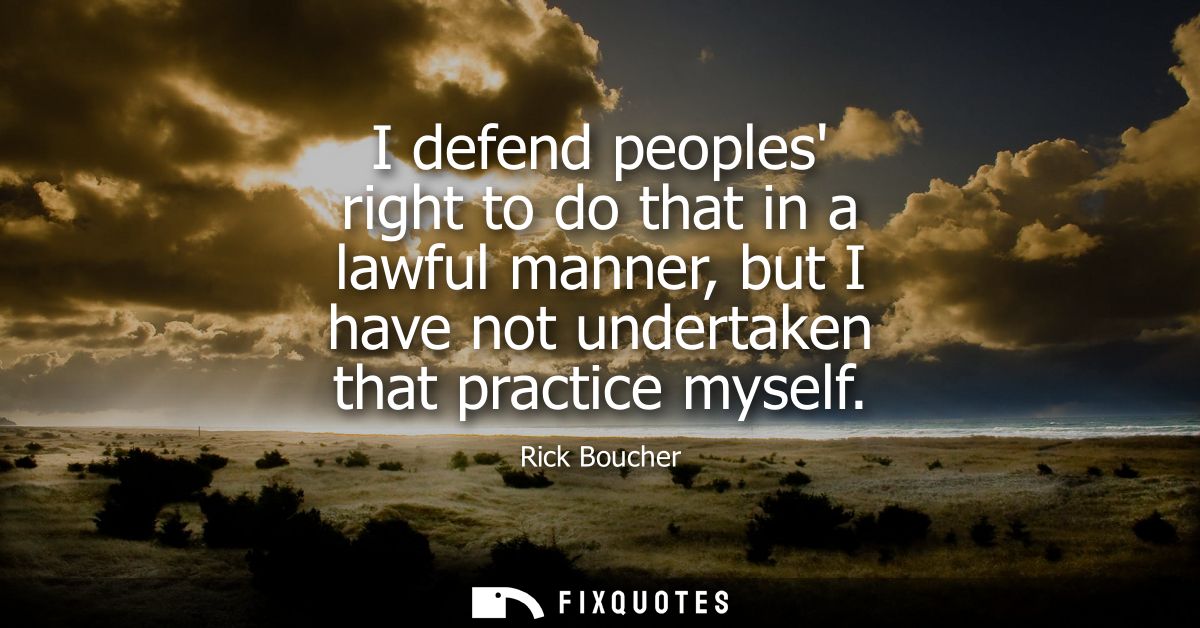
"I defend people's right to do that in a lawful manner, but I have not undertaken that practice myself"
About this Quote
The key phrase is “in a lawful manner,” a tidy qualifier that sounds neutral but does real work. It narrows the defense to behavior that already clears the state’s gatekeeping, avoiding the messier implication that some laws are unjust or that civil disobedience can be legitimate. That’s not an accident; it’s a way to appear libertarian on the surface while staying firmly inside institutional boundaries.
Subtext: I’m not here to police your private life, but I’m also not going to let your private life stick to me. The careful vagueness - “that” and “that practice” - suggests a topic that was culturally charged at the time: something like drug use, sex work, same-sex relationships, or another stigmatized behavior politicians are routinely asked to disavow. He refuses the moral condemnation, but he also refuses solidarity.
In context, it’s the classic “live and let live, just not too close” posture: rights affirmed, identification denied, risk managed.
Quote Details
| Topic | Freedom |
|---|---|
| Source | Help us find the source |
| Cite |
Citation Formats
APA Style (7th ed.)
Boucher, Rick. (2026, February 16). I defend people's right to do that in a lawful manner, but I have not undertaken that practice myself. FixQuotes. https://fixquotes.com/quotes/i-defend-peoples-right-to-do-that-in-a-lawful-121212/
Chicago Style
Boucher, Rick. "I defend people's right to do that in a lawful manner, but I have not undertaken that practice myself." FixQuotes. February 16, 2026. https://fixquotes.com/quotes/i-defend-peoples-right-to-do-that-in-a-lawful-121212/.
MLA Style (9th ed.)
"I defend people's right to do that in a lawful manner, but I have not undertaken that practice myself." FixQuotes, 16 Feb. 2026, https://fixquotes.com/quotes/i-defend-peoples-right-to-do-that-in-a-lawful-121212/. Accessed 8 Mar. 2026.