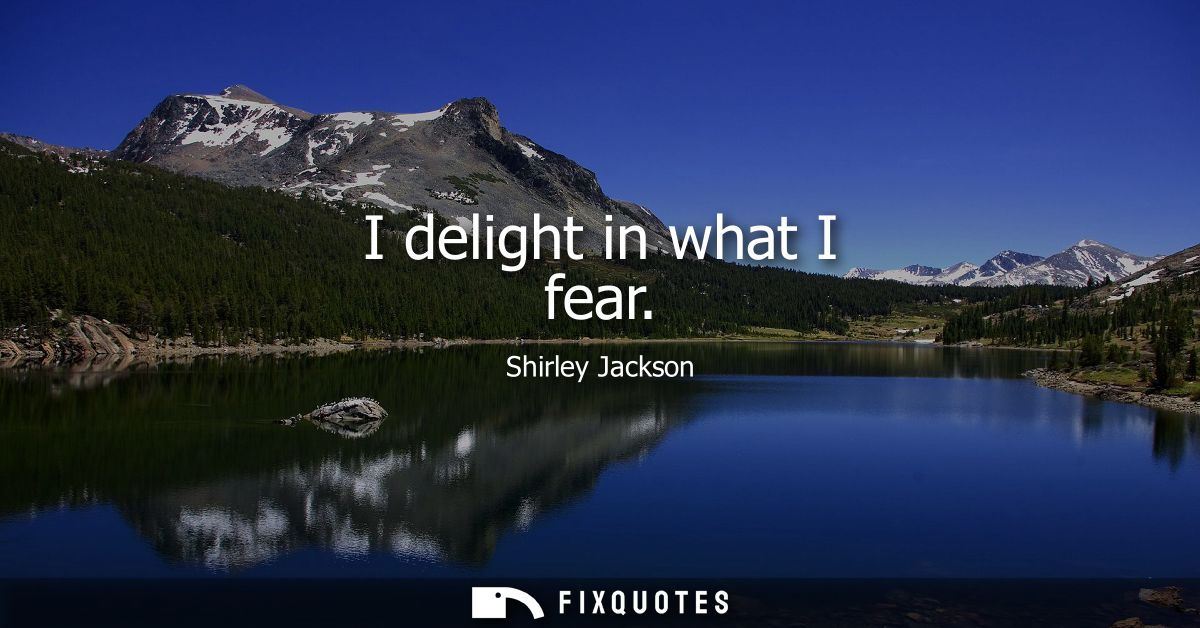
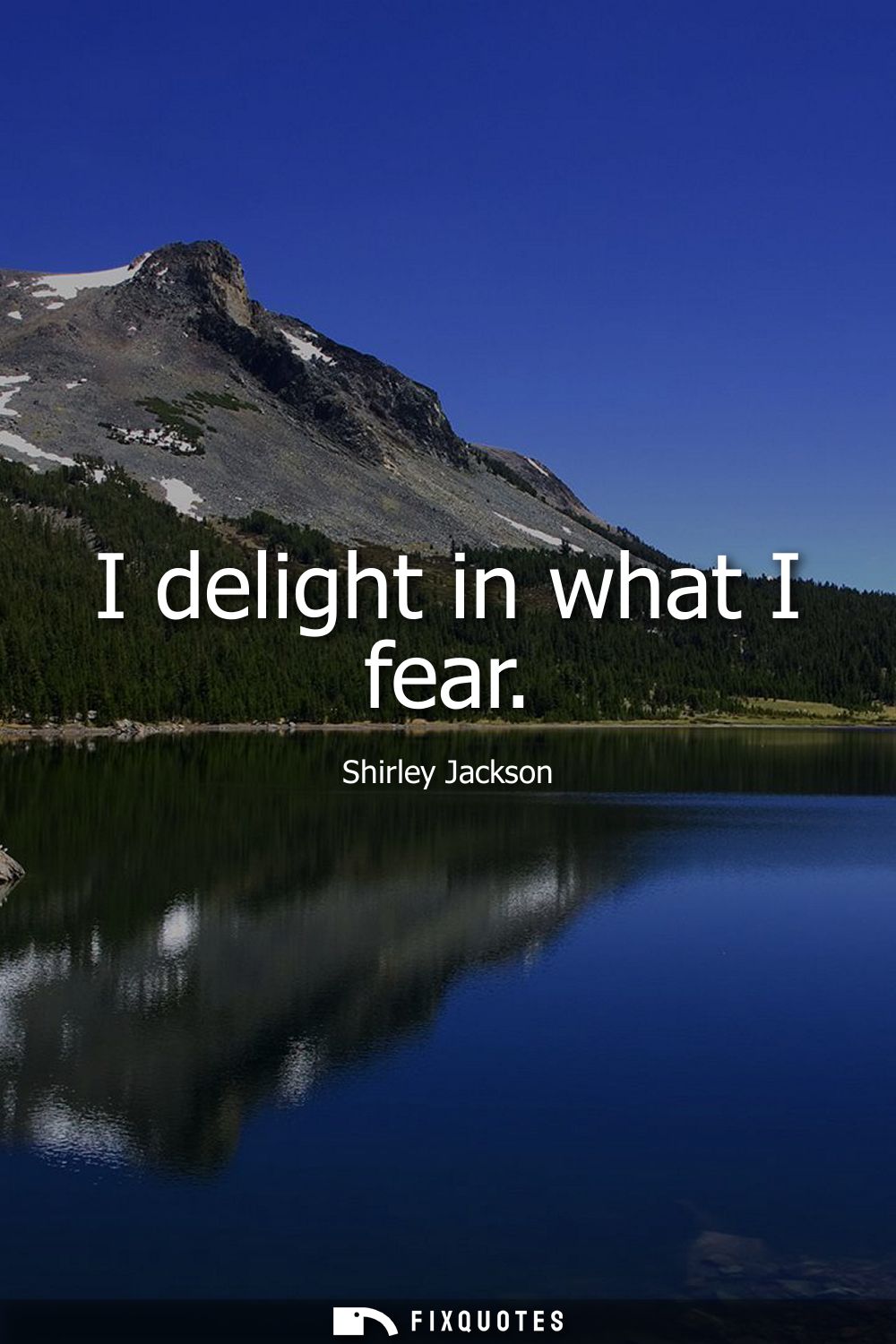
"I delight in what I fear"
About this Quote
A clean little paradox, sharpened into a confession: "I delight in what I fear" turns anxiety into appetite. Jackson isn’t just admitting she’s spooked by the dark; she’s naming the engine of her work, where dread is both subject and fuel. The verb "delight" matters. It’s not relief, not endurance, not morbid curiosity. It’s pleasure - chosen, cultivated - suggesting that fear can be domesticated, even savored, without ever being defanged.
The line also hints at complicity. Jackson’s fiction thrives on the uncomfortable suspicion that the monster isn’t an intruder but a household member, a neighbor, a social custom. Her fears are rarely supernatural in the traditional sense; they’re civic and intimate: communities that close ranks, marriages that turn claustrophobic, motherhood as surveillance, the polite smile that masks cruelty. To "delight" in that fear is to look straight at the social machinery that produces it and find, in the clarity, a perverse satisfaction.
Context helps: Jackson wrote in midcentury America, an era obsessed with normalcy, conformity, and domestic order. Her great trick was showing how the bright kitchen and the friendly town square can feel like crime scenes. The quote performs that same trick in miniature, collapsing comfort and terror into a single breath. It’s a statement of artistic method, but also a bleak joke about modern life: the things that threaten us are often the things we’re trained to call home.
The line also hints at complicity. Jackson’s fiction thrives on the uncomfortable suspicion that the monster isn’t an intruder but a household member, a neighbor, a social custom. Her fears are rarely supernatural in the traditional sense; they’re civic and intimate: communities that close ranks, marriages that turn claustrophobic, motherhood as surveillance, the polite smile that masks cruelty. To "delight" in that fear is to look straight at the social machinery that produces it and find, in the clarity, a perverse satisfaction.
Context helps: Jackson wrote in midcentury America, an era obsessed with normalcy, conformity, and domestic order. Her great trick was showing how the bright kitchen and the friendly town square can feel like crime scenes. The quote performs that same trick in miniature, collapsing comfort and terror into a single breath. It’s a statement of artistic method, but also a bleak joke about modern life: the things that threaten us are often the things we’re trained to call home.
Quote Details
| Topic | Fear |
|---|---|
| Source | Help us find the source |
| Cite |
Citation Formats
APA Style (7th ed.)
Jackson, Shirley. (2026, January 16). I delight in what I fear. FixQuotes. https://fixquotes.com/quotes/i-delight-in-what-i-fear-97248/
Chicago Style
Jackson, Shirley. "I delight in what I fear." FixQuotes. January 16, 2026. https://fixquotes.com/quotes/i-delight-in-what-i-fear-97248/.
MLA Style (9th ed.)
"I delight in what I fear." FixQuotes, 16 Jan. 2026, https://fixquotes.com/quotes/i-delight-in-what-i-fear-97248/. Accessed 2 Apr. 2026.
More Quotes by Shirley
Add to List