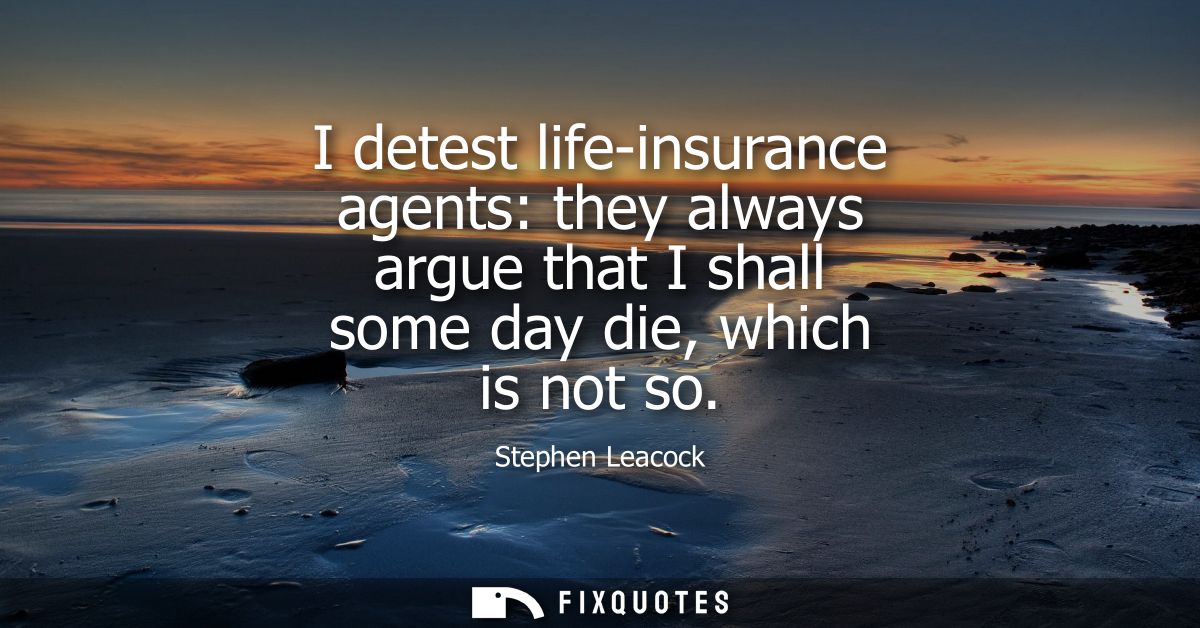
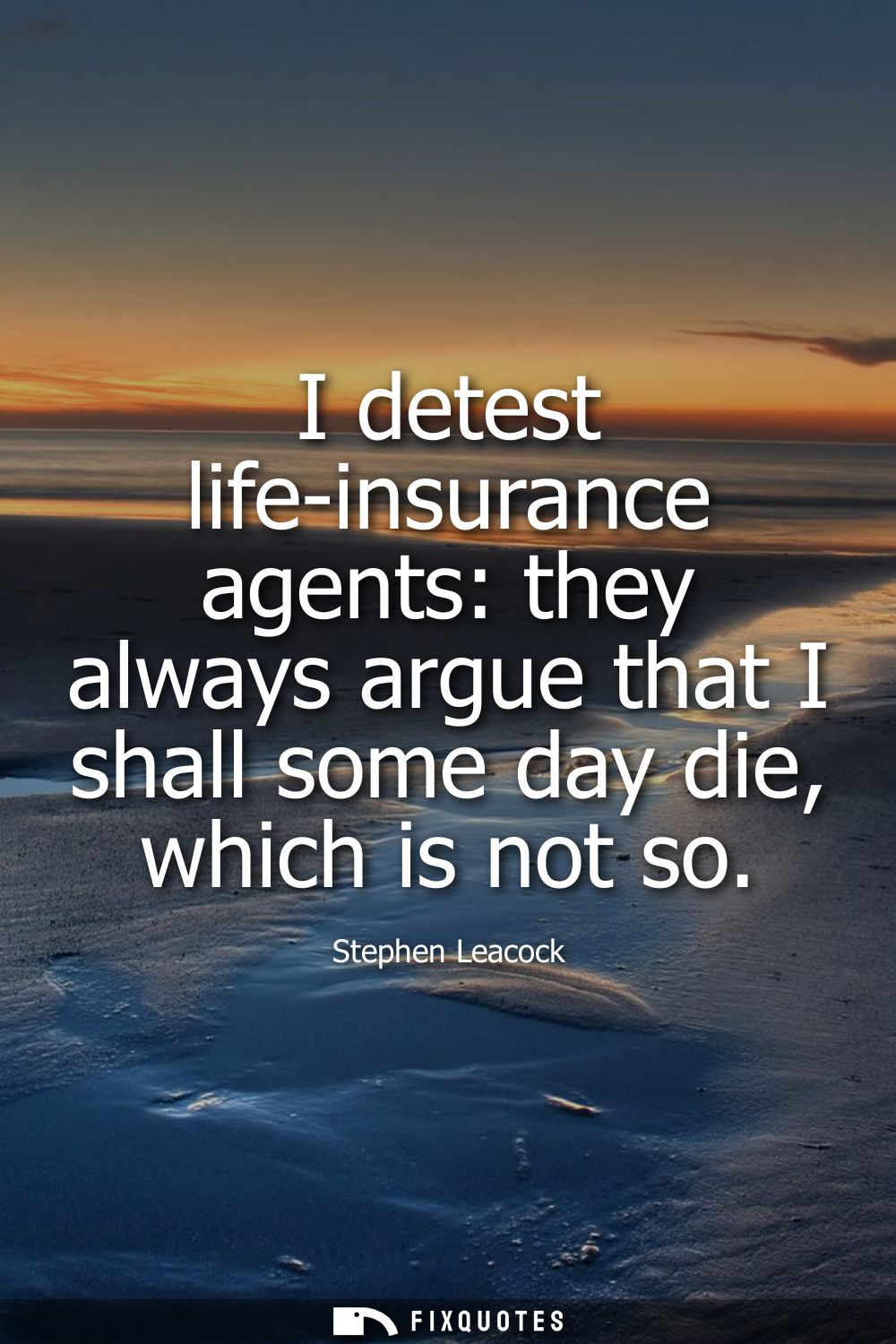
"I detest life-insurance agents: they always argue that I shall some day die, which is not so"
About this Quote
The punchline hinges on a sly grammatical trick. “Some day” is the wedge: death is inevitable, but its date is always conveniently undefined, forever postponable. By replying “which is not so,” Leacock doesn’t refute death; he rejects the agent’s attempt to pin it to a calendar and turn it into a purchasable fear. It’s a defense of psychological sovereignty: you can’t make my finitude your commission.
Context sharpens the cynicism. Writing in the early 20th century, amid the rise of modern finance and the professionalization of risk, Leacock (an economist who understood incentives) skewers how capitalism monetizes uncertainty. Insurance translates existential dread into monthly premiums and actuarial tables, a rational system that still feels like a social faux pas. The detestation isn’t really about the agent; it’s about being forced to acknowledge that the future can be priced, predicted, and used against you. Leacock’s humor is the last refuge of the irrational human, refusing to cooperate with the spreadsheet.
Quote Details
| Topic | Witty One-Liners |
|---|---|
| Source | Help us find the source |
| Cite |
Citation Formats
APA Style (7th ed.)
Leacock, Stephen. (2026, January 18). I detest life-insurance agents: they always argue that I shall some day die, which is not so. FixQuotes. https://fixquotes.com/quotes/i-detest-life-insurance-agents-they-always-argue-1861/
Chicago Style
Leacock, Stephen. "I detest life-insurance agents: they always argue that I shall some day die, which is not so." FixQuotes. January 18, 2026. https://fixquotes.com/quotes/i-detest-life-insurance-agents-they-always-argue-1861/.
MLA Style (9th ed.)
"I detest life-insurance agents: they always argue that I shall some day die, which is not so." FixQuotes, 18 Jan. 2026, https://fixquotes.com/quotes/i-detest-life-insurance-agents-they-always-argue-1861/. Accessed 18 Mar. 2026.