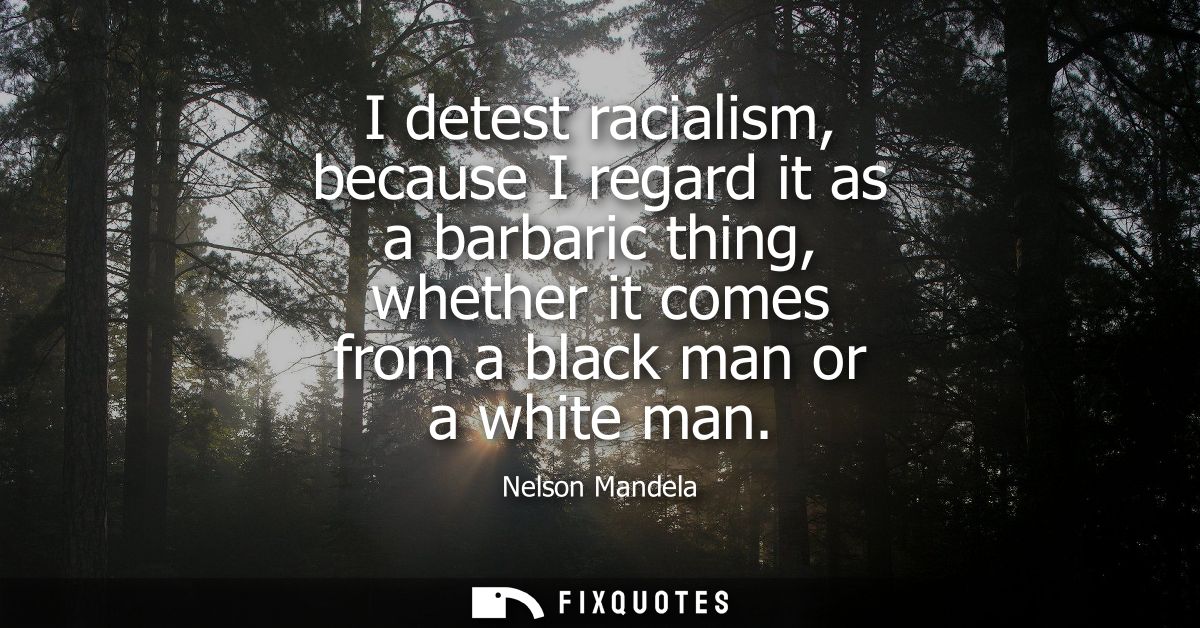
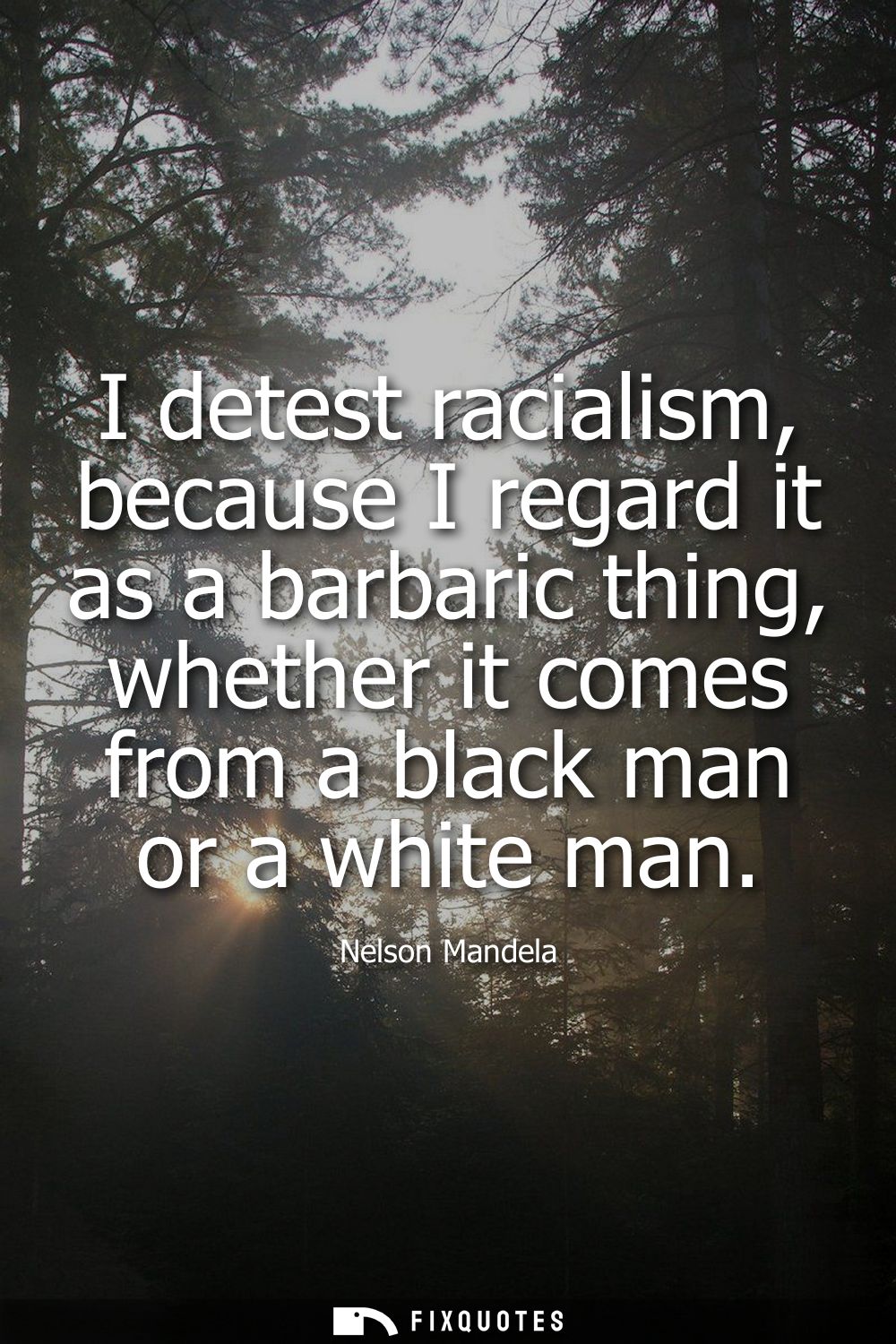
"I detest racialism, because I regard it as a barbaric thing, whether it comes from a black man or a white man"
About this Quote
The clause “whether it comes from a black man or a white man” is the hard pivot, and it’s doing multiple jobs at once. It signals to white audiences that his politics aren’t revenge masquerading as justice, a crucial reassurance for any negotiated transition. It also speaks to black South Africans and liberation movements tempted by racial essentialism: liberation can’t be built on a mirror image of the oppressor’s logic without reproducing the same cage.
The subtext is discipline. Mandela is outlining an ethical boundary for struggle: the enemy is not a race but a racial order. That distinction becomes especially potent given his biography - decades of imprisonment, an easy license for bitterness, and yet a public insistence on nonracialism as a political technology. In the context of late apartheid and the precarious birth of a multiracial democracy, the sentence functions like a constitutional principle in miniature: a warning that the new society will be judged not just by who holds power, but by whether it rejects race-as-fate altogether.
Quote Details
| Topic | Equality |
|---|---|
| Source | Help us find the source |
| Cite |
Citation Formats
APA Style (7th ed.)
Mandela, Nelson. (2026, January 18). I detest racialism, because I regard it as a barbaric thing, whether it comes from a black man or a white man. FixQuotes. https://fixquotes.com/quotes/i-detest-racialism-because-i-regard-it-as-a-1021/
Chicago Style
Mandela, Nelson. "I detest racialism, because I regard it as a barbaric thing, whether it comes from a black man or a white man." FixQuotes. January 18, 2026. https://fixquotes.com/quotes/i-detest-racialism-because-i-regard-it-as-a-1021/.
MLA Style (9th ed.)
"I detest racialism, because I regard it as a barbaric thing, whether it comes from a black man or a white man." FixQuotes, 18 Jan. 2026, https://fixquotes.com/quotes/i-detest-racialism-because-i-regard-it-as-a-1021/. Accessed 29 Mar. 2026.