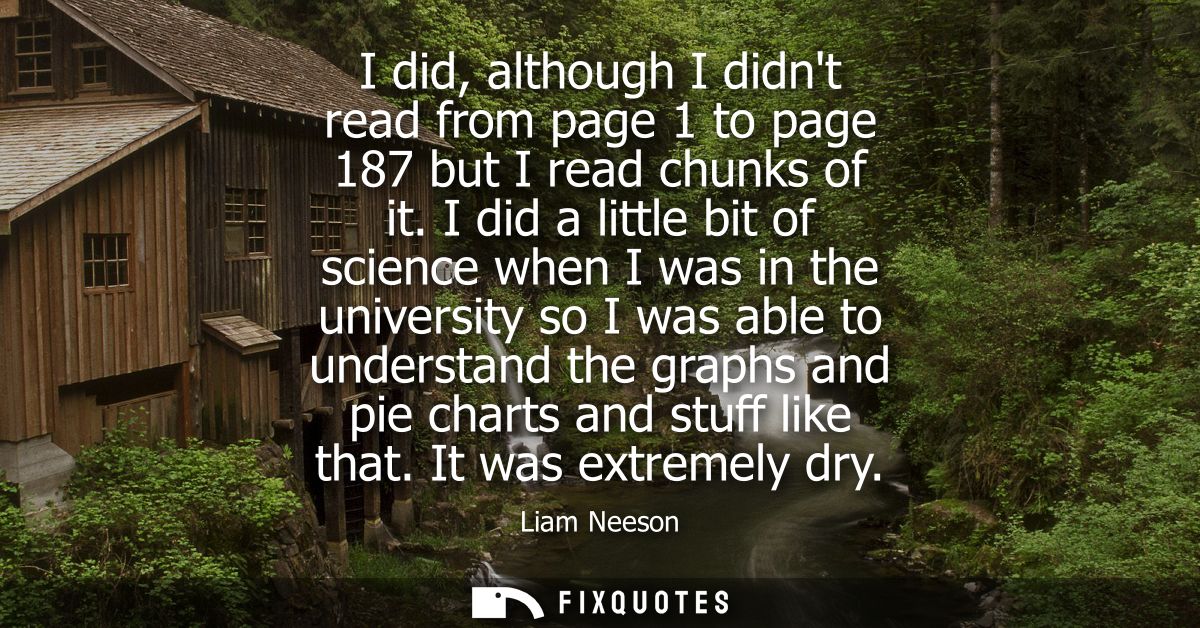
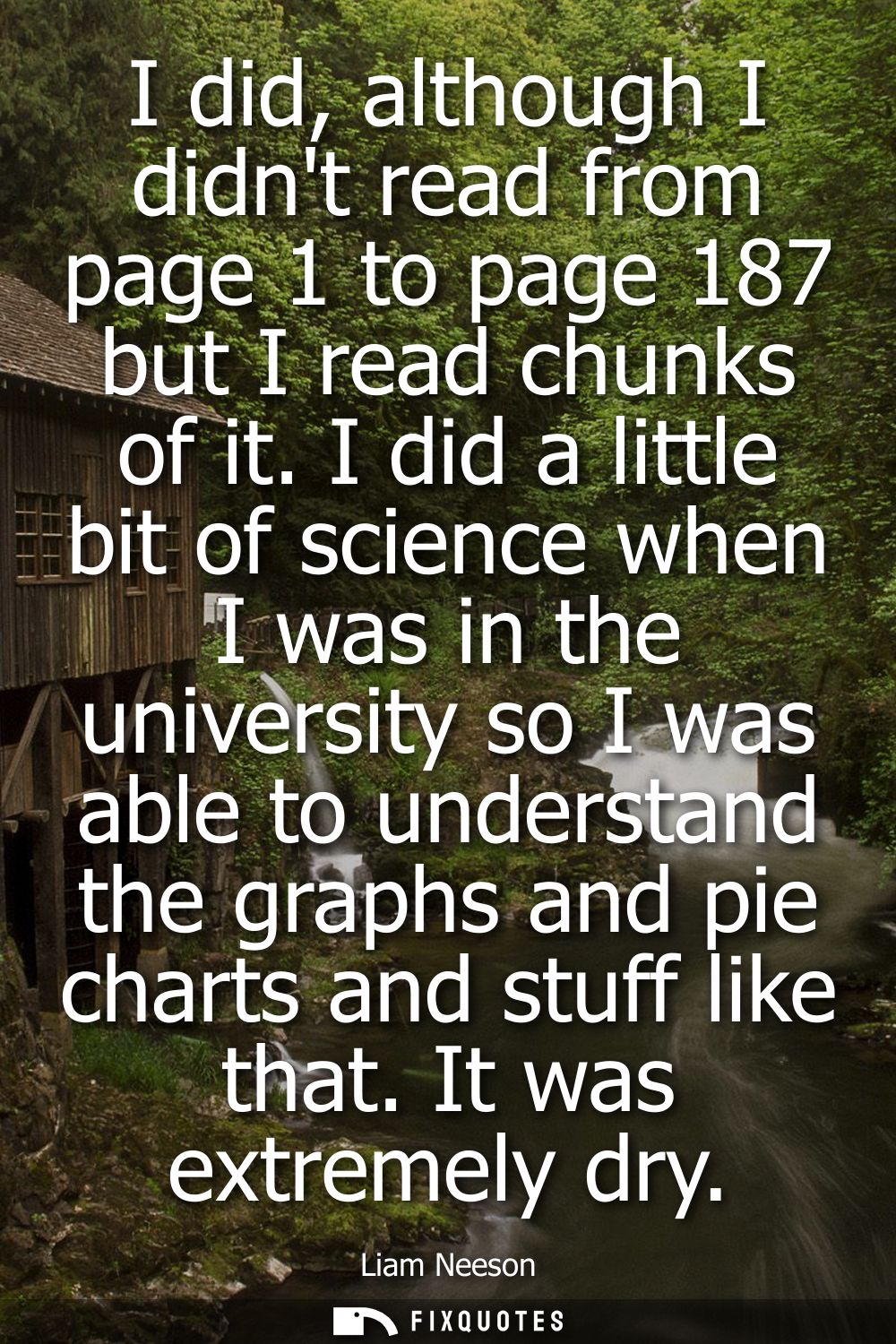
"I did, although I didn't read from page 1 to page 187 but I read chunks of it. I did a little bit of science when I was in the university so I was able to understand the graphs and pie charts and stuff like that. It was extremely dry"
About this Quote
There is a specific kind of modern humility baked into this: the celebrity as half-civic participant, half-busy person confessing the limits of attention. Neeson doesn’t posture as an expert; he narrates competence in a deliberately modest key. “Chunks of it” is a small phrase with big cultural mileage, because it’s how most people actually engage with dense reports, policy briefs, and “important” books they feel they should have read. He’s not offering a defense so much as a recognition of the performance we’re all asked to do: be informed, be responsible, but also keep moving.
The line about “science… in the university” works like a credential softened by self-deprecation. It signals he’s not totally out of his depth, without pretending to be a specialist. “Graphs and pie charts and stuff like that” is telling too: the “stuff” shrugs at the fetish of data literacy. He can decode the visuals, but the underlying experience is still boredom. That’s the point of “extremely dry,” which lands as both a complaint and an alibi. Dryness becomes a structural critique: public knowledge is often packaged in ways that repel the very audiences it claims to serve.
Contextually, it reads like an interview about engaging with some formal document (a report, a script, a study) where the expectation is diligence. The subtext is a candid admission that information doesn’t automatically create intimacy or urgency. Neeson’s charm here is that he refuses the heroic narrative of the celebrity-activist and instead models something rarer: imperfect, plausible engagement.
The line about “science… in the university” works like a credential softened by self-deprecation. It signals he’s not totally out of his depth, without pretending to be a specialist. “Graphs and pie charts and stuff like that” is telling too: the “stuff” shrugs at the fetish of data literacy. He can decode the visuals, but the underlying experience is still boredom. That’s the point of “extremely dry,” which lands as both a complaint and an alibi. Dryness becomes a structural critique: public knowledge is often packaged in ways that repel the very audiences it claims to serve.
Contextually, it reads like an interview about engaging with some formal document (a report, a script, a study) where the expectation is diligence. The subtext is a candid admission that information doesn’t automatically create intimacy or urgency. Neeson’s charm here is that he refuses the heroic narrative of the celebrity-activist and instead models something rarer: imperfect, plausible engagement.
Quote Details
| Topic | Book |
|---|---|
| Source | Help us find the source |
More Quotes by Liam
Add to List