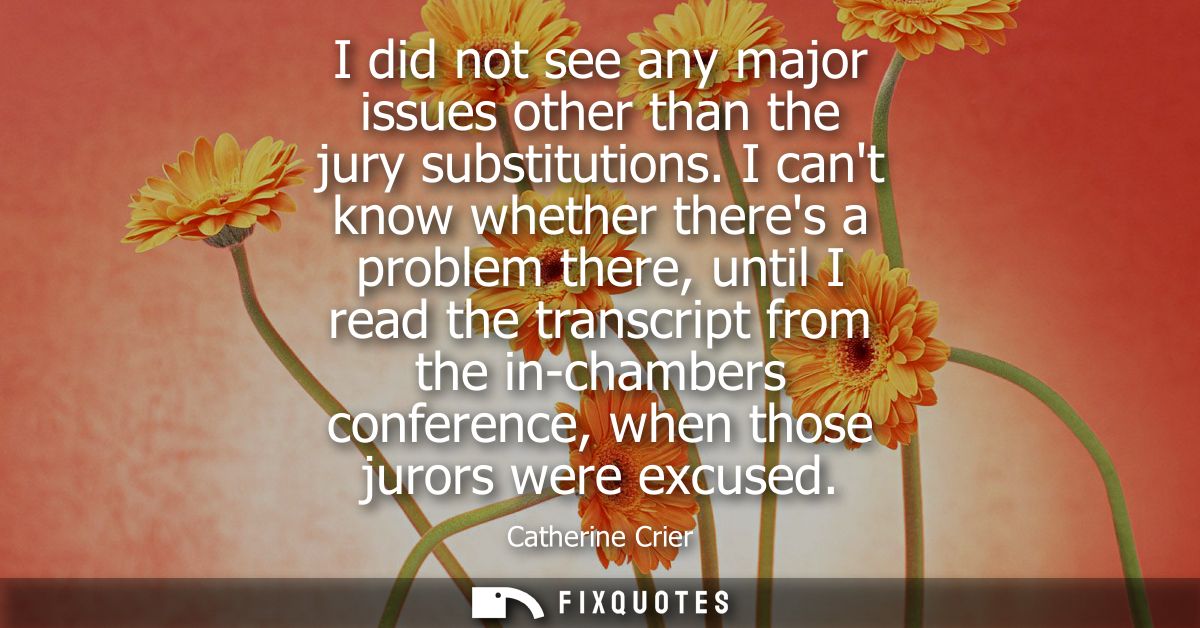
"I did not see any major issues other than the jury substitutions. I can't know whether there's a problem there until I read the transcript from the in-chambers conference, when those jurors were excused"
About this Quote
The phrasing is doing careful work. “I did not see” signals that her skepticism is evidence-based, not ideological. “Other than” is the tell: the exception is big enough to merit its own category. Then comes the key legal-media move: “I can’t know whether there’s a problem there.” That’s not ignorance; it’s disciplined epistemology. She’s reminding the audience that courtroom optics are staged, and the real decisions often happen off-camera, in chambers, where lawyers and judges speak more candidly and the record becomes the battleground.
The insistence on reading “the transcript from the in-chambers conference” signals both due process and distrust. If jurors were excused for cause, hardship, bias, intimidation, or something more strategic, the rationale will be embedded in that transcript - or suspiciously absent. Crier’s subtext is that jury composition is power, and power rarely announces itself loudly. Her intent is to keep the conversation tethered to what can be proven while still flagging the exact place where procedure can be weaponized under the cover of professionalism.
Quote Details
| Topic | Justice |
|---|---|
| Source | Help us find the source |
| Cite |
Citation Formats
APA Style (7th ed.)
Crier, Catherine. (2026, February 16). I did not see any major issues other than the jury substitutions. I can't know whether there's a problem there until I read the transcript from the in-chambers conference, when those jurors were excused. FixQuotes. https://fixquotes.com/quotes/i-did-not-see-any-major-issues-other-than-the-142080/
Chicago Style
Crier, Catherine. "I did not see any major issues other than the jury substitutions. I can't know whether there's a problem there until I read the transcript from the in-chambers conference, when those jurors were excused." FixQuotes. February 16, 2026. https://fixquotes.com/quotes/i-did-not-see-any-major-issues-other-than-the-142080/.
MLA Style (9th ed.)
"I did not see any major issues other than the jury substitutions. I can't know whether there's a problem there until I read the transcript from the in-chambers conference, when those jurors were excused." FixQuotes, 16 Feb. 2026, https://fixquotes.com/quotes/i-did-not-see-any-major-issues-other-than-the-142080/. Accessed 27 Mar. 2026.