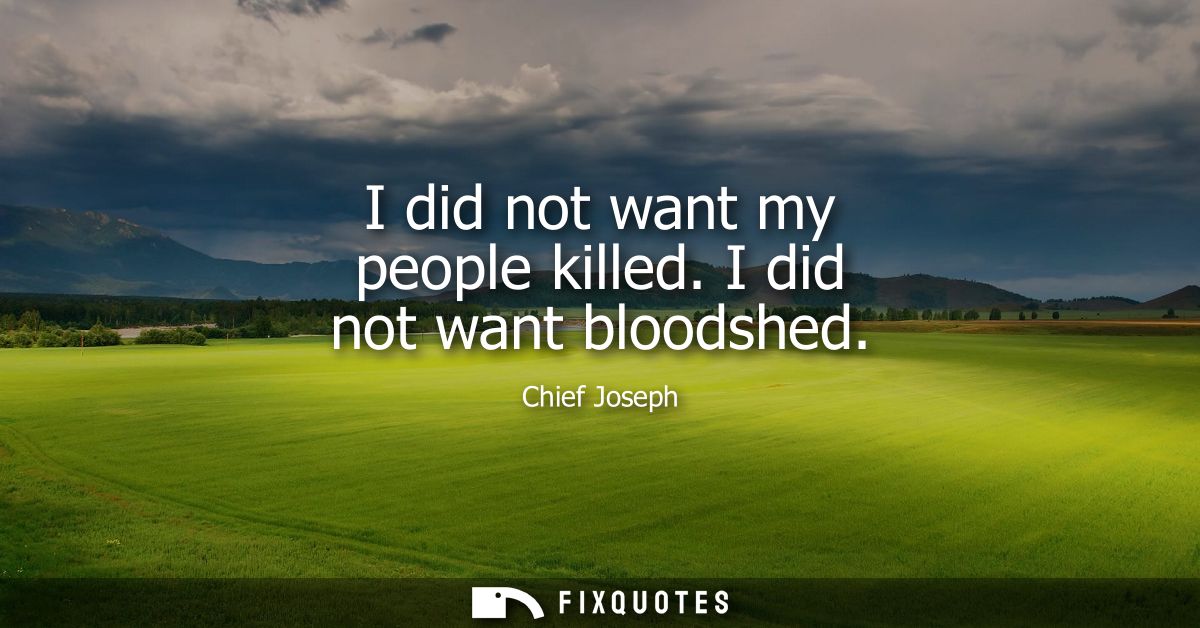
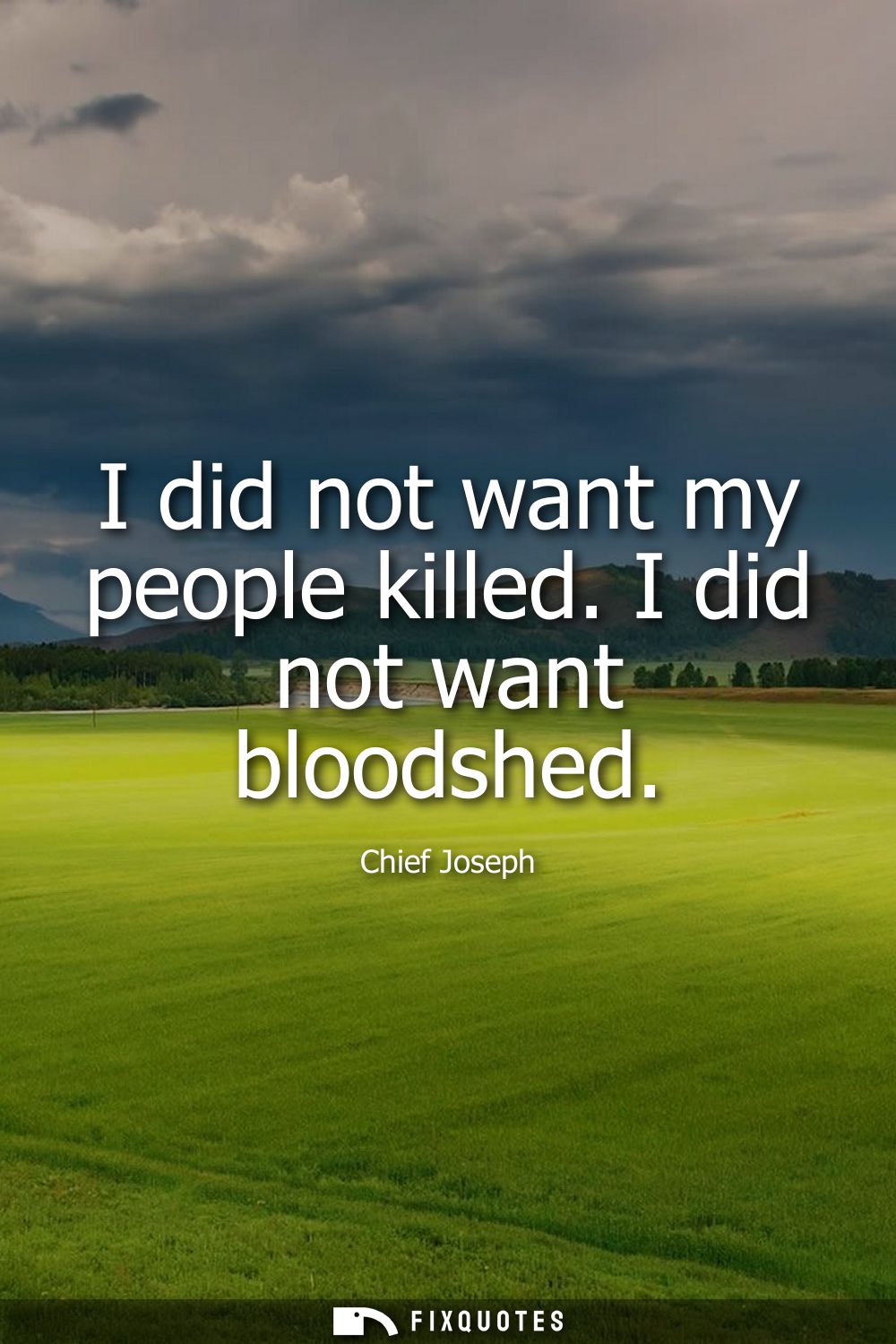
"I did not want my people killed. I did not want bloodshed"
About this Quote
A leader’s most radical move is sometimes refusing the romance of war. Chief Joseph’s plainspoken repetition, “I did not want... I did not want...,” strips conflict of its usual alibis: honor, destiny, the supposed cleansing power of violence. The line reads like testimony, not slogan. It’s an ethical stance delivered in the simplest grammar because the audience that mattered most - U.S. military power and the settler public mood behind it - had already shown it could ignore complexity. Joseph chooses a sentence that can’t be misunderstood, only dismissed.
The intent is protective, but the subtext is accusatory. By centering “my people,” he rejects the colonial habit of treating Native lives as collateral or as symbols in someone else’s national story. The phrase “bloodshed” widens the indictment beyond a single battle. It names a pattern: removal sold as policy, enforced as violence, then narrated as inevitability. Joseph’s restraint also functions as a rebuke to the stereotype of the “warlike Indian.” He’s not pleading for sympathy; he’s documenting that he tried to prevent exactly what the U.S. would later claim it had to stop.
Context sharpens the edge. During the Nez Perce War and its aftermath, Joseph became a public voice forced into a brutal bind: resist and be branded savage; negotiate and be read as weak. This line refuses that trap. It asserts leadership as stewardship, not spectacle, and exposes how “peace” is often demanded from the powerless right up until the powerful decide to make war anyway.
The intent is protective, but the subtext is accusatory. By centering “my people,” he rejects the colonial habit of treating Native lives as collateral or as symbols in someone else’s national story. The phrase “bloodshed” widens the indictment beyond a single battle. It names a pattern: removal sold as policy, enforced as violence, then narrated as inevitability. Joseph’s restraint also functions as a rebuke to the stereotype of the “warlike Indian.” He’s not pleading for sympathy; he’s documenting that he tried to prevent exactly what the U.S. would later claim it had to stop.
Context sharpens the edge. During the Nez Perce War and its aftermath, Joseph became a public voice forced into a brutal bind: resist and be branded savage; negotiate and be read as weak. This line refuses that trap. It asserts leadership as stewardship, not spectacle, and exposes how “peace” is often demanded from the powerless right up until the powerful decide to make war anyway.
Quote Details
| Topic | Peace |
|---|---|
| Source | Help us find the source |
| Cite |
Citation Formats
APA Style (7th ed.)
Joseph, Chief. (2026, January 17). I did not want my people killed. I did not want bloodshed. FixQuotes. https://fixquotes.com/quotes/i-did-not-want-my-people-killed-i-did-not-want-30564/
Chicago Style
Joseph, Chief. "I did not want my people killed. I did not want bloodshed." FixQuotes. January 17, 2026. https://fixquotes.com/quotes/i-did-not-want-my-people-killed-i-did-not-want-30564/.
MLA Style (9th ed.)
"I did not want my people killed. I did not want bloodshed." FixQuotes, 17 Jan. 2026, https://fixquotes.com/quotes/i-did-not-want-my-people-killed-i-did-not-want-30564/. Accessed 21 Feb. 2026.
More Quotes by Chief
Add to List