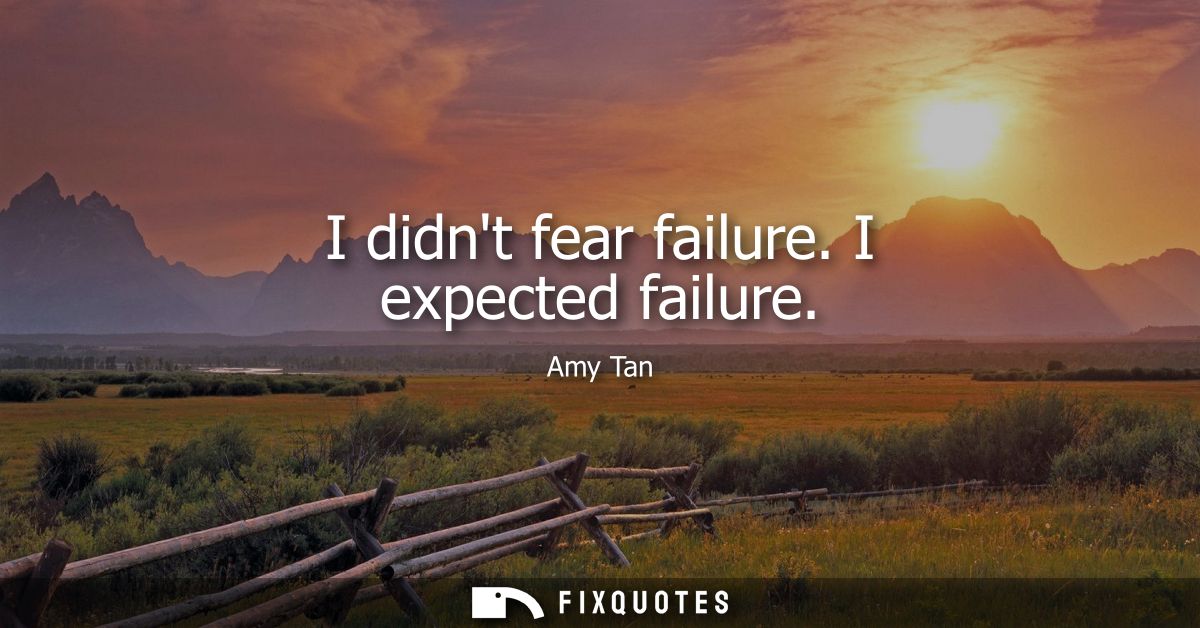
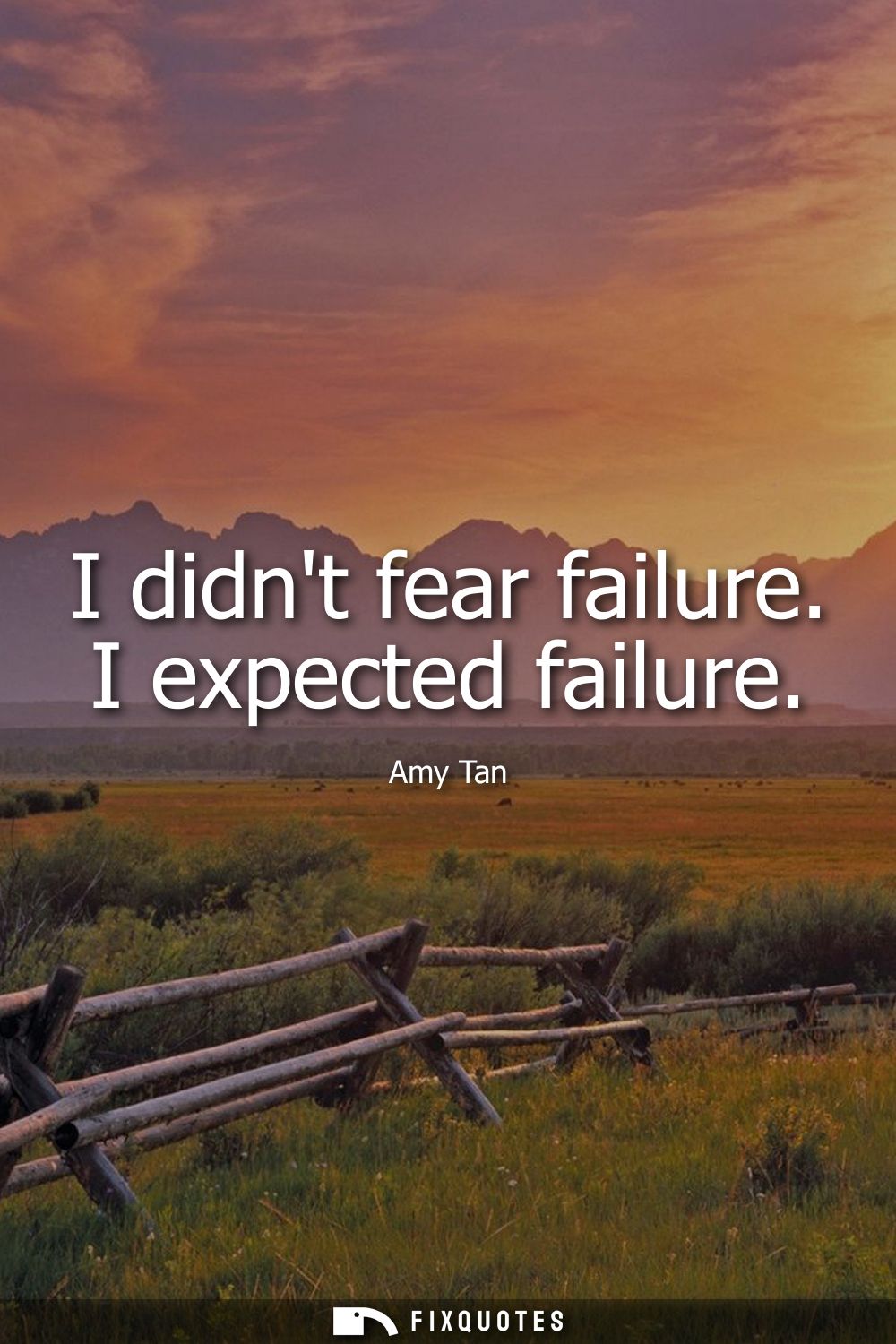
"I didn't fear failure. I expected failure"
About this Quote
Amy Tan’s line lands like a quiet confession that doubles as a survival strategy. “I didn’t fear failure” sounds like the standard bravery slogan, but she undercuts it with the colder, more workable truth: “I expected failure.” Expectation is not courage; it’s calibration. The sentence shifts the emotional burden from willpower to realism. If you already assume the door might stay shut, rejection loses its power to define you.
The subtext is immigrant and outsider psychology without ever naming it. Tan’s work often lives inside the pressure cooker of family expectation, cultural translation, and the sense of being judged by rules you didn’t write. In that world, “failure” isn’t a single bad review or a missed opportunity; it’s a looming verdict about belonging. Expecting it becomes a way to keep moving anyway, to treat setbacks as weather rather than prophecy.
It also reframes ambition. Expecting failure doesn’t mean aiming low; it means decoupling effort from the fantasy of guaranteed reward. For a novelist especially, where the process is built on drafts that don’t work and stories that collapse, Tan is pointing to a craft ethic: you don’t write from confidence, you write through uncertainty. The line’s power is its refusal to romanticize grit. It’s a portrait of persistence stripped of pep talk, built from the kind of clear-eyed pessimism that can, paradoxically, keep a person free.
The subtext is immigrant and outsider psychology without ever naming it. Tan’s work often lives inside the pressure cooker of family expectation, cultural translation, and the sense of being judged by rules you didn’t write. In that world, “failure” isn’t a single bad review or a missed opportunity; it’s a looming verdict about belonging. Expecting it becomes a way to keep moving anyway, to treat setbacks as weather rather than prophecy.
It also reframes ambition. Expecting failure doesn’t mean aiming low; it means decoupling effort from the fantasy of guaranteed reward. For a novelist especially, where the process is built on drafts that don’t work and stories that collapse, Tan is pointing to a craft ethic: you don’t write from confidence, you write through uncertainty. The line’s power is its refusal to romanticize grit. It’s a portrait of persistence stripped of pep talk, built from the kind of clear-eyed pessimism that can, paradoxically, keep a person free.
Quote Details
| Topic | Failure |
|---|---|
| Source | Help us find the source |
| Cite |
Citation Formats
APA Style (7th ed.)
Tan, Amy. (2026, January 17). I didn't fear failure. I expected failure. FixQuotes. https://fixquotes.com/quotes/i-didnt-fear-failure-i-expected-failure-37465/
Chicago Style
Tan, Amy. "I didn't fear failure. I expected failure." FixQuotes. January 17, 2026. https://fixquotes.com/quotes/i-didnt-fear-failure-i-expected-failure-37465/.
MLA Style (9th ed.)
"I didn't fear failure. I expected failure." FixQuotes, 17 Jan. 2026, https://fixquotes.com/quotes/i-didnt-fear-failure-i-expected-failure-37465/. Accessed 27 Mar. 2026.
More Quotes by Amy
Add to List