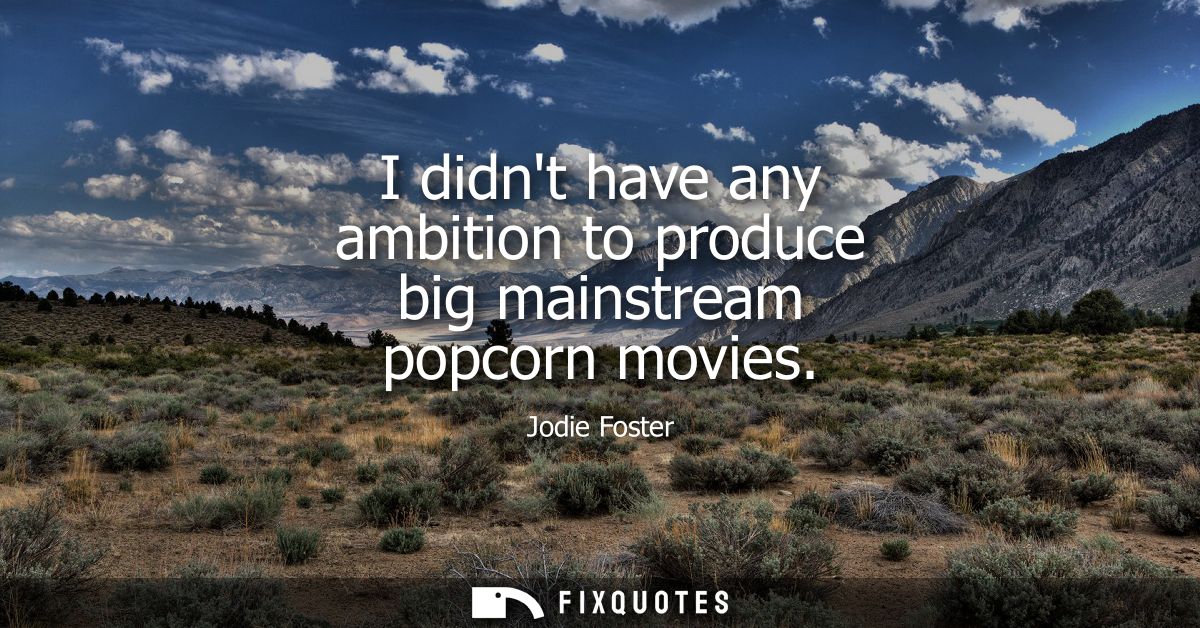
"I didn't have any ambition to produce big mainstream popcorn movies"
About this Quote
It is both a refusal and a flex: Jodie Foster frames “big mainstream popcorn movies” as something you choose, not something you fall into because you can’t do better. The line works because it quietly rewrites the usual Hollywood narrative. Most actors are expected to sound grateful for whatever scale they can get; Foster flips it, implying that spectacle is the default current and she’s deliberately swimming against it.
The word “ambition” is the tell. Ambition isn’t talent or opportunity; it’s desire, values, self-image. By saying she didn’t have it, Foster signals an internal compass oriented toward control, craft, and material that leaves bruises. “Popcorn” isn’t just a genre label here; it’s a cultural shorthand for disposable pleasure, a product designed to be consumed and forgotten. She’s not attacking the audience so much as rejecting a system that equates bigness with importance.
Context matters: Foster is one of the rare child actors who converted early fame into adult authority, building a career around projects that are thorny, risky, and often psychologically dark. She also became a director, which changes the stakes. Directing is where “mainstream” pressure becomes structural: budgets, notes, marketing, test screenings. Her statement reads like an artist’s boundary-setting, but also like a negotiation tactic in an industry that rewards compliance.
There’s a subtle feminist undertone, too. For women, “mainstream” often means being positioned as a commodity inside someone else’s franchise engine. Foster’s line insists on authorship over visibility: not anti-fun, just pro-intention.
The word “ambition” is the tell. Ambition isn’t talent or opportunity; it’s desire, values, self-image. By saying she didn’t have it, Foster signals an internal compass oriented toward control, craft, and material that leaves bruises. “Popcorn” isn’t just a genre label here; it’s a cultural shorthand for disposable pleasure, a product designed to be consumed and forgotten. She’s not attacking the audience so much as rejecting a system that equates bigness with importance.
Context matters: Foster is one of the rare child actors who converted early fame into adult authority, building a career around projects that are thorny, risky, and often psychologically dark. She also became a director, which changes the stakes. Directing is where “mainstream” pressure becomes structural: budgets, notes, marketing, test screenings. Her statement reads like an artist’s boundary-setting, but also like a negotiation tactic in an industry that rewards compliance.
There’s a subtle feminist undertone, too. For women, “mainstream” often means being positioned as a commodity inside someone else’s franchise engine. Foster’s line insists on authorship over visibility: not anti-fun, just pro-intention.
Quote Details
| Topic | Movie |
|---|---|
| Source | Help us find the source |
| Cite |
Citation Formats
APA Style (7th ed.)
Foster, Jodie. (2026, January 17). I didn't have any ambition to produce big mainstream popcorn movies. FixQuotes. https://fixquotes.com/quotes/i-didnt-have-any-ambition-to-produce-big-67150/
Chicago Style
Foster, Jodie. "I didn't have any ambition to produce big mainstream popcorn movies." FixQuotes. January 17, 2026. https://fixquotes.com/quotes/i-didnt-have-any-ambition-to-produce-big-67150/.
MLA Style (9th ed.)
"I didn't have any ambition to produce big mainstream popcorn movies." FixQuotes, 17 Jan. 2026, https://fixquotes.com/quotes/i-didnt-have-any-ambition-to-produce-big-67150/. Accessed 2 Apr. 2026.
More Quotes by Jodie
Add to List