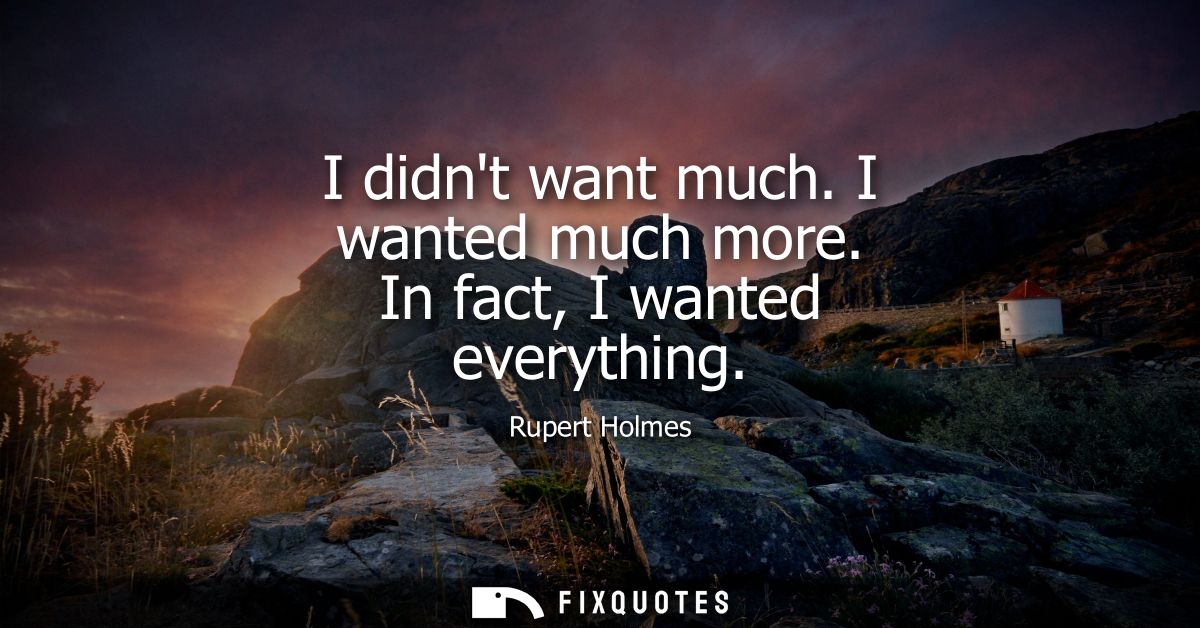
"I didn't want much. I wanted much more. In fact, I wanted everything"
About this Quote
Desire rarely announces itself politely, and Rupert Holmes gives it a wickedly clean escalation: from the modesty mask ("I didn't want much") to the confession ("I wanted much more") to the punchline that isn’t really a joke ("I wanted everything"). The line works because it dramatizes self-justification in real time. You can hear the speaker trying to sound reasonable, then failing in three short steps. It’s not just greed; it’s the psychology of appetite, how we narrate our longing to ourselves until it becomes destiny.
As a composer, Holmes understands pacing. Each sentence is a beat drop, tightening the screw: short clauses, plain words, no ornament. That simplicity is the trap. It sounds like a shrug, but it lands like an indictment of the American-ish fantasy that wanting "everything" is bold rather than childish. The rhetorical move is also defensive: by starting with "I didn't want much", the speaker preemptively denies the charge of excess, as if moderation were still the social expectation even while excess is the private goal.
The subtext is ambition with its manners removed. "Everything" isn’t a concrete object; it’s a refusal of limits - romantic, artistic, material, existential. Coming from a pop-savvy storyteller, it reads like a character’s interior monologue at the exact moment self-control snaps. It’s the seduction and the warning in one: if you can’t name what you want, you can always call it everything, and let the world do the math.
As a composer, Holmes understands pacing. Each sentence is a beat drop, tightening the screw: short clauses, plain words, no ornament. That simplicity is the trap. It sounds like a shrug, but it lands like an indictment of the American-ish fantasy that wanting "everything" is bold rather than childish. The rhetorical move is also defensive: by starting with "I didn't want much", the speaker preemptively denies the charge of excess, as if moderation were still the social expectation even while excess is the private goal.
The subtext is ambition with its manners removed. "Everything" isn’t a concrete object; it’s a refusal of limits - romantic, artistic, material, existential. Coming from a pop-savvy storyteller, it reads like a character’s interior monologue at the exact moment self-control snaps. It’s the seduction and the warning in one: if you can’t name what you want, you can always call it everything, and let the world do the math.
Quote Details
| Topic | Life |
|---|---|
| Source | Help us find the source |
| Cite |
Citation Formats
APA Style (7th ed.)
Holmes, Rupert. (2026, January 16). I didn't want much. I wanted much more. In fact, I wanted everything. FixQuotes. https://fixquotes.com/quotes/i-didnt-want-much-i-wanted-much-more-in-fact-i-85550/
Chicago Style
Holmes, Rupert. "I didn't want much. I wanted much more. In fact, I wanted everything." FixQuotes. January 16, 2026. https://fixquotes.com/quotes/i-didnt-want-much-i-wanted-much-more-in-fact-i-85550/.
MLA Style (9th ed.)
"I didn't want much. I wanted much more. In fact, I wanted everything." FixQuotes, 16 Jan. 2026, https://fixquotes.com/quotes/i-didnt-want-much-i-wanted-much-more-in-fact-i-85550/. Accessed 14 Mar. 2026.
More Quotes by Rupert
Add to List