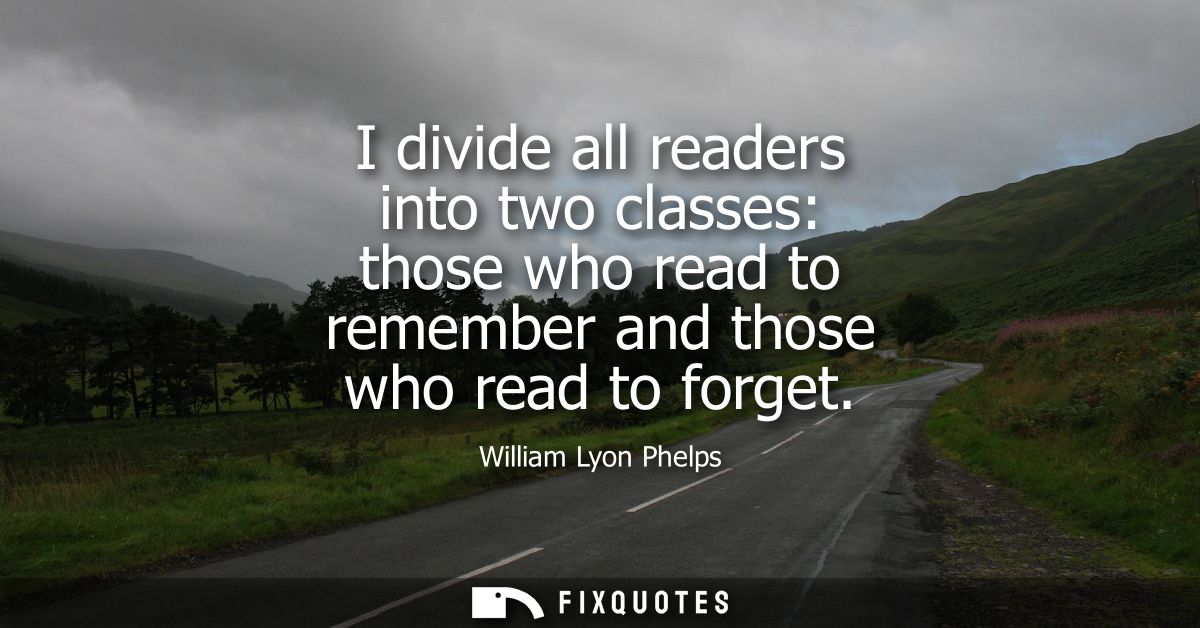
"I divide all readers into two classes: those who read to remember and those who read to forget"
About this Quote
The subtext is a defense of pleasure and escape at a moment when American culture was turning literacy into a civic religion. As a prominent teacher and public intellectual in the late 19th and early 20th century, Phelps lived amid anxieties about “serious” books versus popular fiction, self-improvement versus entertainment. By framing forgetfulness as a legitimate motive, he quietly decriminalizes the so-called frivolous reader without fully surrendering the authority of the classroom. It’s permissive, but still supervisory: he grants the second category existence while keeping the first as the implied ideal.
The line also flatters both camps. The rememberers get discipline and status; the forgetters get relief, even salvation. And it hints at something darker: forgetting isn’t just leisure, it’s coping. Reading can be a technology for managing modernity’s pressures, a private room you can enter without permission. Phelps’s neat division works because it captures an old tension in one clean hinge: books as tools for building a self, and books as doors you walk through to stop being one for a while.
Quote Details
| Topic | Learning |
|---|---|
| Source | Help us find the source |
| Cite |
Citation Formats
APA Style (7th ed.)
Phelps, William Lyon. (2026, January 17). I divide all readers into two classes: those who read to remember and those who read to forget. FixQuotes. https://fixquotes.com/quotes/i-divide-all-readers-into-two-classes-those-who-59296/
Chicago Style
Phelps, William Lyon. "I divide all readers into two classes: those who read to remember and those who read to forget." FixQuotes. January 17, 2026. https://fixquotes.com/quotes/i-divide-all-readers-into-two-classes-those-who-59296/.
MLA Style (9th ed.)
"I divide all readers into two classes: those who read to remember and those who read to forget." FixQuotes, 17 Jan. 2026, https://fixquotes.com/quotes/i-divide-all-readers-into-two-classes-those-who-59296/. Accessed 27 Mar. 2026.