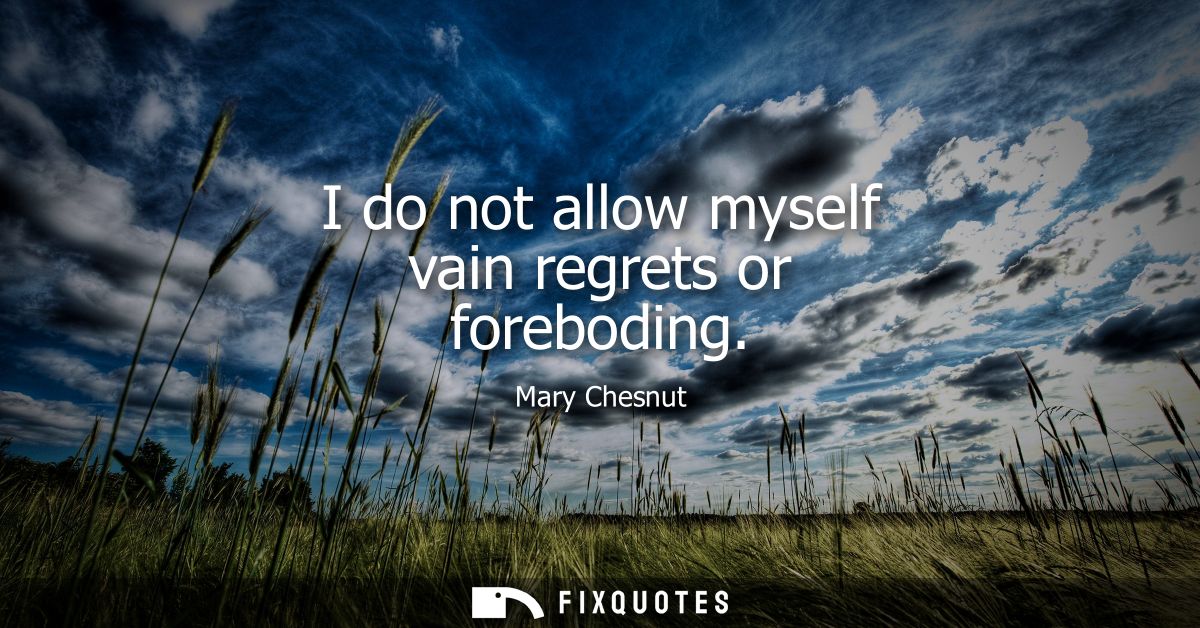
"I do not allow myself vain regrets or foreboding"
About this Quote
A line like this doesn’t read as serenity; it reads as strategy. Mary Chesnut isn’t claiming she lacks regret or dread. She’s asserting control over what she will “allow” herself to feel, turning emotion into a governed territory. That verb matters. In a culture that prized feminine composure and punished female frankness, the phrase works as a coded flex: discipline as survival, self-command as credibility. It’s also a subtle admission that the pressures are there, pressing in, requiring constant management.
Chesnut wrote from inside the Confederate elite during the Civil War, watching a world built on slavery and social hierarchy wobble, then crack. Her diaries are famous for their mix of sharp observation and moral unease. Against that backdrop, “vain” does heavy lifting: it dismisses regret and foreboding not as illegitimate feelings but as unproductive ones, luxuries that don’t purchase agency. The word carries Protestant thrift and planter-class pragmatism at once, an ethic that says emotions are acceptable only if they’re useful.
The subtext is bracingly modern: when history accelerates, private feeling can become a kind of narcissism, a trapdoor away from action. Yet Chesnut’s restraint also has a darker edge. Refusing “foreboding” can be a way to keep living inside denial, to maintain the social order by treating looming catastrophe as melodrama. The sentence lands because it’s both admirable and suspect: a clean, controlled line that reveals the mess it’s trying not to name.
Chesnut wrote from inside the Confederate elite during the Civil War, watching a world built on slavery and social hierarchy wobble, then crack. Her diaries are famous for their mix of sharp observation and moral unease. Against that backdrop, “vain” does heavy lifting: it dismisses regret and foreboding not as illegitimate feelings but as unproductive ones, luxuries that don’t purchase agency. The word carries Protestant thrift and planter-class pragmatism at once, an ethic that says emotions are acceptable only if they’re useful.
The subtext is bracingly modern: when history accelerates, private feeling can become a kind of narcissism, a trapdoor away from action. Yet Chesnut’s restraint also has a darker edge. Refusing “foreboding” can be a way to keep living inside denial, to maintain the social order by treating looming catastrophe as melodrama. The sentence lands because it’s both admirable and suspect: a clean, controlled line that reveals the mess it’s trying not to name.
Quote Details
| Topic | Letting Go |
|---|
More Quotes by Mary
Add to List