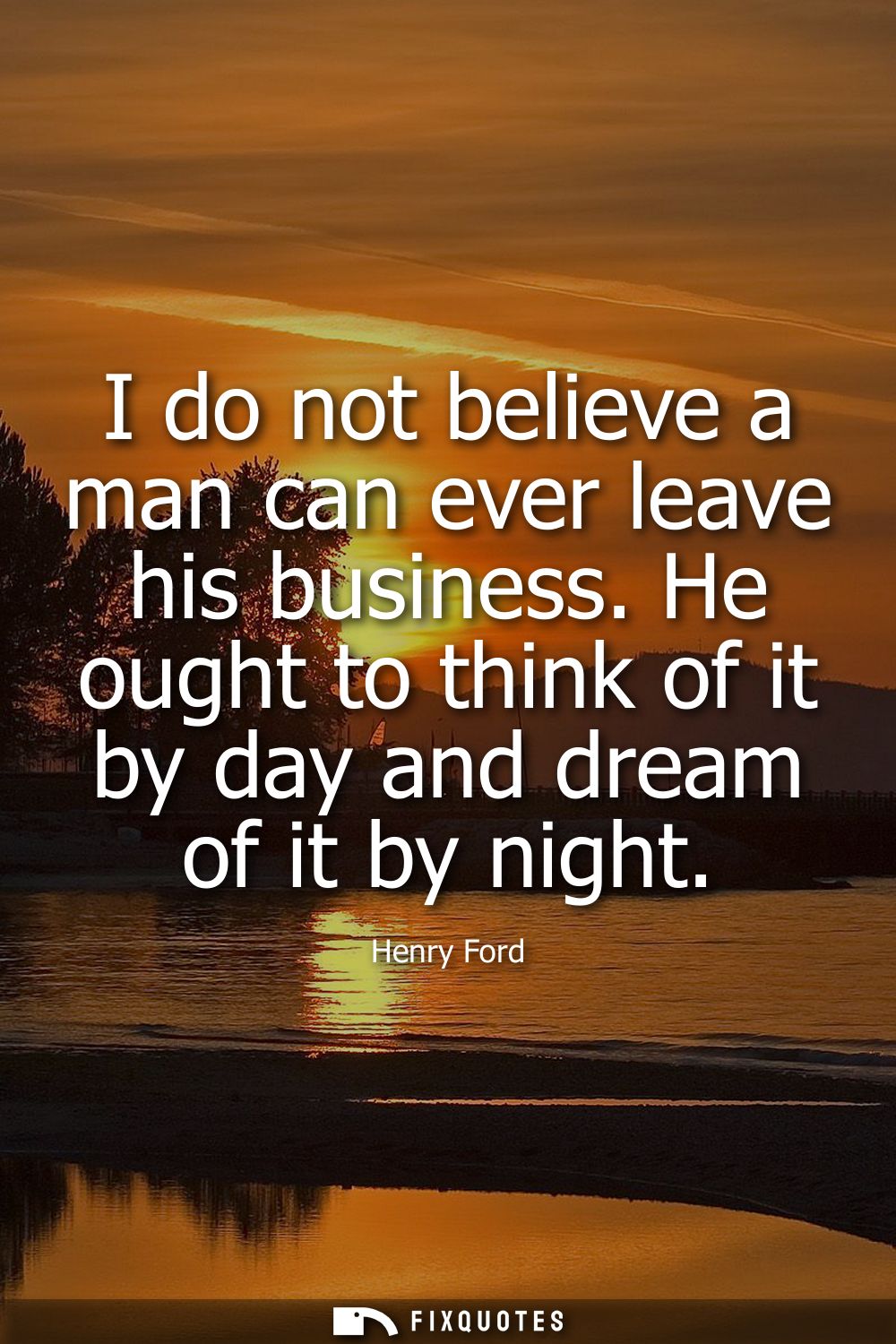
"I do not believe a man can ever leave his business. He ought to think of it by day and dream of it by night"
About this Quote
The phrasing is deceptively intimate. “By day” and “dream of it by night” doesn’t just recommend long hours; it colonizes the unconscious. It’s a vision of business as a faith that deserves your waking attention and your private mind. That subtext matters because it reframes sacrifice as virtue while quietly erasing what gets sacrificed: family time, leisure, health, the civic self that exists outside the factory gate.
Context sharpens the edge. Ford is the emblem of industrial modernity, a man who could raise wages and lower prices while also standardizing bodies and minutes through the assembly line. His system made mass production feel inevitable, and this quote supplies the psychological soundtrack: if the machine never really stops, neither should the person running it. It also echoes Ford’s paternalistic streak; he famously policed workers’ “morality” through company programs, implying that the boss’s interests were the proper organizing principle of a worker’s whole life.
In 2026, it reads like a precursor to startup culture’s “grindset” rhetoric: inspirational on a poster, alarming as a social blueprint. The intent isn’t balance. It’s a worldview where devotion to enterprise becomes the cleanest alibi for power.
Quote Details
| Topic | Business |
|---|---|
| Source | Help us find the source |
| Cite |
Citation Formats
APA Style (7th ed.)
Ford, Henry. (2026, January 18). I do not believe a man can ever leave his business. He ought to think of it by day and dream of it by night. FixQuotes. https://fixquotes.com/quotes/i-do-not-believe-a-man-can-ever-leave-his-16671/
Chicago Style
Ford, Henry. "I do not believe a man can ever leave his business. He ought to think of it by day and dream of it by night." FixQuotes. January 18, 2026. https://fixquotes.com/quotes/i-do-not-believe-a-man-can-ever-leave-his-16671/.
MLA Style (9th ed.)
"I do not believe a man can ever leave his business. He ought to think of it by day and dream of it by night." FixQuotes, 18 Jan. 2026, https://fixquotes.com/quotes/i-do-not-believe-a-man-can-ever-leave-his-16671/. Accessed 13 Feb. 2026.