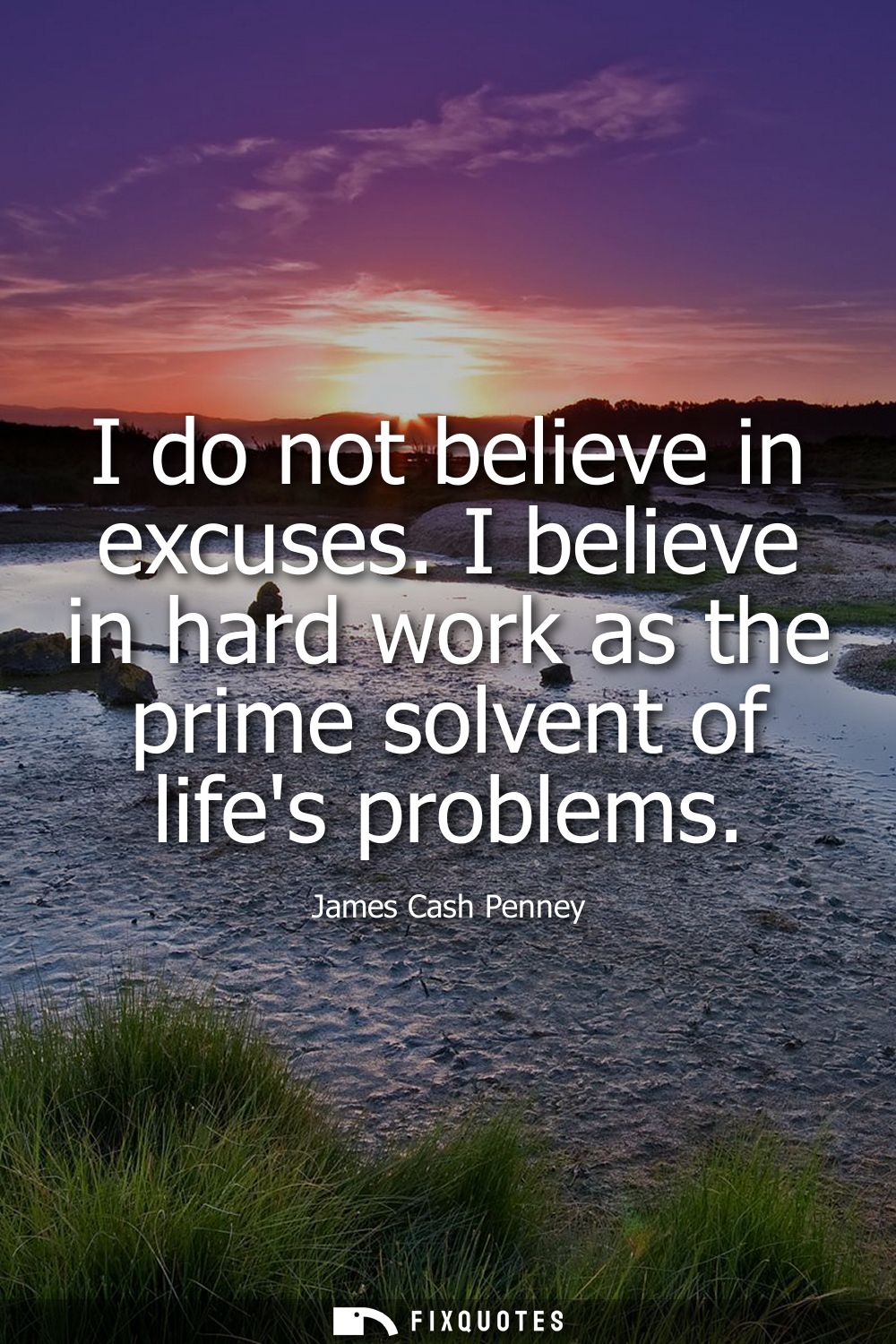
"I do not believe in excuses. I believe in hard work as the prime solvent of life's problems"
About this Quote
Penney’s refusal to “believe in excuses” isn’t just motivational muscle-flexing; it’s a moral business ethic disguised as self-help. Calling hard work the “prime solvent” is shrewd: it borrows the language of chemistry and commerce at once. Solvents dissolve what looks solid and immovable. Problems aren’t tragedies in this worldview, they’re residues to be broken down by effort. That metaphor flatters the striver because it makes success feel procedural, almost industrial: apply enough labor and the mess clears.
The intent is managerial as much as personal. A retailer who built an empire on standardized stores and disciplined operations needs a creed that scales. “No excuses” becomes a portable rule for employees, franchise partners, and customers alike: reliability is virtue; unpredictability is vice. It also functions as a quiet rejection of structural explanations. If hard work is the prime solvent, then the obstacle is never the system, the market, or luck. The obstacle is you.
That’s the subtext that makes the line powerful and, to modern ears, a little unnerving. It offers dignity through agency while narrowing the range of acceptable narratives about failure. In early 20th-century American commerce, that stance fit perfectly: Protestant-inflected self-discipline, the mythos of the self-made man, and a retail economy that rewarded punctuality, thrift, and conformity. Penney’s quote sells more than work. It sells a worldview where character is the ultimate balance sheet.
The intent is managerial as much as personal. A retailer who built an empire on standardized stores and disciplined operations needs a creed that scales. “No excuses” becomes a portable rule for employees, franchise partners, and customers alike: reliability is virtue; unpredictability is vice. It also functions as a quiet rejection of structural explanations. If hard work is the prime solvent, then the obstacle is never the system, the market, or luck. The obstacle is you.
That’s the subtext that makes the line powerful and, to modern ears, a little unnerving. It offers dignity through agency while narrowing the range of acceptable narratives about failure. In early 20th-century American commerce, that stance fit perfectly: Protestant-inflected self-discipline, the mythos of the self-made man, and a retail economy that rewarded punctuality, thrift, and conformity. Penney’s quote sells more than work. It sells a worldview where character is the ultimate balance sheet.
Quote Details
| Topic | Work Ethic |
|---|
More Quotes by James
Add to List