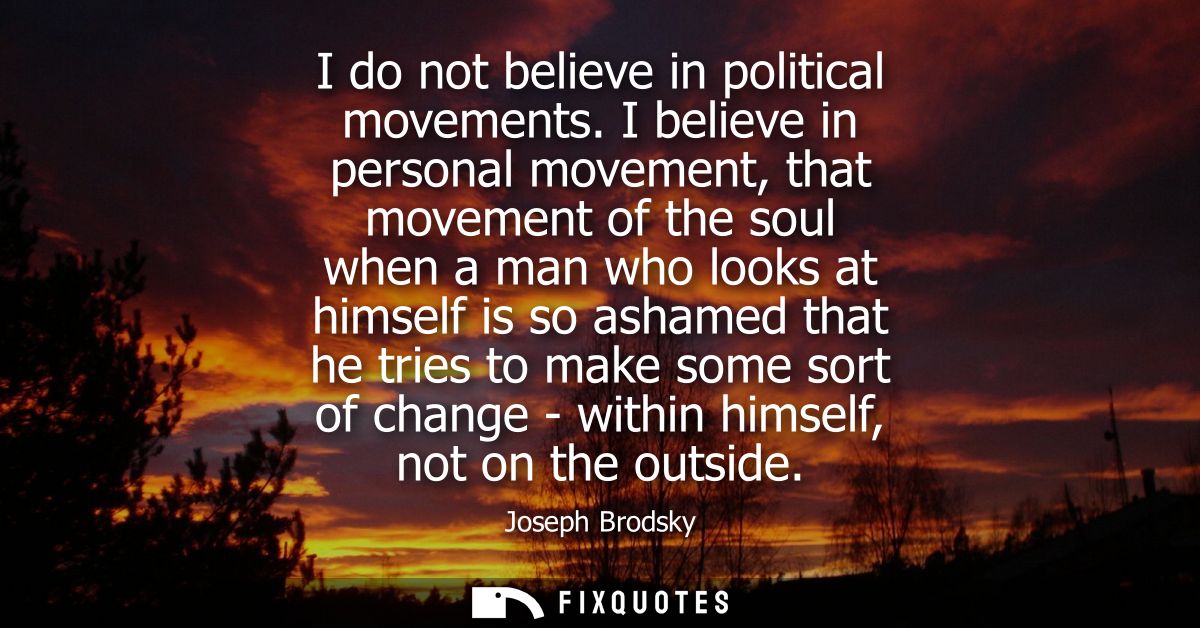
"I do not believe in political movements. I believe in personal movement, that movement of the soul when a man who looks at himself is so ashamed that he tries to make some sort of change - within himself, not on the outside"
About this Quote
The real engine here is shame, a word modern public discourse tends to dodge or rebrand. Brodsky makes it the ignition for change, but not the performative kind. He describes a private rupture: “the movement of the soul” that begins when self-scrutiny becomes unbearable. That’s a deliberately unglamorous origin story. No banners, no slogans, no crowd absolution. Just an individual confronting the gap between self-image and reality.
The subtext is also a warning about how ideology can launder the self. “On the outside” reads like a critique of activism as cosmetics: repaint the world and you won’t have to renovate the interior. Brodsky’s emphasis on inward change doesn’t deny injustice; it denies the fantasy that structural passion automatically equals personal virtue. In a system built on collective narratives, insisting on the individual soul is a kind of resistance.
As a poet, he’s staking a claim for moral imagination over political choreography. The sharpest provocation is that he’s not offering hope so much as a burden: if you want change, start where no one can clap for you.
Quote Details
| Topic | Change |
|---|---|
| Source | Help us find the source |
| Cite |
Citation Formats
APA Style (7th ed.)
Brodsky, Joseph. (2026, January 15). I do not believe in political movements. I believe in personal movement, that movement of the soul when a man who looks at himself is so ashamed that he tries to make some sort of change - within himself, not on the outside. FixQuotes. https://fixquotes.com/quotes/i-do-not-believe-in-political-movements-i-believe-94156/
Chicago Style
Brodsky, Joseph. "I do not believe in political movements. I believe in personal movement, that movement of the soul when a man who looks at himself is so ashamed that he tries to make some sort of change - within himself, not on the outside." FixQuotes. January 15, 2026. https://fixquotes.com/quotes/i-do-not-believe-in-political-movements-i-believe-94156/.
MLA Style (9th ed.)
"I do not believe in political movements. I believe in personal movement, that movement of the soul when a man who looks at himself is so ashamed that he tries to make some sort of change - within himself, not on the outside." FixQuotes, 15 Jan. 2026, https://fixquotes.com/quotes/i-do-not-believe-in-political-movements-i-believe-94156/. Accessed 19 Feb. 2026.