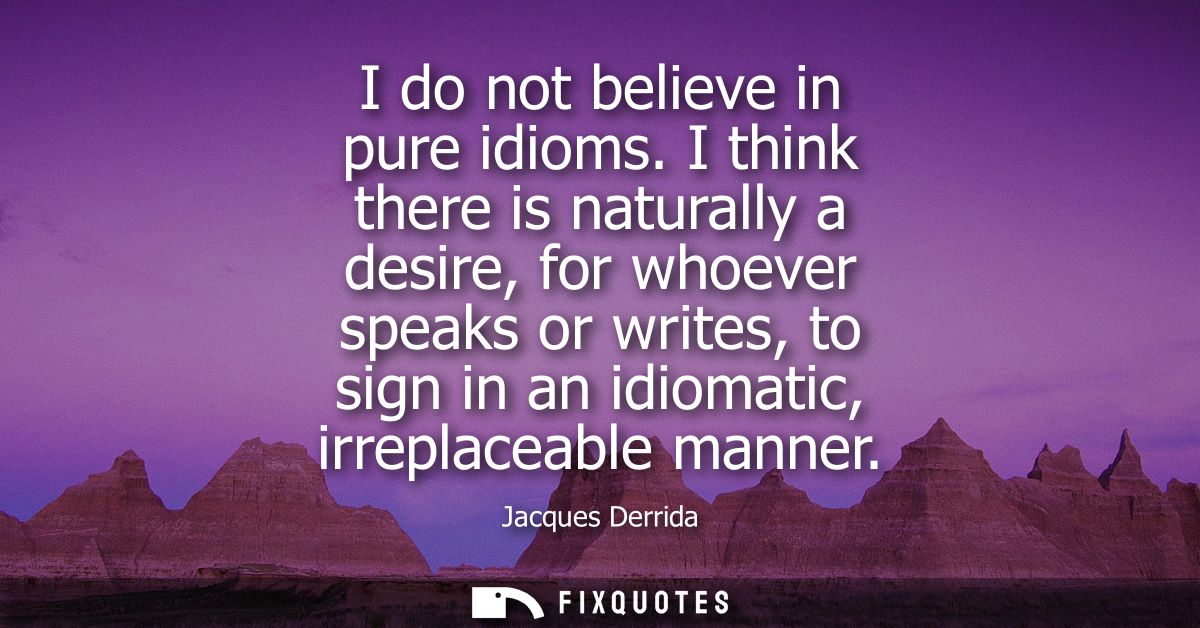
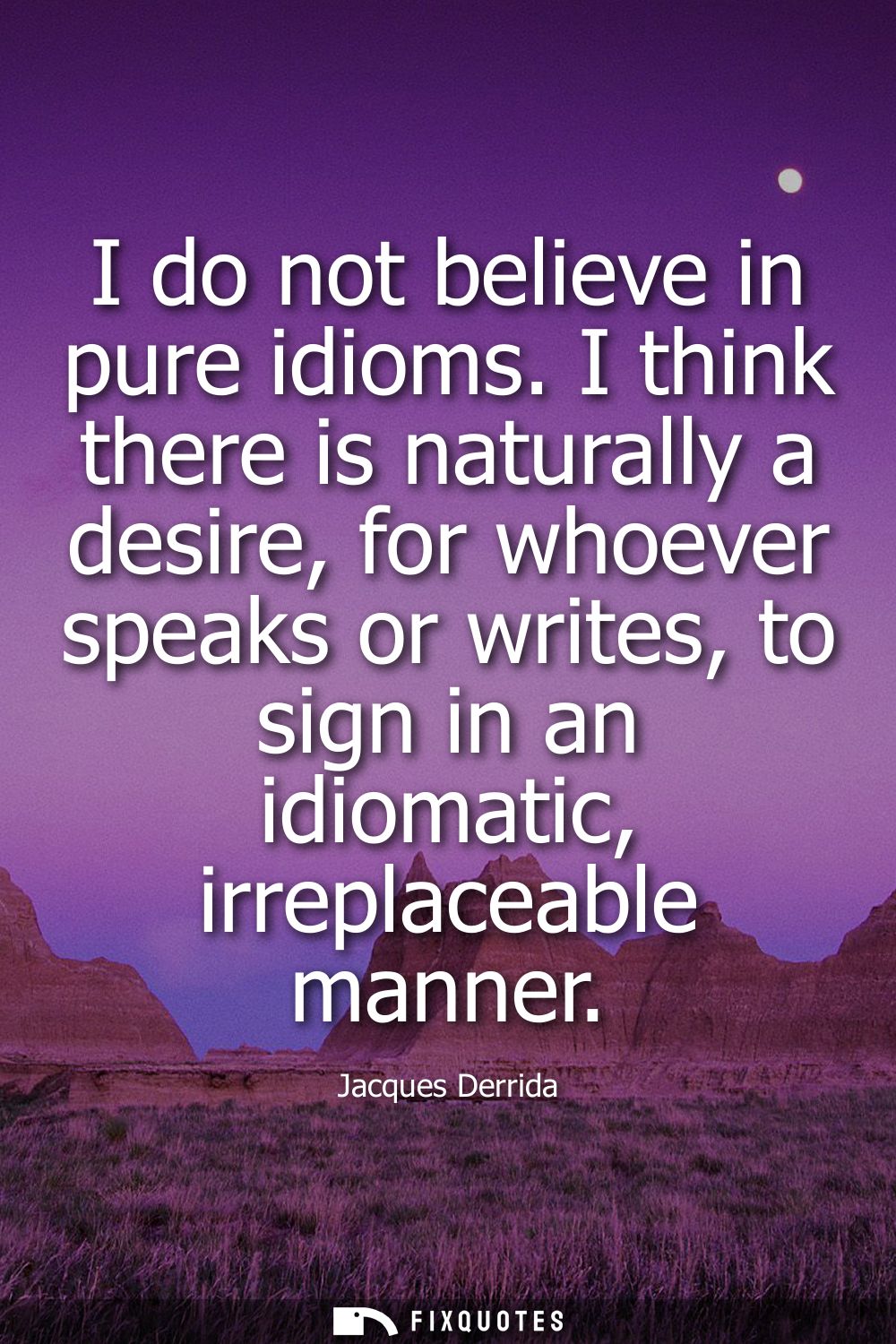
"I do not believe in pure idioms. I think there is naturally a desire, for whoever speaks or writes, to sign in an idiomatic, irreplaceable manner"
About this Quote
Then he pivots to the human impulse that keeps the purity-myth alive. “To sign” is doing heavy Derridean work. It’s not merely to speak with style; it’s to leave a trace that can be recognized as yours, to stamp language with singularity. That desire is “naturally” there because speech is social and competitive: we want to be legible, credited, unrepeatable. The catch is that idiom is exactly what can’t be fully possessed. Your “irreplaceable manner” is built out of shared materials - inherited phrases, institutional codes, genre habits, accents, quotations - all of which are iterable, repeatable by others. Signature depends on repetition even as it tries to escape it.
The subtext has political bite. Calls for linguistic purity often function as border patrol: policing who belongs, who speaks “properly,” who has the right to signify. Derrida, marked by his own experience of language and exclusion in colonial Algeria, treats idiom as both intimacy and weapon. His line offers a bracing alternative: stop pretending language can be purified; pay attention to the ethics of how we sign ourselves in a medium that never fully belongs to us.
Quote Details
| Topic | Writing |
|---|---|
| Source | Help us find the source |
| Cite |
Citation Formats
APA Style (7th ed.)
Derrida, Jacques. (2026, January 18). I do not believe in pure idioms. I think there is naturally a desire, for whoever speaks or writes, to sign in an idiomatic, irreplaceable manner. FixQuotes. https://fixquotes.com/quotes/i-do-not-believe-in-pure-idioms-i-think-there-is-2709/
Chicago Style
Derrida, Jacques. "I do not believe in pure idioms. I think there is naturally a desire, for whoever speaks or writes, to sign in an idiomatic, irreplaceable manner." FixQuotes. January 18, 2026. https://fixquotes.com/quotes/i-do-not-believe-in-pure-idioms-i-think-there-is-2709/.
MLA Style (9th ed.)
"I do not believe in pure idioms. I think there is naturally a desire, for whoever speaks or writes, to sign in an idiomatic, irreplaceable manner." FixQuotes, 18 Jan. 2026, https://fixquotes.com/quotes/i-do-not-believe-in-pure-idioms-i-think-there-is-2709/. Accessed 8 Apr. 2026.