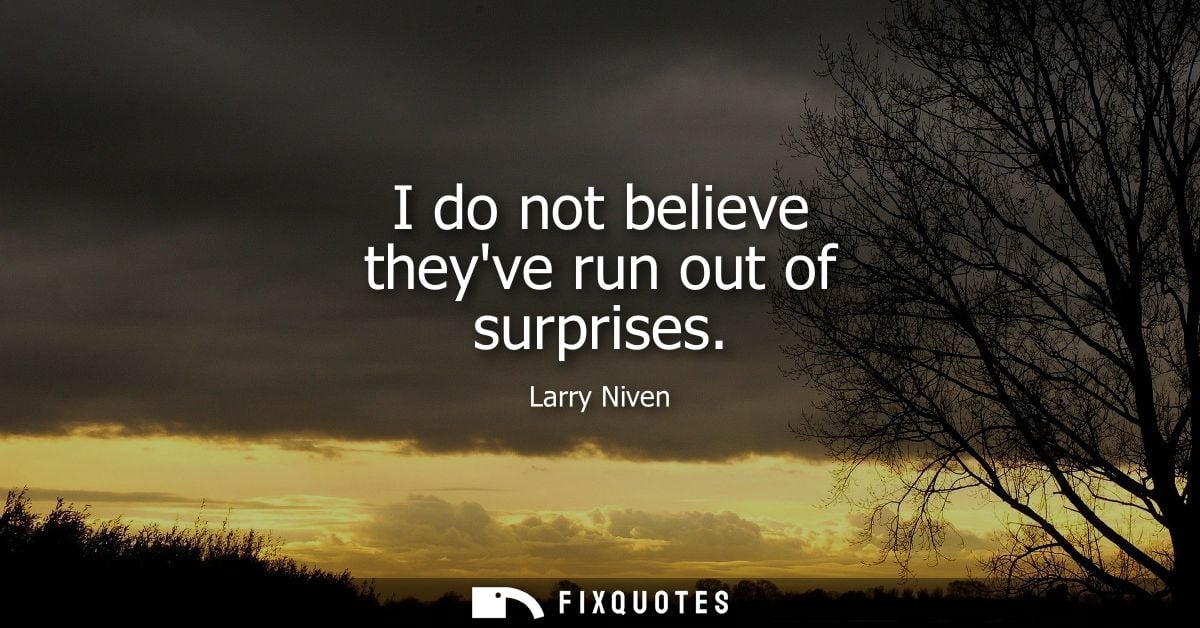
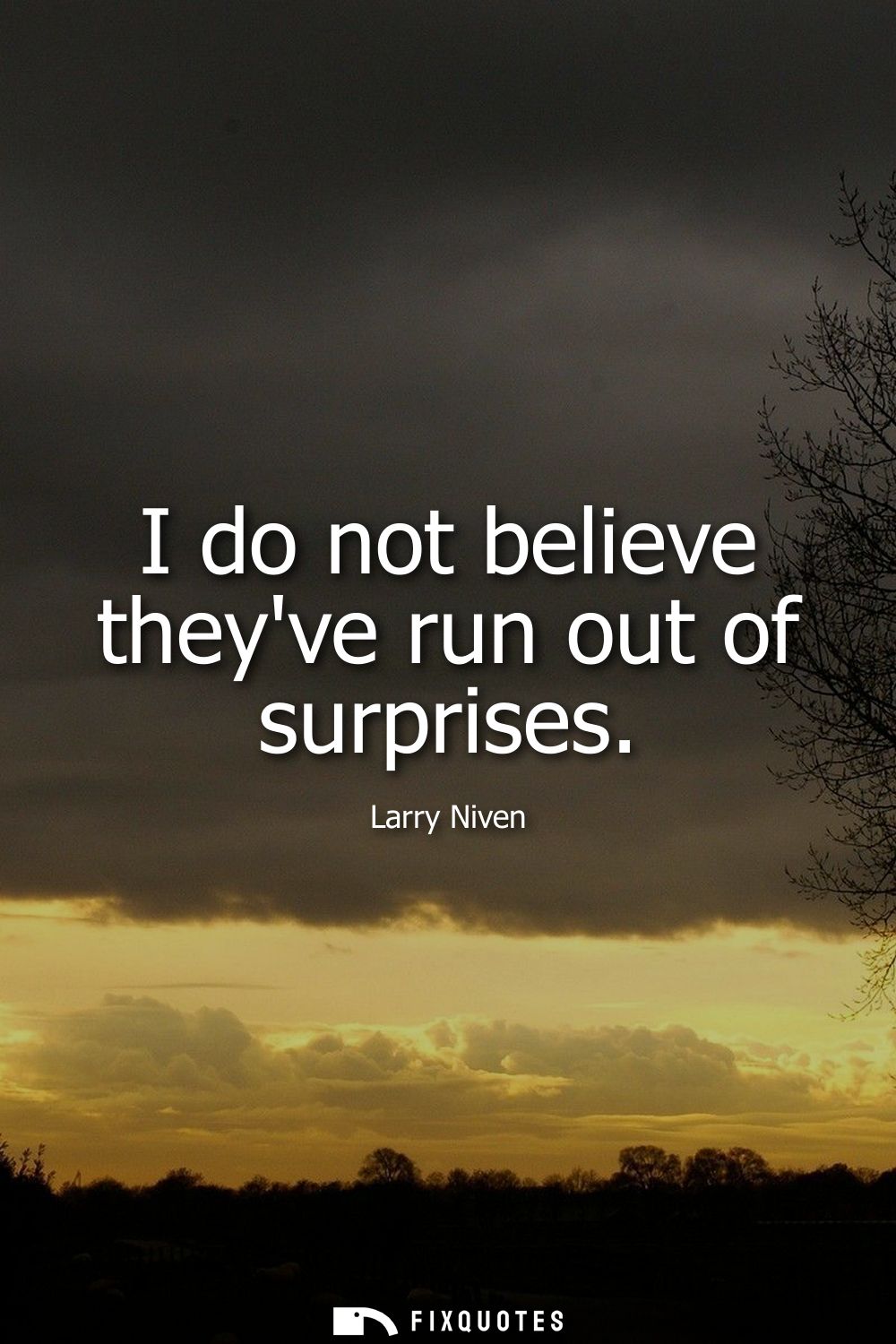
"I do not believe they've run out of surprises"
About this Quote
Optimism, in Larry Niven’s hands, isn’t a warm hug; it’s a dare. “I do not believe they’ve run out of surprises” reads like a calm sentence that smuggles in an entire worldview: the universe stays interesting longer than our confidence does. Niven’s science fiction has always treated “surprise” as the engine of plot and the corrective to human arrogance. The line carries the tone of someone who’s watched experts declare the case closed, only to see reality kick the door back open.
The deliberate vagueness of “they” is doing heavy lifting. It could be aliens, engineers, institutions, even the laws of physics. That ambiguity broadens the claim from a single story beat to a philosophy of inquiry: don’t overfit your theories, don’t get sentimental about your models, don’t assume the map is finished. The phrase “run out” is also slyly economic, implying surprises are a resource you can deplete. Niven pushes against that consumer mindset. In his fiction, novelty isn’t a finite stockpile; it’s what happens when you collide with scales, intelligences, and systems bigger than your imagination.
There’s a cultural context here, too: late-20th-century techno-confidence paired with Cold War unease. Niven’s era loved sleek predictions, then watched them fail in messy, destabilizing ways. This sentence lands as a warning to the complacent and a promise to the curious: the future won’t stop being strange just because we’re tired of being surprised.
The deliberate vagueness of “they” is doing heavy lifting. It could be aliens, engineers, institutions, even the laws of physics. That ambiguity broadens the claim from a single story beat to a philosophy of inquiry: don’t overfit your theories, don’t get sentimental about your models, don’t assume the map is finished. The phrase “run out” is also slyly economic, implying surprises are a resource you can deplete. Niven pushes against that consumer mindset. In his fiction, novelty isn’t a finite stockpile; it’s what happens when you collide with scales, intelligences, and systems bigger than your imagination.
There’s a cultural context here, too: late-20th-century techno-confidence paired with Cold War unease. Niven’s era loved sleek predictions, then watched them fail in messy, destabilizing ways. This sentence lands as a warning to the complacent and a promise to the curious: the future won’t stop being strange just because we’re tired of being surprised.
Quote Details
| Topic | Optimism |
|---|---|
| Source | Help us find the source |
| Cite |
Citation Formats
APA Style (7th ed.)
Niven, Larry. (2026, January 15). I do not believe they've run out of surprises. FixQuotes. https://fixquotes.com/quotes/i-do-not-believe-theyve-run-out-of-surprises-144313/
Chicago Style
Niven, Larry. "I do not believe they've run out of surprises." FixQuotes. January 15, 2026. https://fixquotes.com/quotes/i-do-not-believe-theyve-run-out-of-surprises-144313/.
MLA Style (9th ed.)
"I do not believe they've run out of surprises." FixQuotes, 15 Jan. 2026, https://fixquotes.com/quotes/i-do-not-believe-theyve-run-out-of-surprises-144313/. Accessed 21 Feb. 2026.
More Quotes by Larry
Add to List