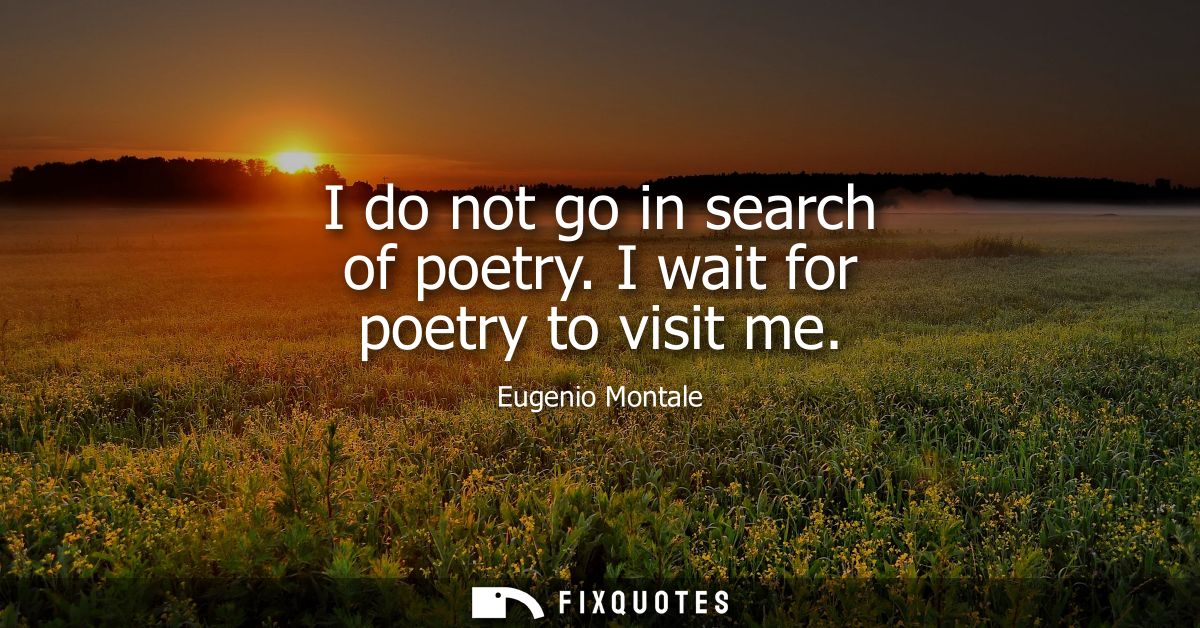
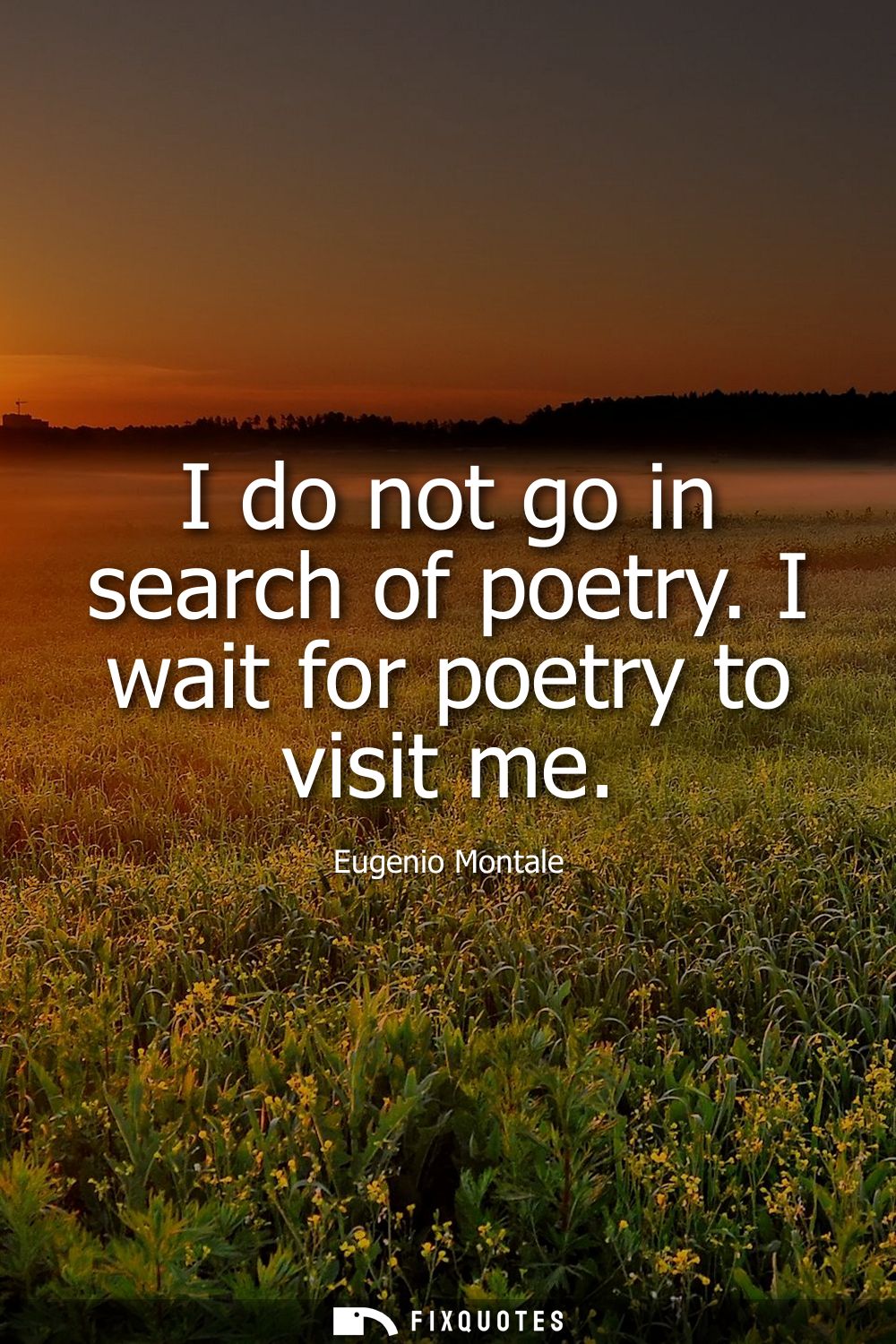
"I do not go in search of poetry. I wait for poetry to visit me"
About this Quote
Montale’s line pretends to be passive, but it’s really a manifesto for a certain kind of artistic rigor: the refusal to counterfeit inspiration. “I do not go in search” reads like a rebuke to the hustling romantic myth of the poet as tireless prospector, panning the world for lyrical gold. He flips the power dynamic. Poetry is not a resource to extract; it’s a guest with agency. That small grammatical move - “visit me” - grants the poem a will of its own and casts the poet less as creator than as custodian, someone responsible for being ready when the doorbell rings.
The subtext is disciplined, almost ascetic. Waiting isn’t laziness; it’s training attention, building the inner conditions in which a real poem can arrive. In Montale’s Italy, marked by the pressures of Fascism and the disillusionment that followed, this stance also reads as moral: don’t manufacture consolations on demand, don’t let art become propaganda or decorative optimism. His work is famously wary of grand declarations, more interested in fragments, dry landscapes, and sudden apertures of meaning. “Waiting” aligns with that: the poet as sensor, not salesman.
There’s irony here, too. To “wait for poetry” is itself a form of seeking, just without the noise. Montale is defending a poetics of restraint - the belief that the most honest lines arrive obliquely, as interruption, not conquest.
The subtext is disciplined, almost ascetic. Waiting isn’t laziness; it’s training attention, building the inner conditions in which a real poem can arrive. In Montale’s Italy, marked by the pressures of Fascism and the disillusionment that followed, this stance also reads as moral: don’t manufacture consolations on demand, don’t let art become propaganda or decorative optimism. His work is famously wary of grand declarations, more interested in fragments, dry landscapes, and sudden apertures of meaning. “Waiting” aligns with that: the poet as sensor, not salesman.
There’s irony here, too. To “wait for poetry” is itself a form of seeking, just without the noise. Montale is defending a poetics of restraint - the belief that the most honest lines arrive obliquely, as interruption, not conquest.
Quote Details
| Topic | Poetry |
|---|---|
| Source | Help us find the source |
| Cite |
Citation Formats
APA Style (7th ed.)
Montale, Eugenio. (2026, January 18). I do not go in search of poetry. I wait for poetry to visit me. FixQuotes. https://fixquotes.com/quotes/i-do-not-go-in-search-of-poetry-i-wait-for-poetry-6141/
Chicago Style
Montale, Eugenio. "I do not go in search of poetry. I wait for poetry to visit me." FixQuotes. January 18, 2026. https://fixquotes.com/quotes/i-do-not-go-in-search-of-poetry-i-wait-for-poetry-6141/.
MLA Style (9th ed.)
"I do not go in search of poetry. I wait for poetry to visit me." FixQuotes, 18 Jan. 2026, https://fixquotes.com/quotes/i-do-not-go-in-search-of-poetry-i-wait-for-poetry-6141/. Accessed 28 Mar. 2026.
More Quotes by Eugenio
Add to List