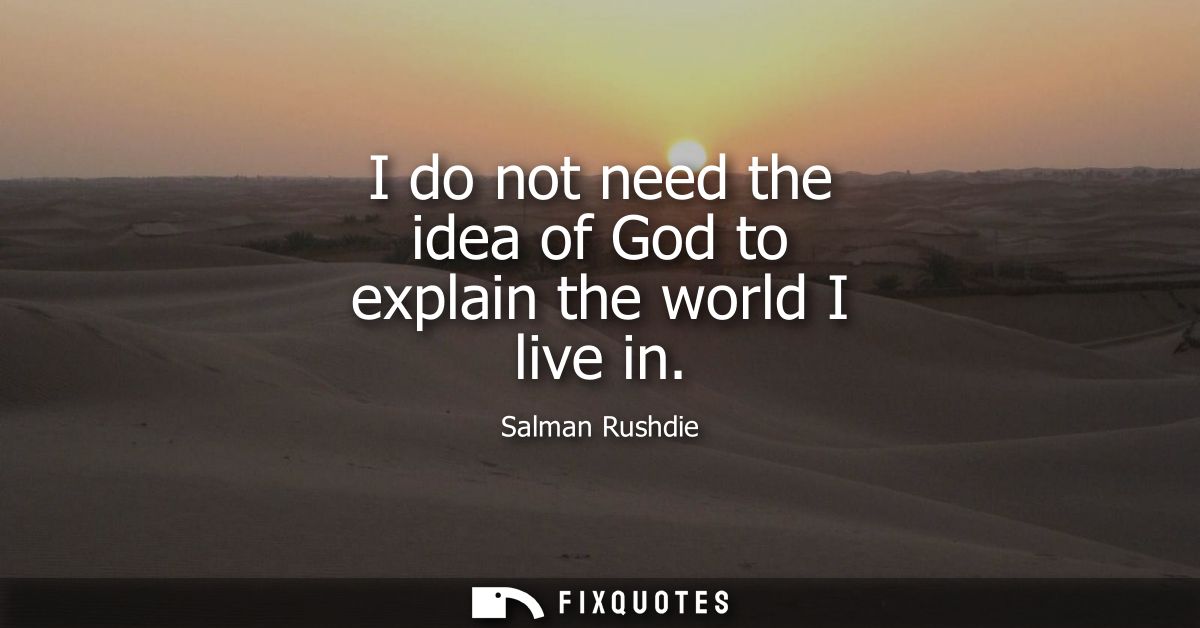
"I do not need the idea of God to explain the world I live in"
About this Quote
There is a quiet provocation in Rushdie’s “I do not need the idea of God to explain the world I live in”: it’s not an argument against faith so much as a refusal to grant it explanatory monopoly. The key word is “need.” Rushdie isn’t claiming certainty about metaphysics; he’s staking a claim for intellectual sufficiency. The world, as he experiences it, can be accounted for through history, politics, desire, cruelty, chance, and the messy machinery of human storytelling. God becomes optional - a narrative choice, not a required premise.
That framing matters because Rushdie is not speaking from the insulated posture of armchair atheism. As a novelist whose work triggered the Iranian fatwa after The Satanic Verses, he occupies a rare position where theological outrage has had literal, violent consequence. The line carries the subtext of lived resistance: the insistence that no religious idea gets to police the imagination, define reality, or set the terms of public life.
It also reads as a writer’s credo. Novelists build worlds; they don’t outsource causality. Rushdie’s fiction often treats identity, nationhood, and myth as competing stories people weaponize. Saying he doesn’t “need” God is a way of demoting divine authority to one story among others - powerful, yes, but not uniquely privileged.
Culturally, it’s a modern secular statement sharpened by postcolonial experience: a pushback against systems that demand reverence, and a defense of pluralism where explanation is earned, not inherited.
That framing matters because Rushdie is not speaking from the insulated posture of armchair atheism. As a novelist whose work triggered the Iranian fatwa after The Satanic Verses, he occupies a rare position where theological outrage has had literal, violent consequence. The line carries the subtext of lived resistance: the insistence that no religious idea gets to police the imagination, define reality, or set the terms of public life.
It also reads as a writer’s credo. Novelists build worlds; they don’t outsource causality. Rushdie’s fiction often treats identity, nationhood, and myth as competing stories people weaponize. Saying he doesn’t “need” God is a way of demoting divine authority to one story among others - powerful, yes, but not uniquely privileged.
Culturally, it’s a modern secular statement sharpened by postcolonial experience: a pushback against systems that demand reverence, and a defense of pluralism where explanation is earned, not inherited.
Quote Details
| Topic | God |
|---|---|
| Source | Help us find the source |
More Quotes by Salman
Add to List