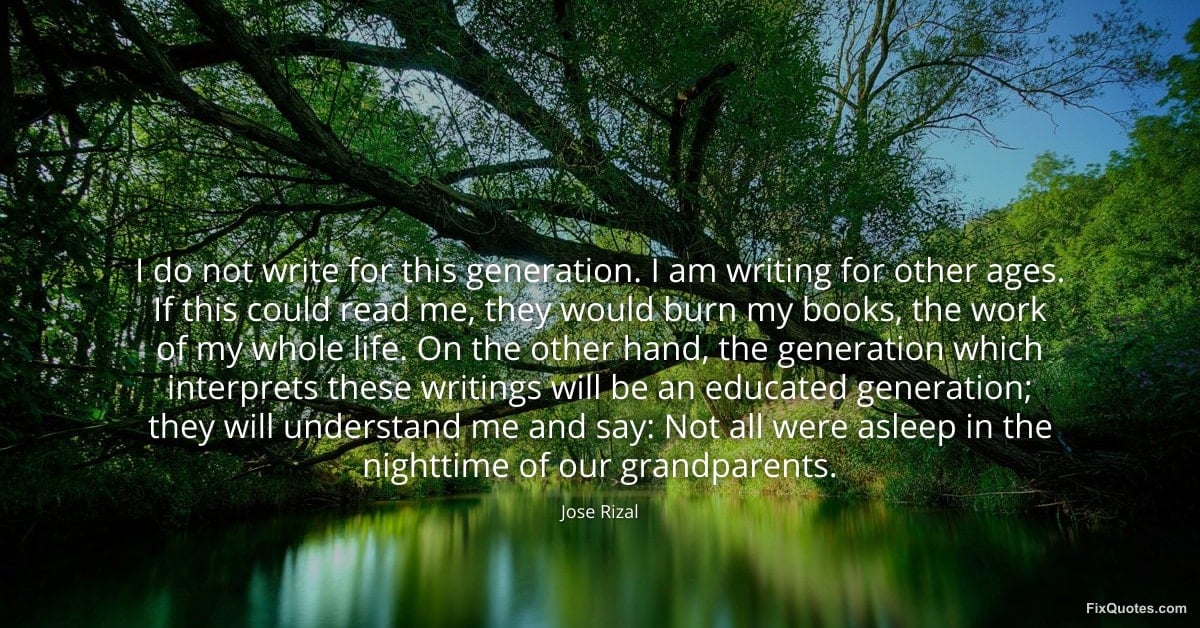
"I do not write for this generation. I am writing for other ages. If this could read me, they would burn my books, the work of my whole life. On the other hand, the generation which interprets these writings will be an educated generation; they will understand me and say: Not all were asleep in the nighttime of our grandparents"
About this Quote
Rizal isn’t courting his contemporaries; he’s indicting them, with the cool confidence of someone who knows exactly how censorship works. The line turns authorial ambition into a political weapon: he writes as if time itself is his publisher, because the present is too compromised, too frightened, too entangled with colonial power to tolerate honest diagnosis. “If this could read me, they would burn my books” isn’t melodrama. It’s an x-ray of a regime that polices imagination precisely because imagination changes what people think is normal.
The subtext is a double move. First, he concedes the inevitability of backlash: the point of writing, under Spain’s colonial order in the Philippines, is not to be understood but to be dangerous. Second, he plants a wager about historical literacy. He imagines a future public that doesn’t just “read” but “interprets” - a crucial distinction. Interpretation implies civic competence: education that can connect private grievances to structural injustice, satire to policy, narrative to nationhood.
The closing image, “the nighttime of our grandparents,” is razor-sharp. It doesn’t merely shame the past; it frames oppression as a manufactured darkness, a social sleep enforced by church, state, and the habits of deference. Rizal casts himself as a contraband candle. If the present is incapable of seeing, his work becomes a message in a bottle meant to wash ashore after the bonfires die down. It’s a writer’s version of revolution: not a call to riot, but a plan to outlast the censors.
The subtext is a double move. First, he concedes the inevitability of backlash: the point of writing, under Spain’s colonial order in the Philippines, is not to be understood but to be dangerous. Second, he plants a wager about historical literacy. He imagines a future public that doesn’t just “read” but “interprets” - a crucial distinction. Interpretation implies civic competence: education that can connect private grievances to structural injustice, satire to policy, narrative to nationhood.
The closing image, “the nighttime of our grandparents,” is razor-sharp. It doesn’t merely shame the past; it frames oppression as a manufactured darkness, a social sleep enforced by church, state, and the habits of deference. Rizal casts himself as a contraband candle. If the present is incapable of seeing, his work becomes a message in a bottle meant to wash ashore after the bonfires die down. It’s a writer’s version of revolution: not a call to riot, but a plan to outlast the censors.
Quote Details
| Topic | Knowledge |
|---|
More Quotes by Jose
Add to List