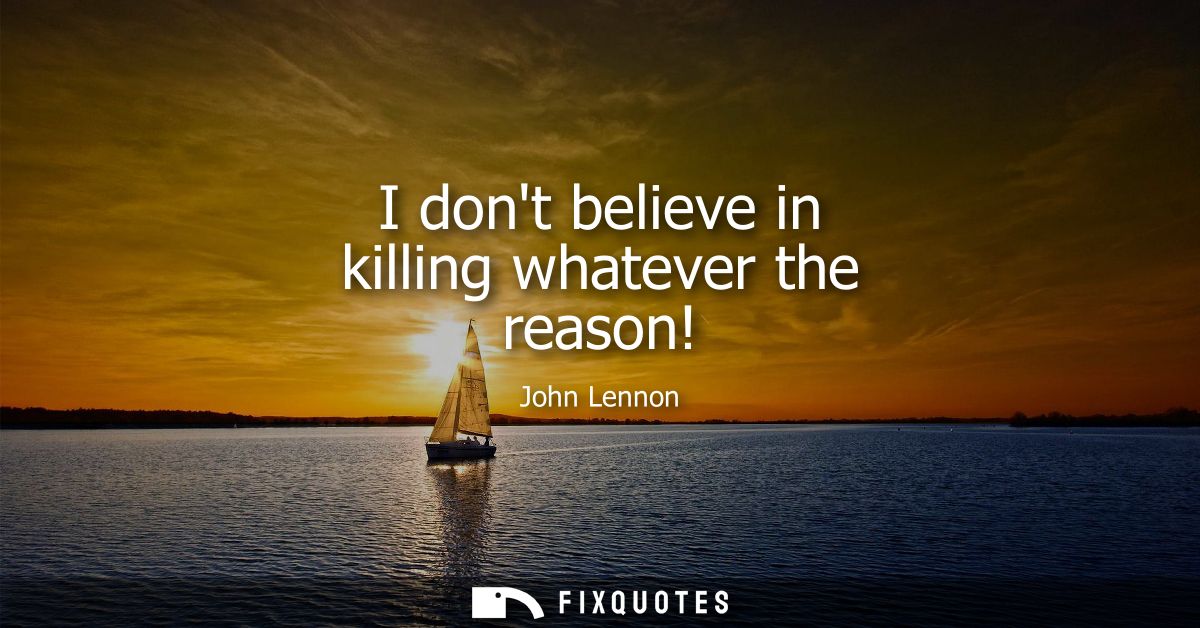
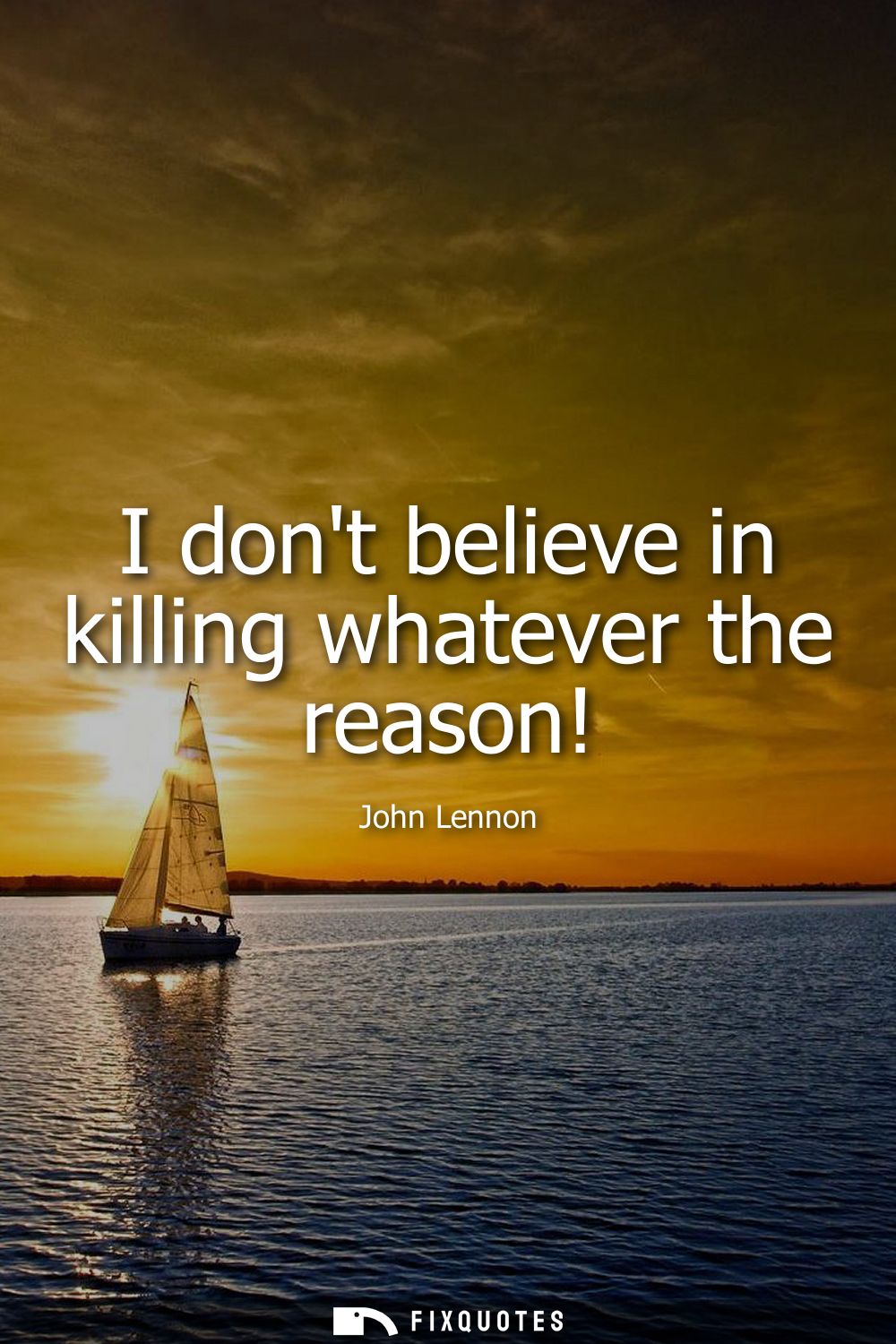
"I don't believe in killing, whatever the reason!"
About this Quote
A blunt sentence like this is Lennon at his most strategic: simple enough to chant, absolute enough to provoke, and human enough to sound like a gut-level refusal rather than a policy paper. “I don’t believe” frames the stance as moral and personal, not partisan. It’s not “I oppose this war” or “I support that movement.” It’s a line drawn around the self. The kicker is “whatever the reason!” - the exclamation point turns the statement from gentle pacifism into a dare, anticipating every familiar justification (patriotism, revenge, “security,” duty) and rejecting them in advance.
The subtext is Lennon’s celebrity-aware understanding of how violence gets marketed. Governments sell killing as necessity; cultures bless it as heroism; even everyday life normalizes it through entertainment. Lennon compresses all of that into one refusal that’s deliberately hard to sophisticate away. The absolutism is the point: it denies listeners the comfort of exceptions, the loopholes where most moral arguments go to hide.
Context matters because Lennon wasn’t speaking from a bunker; he was speaking from the loudest platform pop music had, in the shadow of Vietnam, Cold War paranoia, and a youth culture learning that “reasonable” adults could be spectacularly unreasonable. It also lands differently knowing he’d become a target of political surveillance and, eventually, lethal violence. The line reads as both idealism and pre-emptive grief: a plea to stop calling killing anything other than what it is.
The subtext is Lennon’s celebrity-aware understanding of how violence gets marketed. Governments sell killing as necessity; cultures bless it as heroism; even everyday life normalizes it through entertainment. Lennon compresses all of that into one refusal that’s deliberately hard to sophisticate away. The absolutism is the point: it denies listeners the comfort of exceptions, the loopholes where most moral arguments go to hide.
Context matters because Lennon wasn’t speaking from a bunker; he was speaking from the loudest platform pop music had, in the shadow of Vietnam, Cold War paranoia, and a youth culture learning that “reasonable” adults could be spectacularly unreasonable. It also lands differently knowing he’d become a target of political surveillance and, eventually, lethal violence. The line reads as both idealism and pre-emptive grief: a plea to stop calling killing anything other than what it is.
Quote Details
| Topic | Peace |
|---|---|
| Source | Help us find the source |
| Cite |
Citation Formats
APA Style (7th ed.)
Lennon, John. (2026, February 20). I don't believe in killing, whatever the reason! FixQuotes. https://fixquotes.com/quotes/i-dont-believe-in-killing-whatever-the-reason-24842/
Chicago Style
Lennon, John. "I don't believe in killing, whatever the reason!" FixQuotes. February 20, 2026. https://fixquotes.com/quotes/i-dont-believe-in-killing-whatever-the-reason-24842/.
MLA Style (9th ed.)
"I don't believe in killing, whatever the reason!" FixQuotes, 20 Feb. 2026, https://fixquotes.com/quotes/i-dont-believe-in-killing-whatever-the-reason-24842/. Accessed 29 Mar. 2026.
More Quotes by John
Add to List