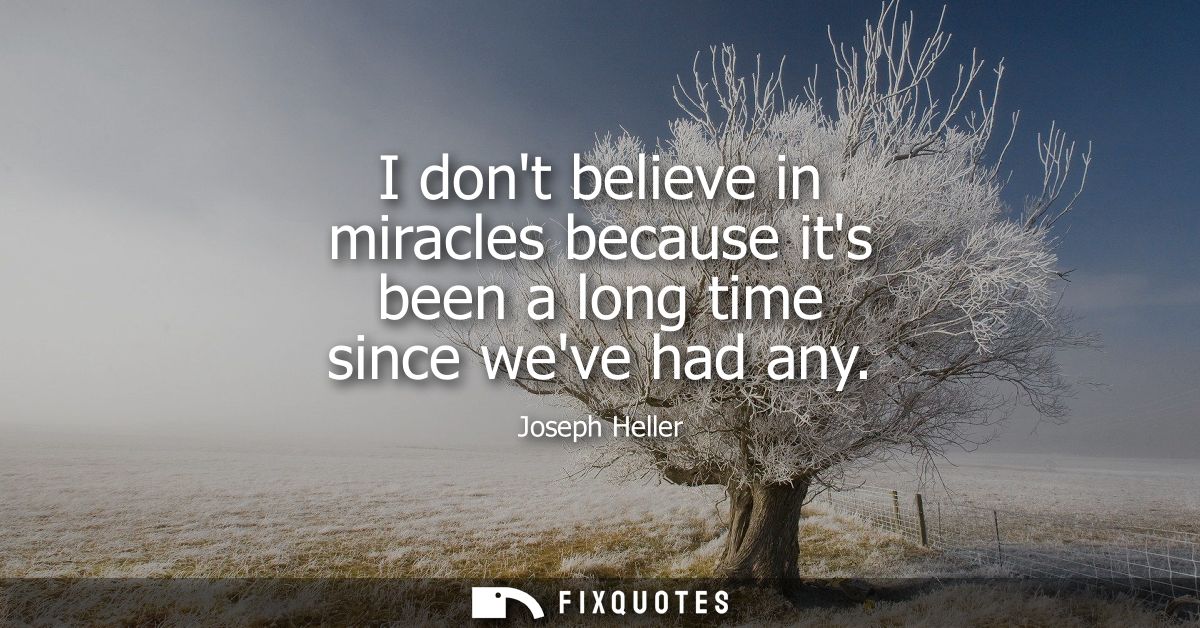
"I don't believe in miracles because it's been a long time since we've had any"
About this Quote
That sly conditional is classic Heller: the logic is intentionally a little crooked, the way bureaucratic logic is crooked in Catch-22. Miracles become a measurable public good, like competent leadership or moral clarity, something you’d notice if it showed up and you’d certainly notice its absence. The subtext is less “miracles aren’t real” than “look around: what would count as proof anymore?” In a landscape shaped by war, institutions that grind people down, and promises that curdle into procedure, optimism starts to sound like gullibility.
There’s also a quiet grief under the cynicism. “We’ve had” implies a shared history, almost a lost entitlement: a time when events could still surprise us in the direction of justice, mercy, reprieve. The line keeps its bite because it refuses the comforting purity of atheism or belief. It’s an exhausted pragmatism, a worldview formed by waiting for rescue and watching the clock run out.
Quote Details
| Topic | Sarcastic |
|---|---|
| Source | Help us find the source |
| Cite |
Citation Formats
APA Style (7th ed.)
Heller, Joseph. (2026, January 16). I don't believe in miracles because it's been a long time since we've had any. FixQuotes. https://fixquotes.com/quotes/i-dont-believe-in-miracles-because-its-been-a-84036/
Chicago Style
Heller, Joseph. "I don't believe in miracles because it's been a long time since we've had any." FixQuotes. January 16, 2026. https://fixquotes.com/quotes/i-dont-believe-in-miracles-because-its-been-a-84036/.
MLA Style (9th ed.)
"I don't believe in miracles because it's been a long time since we've had any." FixQuotes, 16 Jan. 2026, https://fixquotes.com/quotes/i-dont-believe-in-miracles-because-its-been-a-84036/. Accessed 31 Mar. 2026.