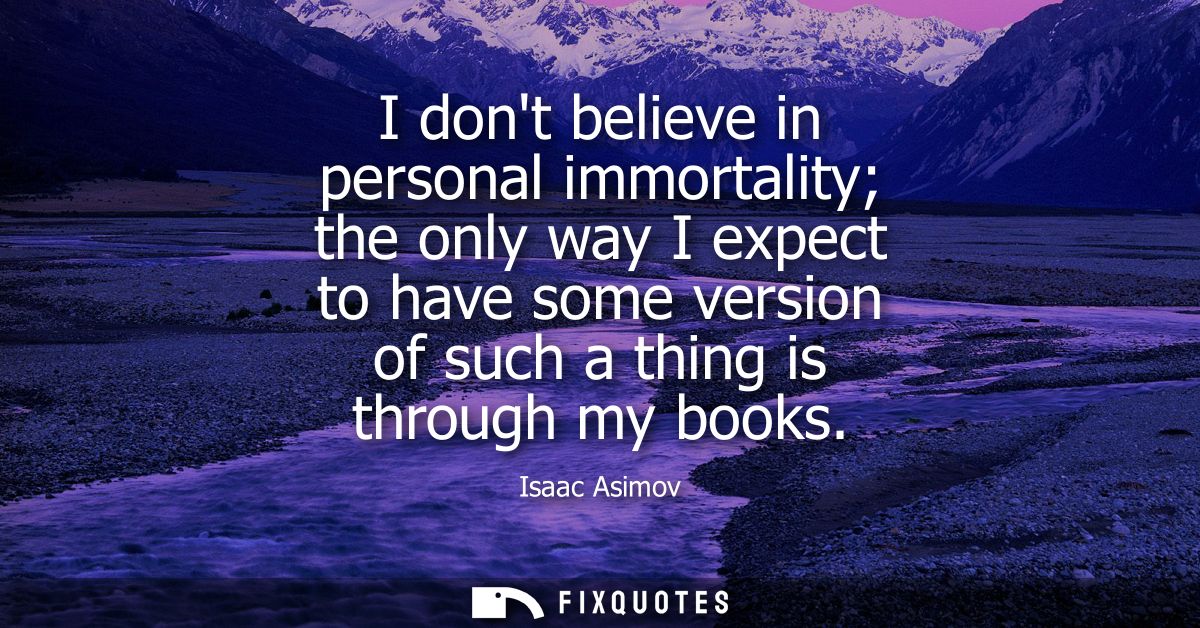
"I don't believe in personal immortality; the only way I expect to have some version of such a thing is through my books"
About this Quote
The phrasing does quiet rhetorical work. “Some version of such a thing” is almost comically modest, like he’s negotiating with the universe for store credit rather than eternal life. It signals intellectual honesty and a refusal to oversell. He’s not claiming greatness; he’s naming a mechanism. Books are the technology that lets a person outlive their body by leaving behind a usable model of their thinking.
The subtext is both humbling and ambitious. Humbling because it concedes that the self ends; ambitious because it bets that ideas can travel farther than a lifetime. It also frames writing as labor rather than legacy cosplay: immortality isn’t granted, it’s built, one page at a time, and it’s contingent on readers choosing to keep the circuit alive.
Context matters. Asimov was a prolific scientist and popularizer who treated knowledge as public infrastructure. In a century scarred by ideological certainty and religious revival, he offers a humanist alternative: meaning without heaven, permanence without miracles. If anything survives, it’s what you make that others can use.
Quote Details
| Topic | Legacy & Remembrance |
|---|---|
| Source | Help us find the source |
| Cite |
Citation Formats
APA Style (7th ed.)
Asimov, Isaac. (2026, January 17). I don't believe in personal immortality; the only way I expect to have some version of such a thing is through my books. FixQuotes. https://fixquotes.com/quotes/i-dont-believe-in-personal-immortality-the-only-31615/
Chicago Style
Asimov, Isaac. "I don't believe in personal immortality; the only way I expect to have some version of such a thing is through my books." FixQuotes. January 17, 2026. https://fixquotes.com/quotes/i-dont-believe-in-personal-immortality-the-only-31615/.
MLA Style (9th ed.)
"I don't believe in personal immortality; the only way I expect to have some version of such a thing is through my books." FixQuotes, 17 Jan. 2026, https://fixquotes.com/quotes/i-dont-believe-in-personal-immortality-the-only-31615/. Accessed 2 Apr. 2026.