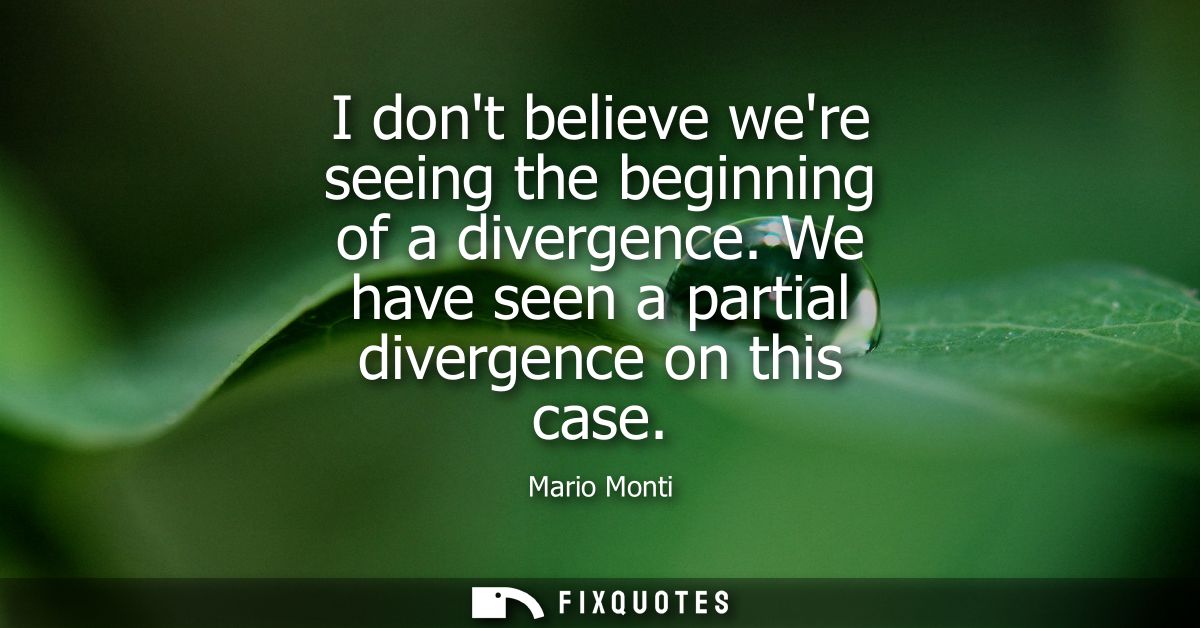
"I don't believe we're seeing the beginning of a divergence. We have seen a partial divergence on this case"
About this Quote
The craft is in the calibration. “I don’t believe” frames the claim as judgment, not decree, leaving room to adjust without losing face. “Beginning” narrows the dispute to timing, a way to argue with alarmists without denying visible stress. Then comes the controlled admission: “partial divergence.” It’s a pressure valve, acknowledging spreads or policy differences while implying they’re containable, situational, and reversible.
Subtext: Monti is managing two audiences with one sentence. To investors, he signals vigilance without panic; to domestic and EU counterparts, he implies the system’s architecture still holds if everyone behaves (read: reforms, fiscal discipline, credible backstops). The passive phrasing “we’re seeing” also deflects blame. No one “caused” this; it’s merely “seen,” like weather.
In context, this is the voice of the euro-crisis era: rhetoric designed to buy time, preserve confidence, and keep “temporary” from becoming a new normal.
Quote Details
| Topic | Decision-Making |
|---|---|
| Source | Help us find the source |
| Cite |
Citation Formats
APA Style (7th ed.)
Monti, Mario. (2026, January 15). I don't believe we're seeing the beginning of a divergence. We have seen a partial divergence on this case. FixQuotes. https://fixquotes.com/quotes/i-dont-believe-were-seeing-the-beginning-of-a-158262/
Chicago Style
Monti, Mario. "I don't believe we're seeing the beginning of a divergence. We have seen a partial divergence on this case." FixQuotes. January 15, 2026. https://fixquotes.com/quotes/i-dont-believe-were-seeing-the-beginning-of-a-158262/.
MLA Style (9th ed.)
"I don't believe we're seeing the beginning of a divergence. We have seen a partial divergence on this case." FixQuotes, 15 Jan. 2026, https://fixquotes.com/quotes/i-dont-believe-were-seeing-the-beginning-of-a-158262/. Accessed 2 Apr. 2026.