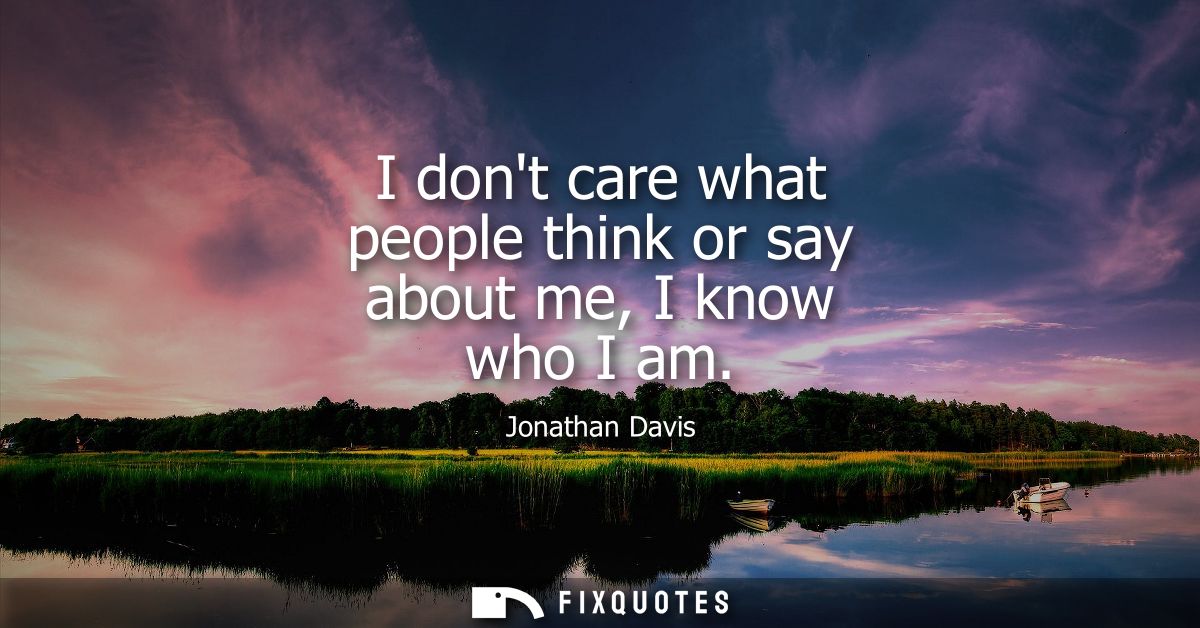
"I don't care what people think or say about me, I know who I am"
About this Quote
A line like this only lands because it’s doing two jobs at once: it’s a middle finger to the audience and a life raft for the person saying it. Coming from Jonathan Davis, whose career with Korn turned psychic distress into stadium-sized catharsis, the statement isn’t airy self-help. It’s a boundary drawn in public, by someone who’s spent decades being publicly interpreted, diagnosed, meme’d, and misread.
The intent is defiant, but the subtext is defensive. “I don’t care” is rarely literal; it’s a spell people cast when they care too much and need to keep functioning anyway. Davis has long written from the bruised zones of bullying, trauma, and alienation, and nu metal was built as a genre-wide rebuttal to cool-kid gatekeeping. In that context, “I know who I am” isn’t bragging. It’s survival language: identity as something you hold onto when the crowd wants to turn you into a caricature.
Culturally, it’s also a preemptive strike against the modern attention economy. Fans demand authenticity; critics punish it; social media turns every vulnerability into content. The quote refuses that bargain. It insists on an inner authority that doesn’t require consensus, likes, or “good press.” That’s why it resonates: it’s not a denial of other people’s power, it’s a refusal to let their noise be the final edit of your life.
The intent is defiant, but the subtext is defensive. “I don’t care” is rarely literal; it’s a spell people cast when they care too much and need to keep functioning anyway. Davis has long written from the bruised zones of bullying, trauma, and alienation, and nu metal was built as a genre-wide rebuttal to cool-kid gatekeeping. In that context, “I know who I am” isn’t bragging. It’s survival language: identity as something you hold onto when the crowd wants to turn you into a caricature.
Culturally, it’s also a preemptive strike against the modern attention economy. Fans demand authenticity; critics punish it; social media turns every vulnerability into content. The quote refuses that bargain. It insists on an inner authority that doesn’t require consensus, likes, or “good press.” That’s why it resonates: it’s not a denial of other people’s power, it’s a refusal to let their noise be the final edit of your life.
Quote Details
| Topic | Confidence |
|---|---|
| Source | Help us find the source |
| Cite | Cite this Quote |
Citation Formats
APA Style (7th ed.)
Davis, Jonathan. (n.d.). I don't care what people think or say about me, I know who I am. FixQuotes. https://fixquotes.com/quotes/i-dont-care-what-people-think-or-say-about-me-i-155081/
Chicago Style
Davis, Jonathan. "I don't care what people think or say about me, I know who I am." FixQuotes. Accessed February 2, 2026. https://fixquotes.com/quotes/i-dont-care-what-people-think-or-say-about-me-i-155081/.
MLA Style (9th ed.)
"I don't care what people think or say about me, I know who I am." FixQuotes, https://fixquotes.com/quotes/i-dont-care-what-people-think-or-say-about-me-i-155081/. Accessed 2 Feb. 2026.
More Quotes by Jonathan
Add to List