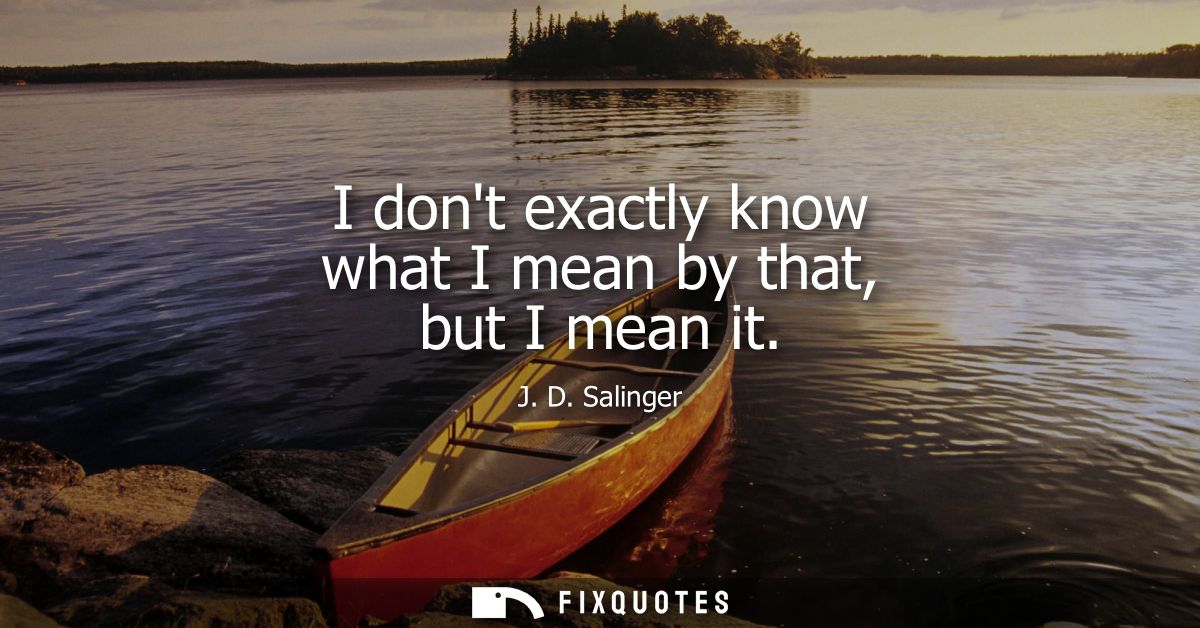
"I don't exactly know what I mean by that, but I mean it"
About this Quote
Pure Salinger: a shrug that’s also a dare. "I don't exactly know what I mean by that, but I mean it" captures the adolescent paradox at the center of his work - the feeling that your inner life is roaring with conviction even when language can’t keep up. The line works because it refuses the polite fiction that sincerity must arrive neatly packaged as clarity. It insists that meaning can be real before it’s articulate, that emotion can outrun explanation.
The subtext is defensive and intimate at once. "I don't exactly know" functions as a preemptive strike against being pinned down, corrected, or psychoanalyzed. It’s the speaker protecting a private, half-formed truth from the adult world’s demand for clean definitions. Then comes the pivot: "but I mean it". Not "it’s true", not "you’ll understand later" - just a claim of intention, of authenticity, with all the stubbornness of someone who expects to be misunderstood and talks anyway.
In Salinger’s context, this is practically a mission statement. His characters often circle what they can’t say directly: grief disguised as sarcasm, tenderness masquerading as contempt, spiritual yearning expressed in throwaway slang. Postwar disillusionment hangs behind it, too - a generation wary of big declarations, yet starving for something unphony to hold onto. The line dramatizes the tension between articulation and honesty: the most accurate thing you can sometimes say is that you can’t quite say it, and refusing to pretend otherwise becomes its own kind of integrity.
The subtext is defensive and intimate at once. "I don't exactly know" functions as a preemptive strike against being pinned down, corrected, or psychoanalyzed. It’s the speaker protecting a private, half-formed truth from the adult world’s demand for clean definitions. Then comes the pivot: "but I mean it". Not "it’s true", not "you’ll understand later" - just a claim of intention, of authenticity, with all the stubbornness of someone who expects to be misunderstood and talks anyway.
In Salinger’s context, this is practically a mission statement. His characters often circle what they can’t say directly: grief disguised as sarcasm, tenderness masquerading as contempt, spiritual yearning expressed in throwaway slang. Postwar disillusionment hangs behind it, too - a generation wary of big declarations, yet starving for something unphony to hold onto. The line dramatizes the tension between articulation and honesty: the most accurate thing you can sometimes say is that you can’t quite say it, and refusing to pretend otherwise becomes its own kind of integrity.
Quote Details
| Topic | Honesty & Integrity |
|---|---|
| Source | Help us find the source |
| Cite |
Citation Formats
APA Style (7th ed.)
Salinger, J.D. (2026, January 15). I don't exactly know what I mean by that, but I mean it. FixQuotes. https://fixquotes.com/quotes/i-dont-exactly-know-what-i-mean-by-that-but-i-23108/
Chicago Style
Salinger, J.D. "I don't exactly know what I mean by that, but I mean it." FixQuotes. January 15, 2026. https://fixquotes.com/quotes/i-dont-exactly-know-what-i-mean-by-that-but-i-23108/.
MLA Style (9th ed.)
"I don't exactly know what I mean by that, but I mean it." FixQuotes, 15 Jan. 2026, https://fixquotes.com/quotes/i-dont-exactly-know-what-i-mean-by-that-but-i-23108/. Accessed 23 Mar. 2026.
More Quotes by Salinger
Add to List