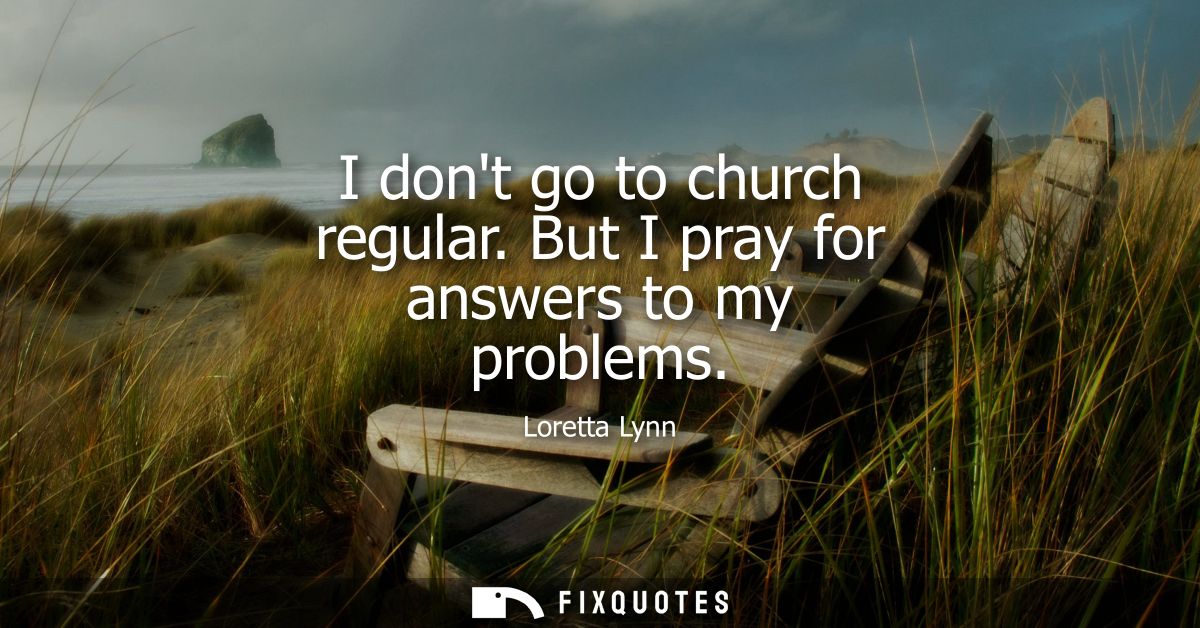
"I don't go to church regular. But I pray for answers to my problems"
About this Quote
A line like this lands because it refuses the tidy binaries people love to police: churchgoer vs. heathen, faithful vs. lapsed. Loretta Lynn gives you a third category that’s more honest to how a lot of Americans actually live - spiritually bilingual, institution-skeptical but not irony-poisoned. “I don’t go to church regular” is plainspoken, even a little defensive, the kind of sentence you say when you’ve been judged before. Then she pivots: “But I pray…” The “but” is the hinge. It’s not an excuse; it’s a claim of access. She’s asserting that the hotline to God doesn’t require a weekly punch card.
The subtext is class and geography as much as theology. Lynn’s world is rural, working, and relentlessly practical: you don’t theorize your way through hardship, you endure it. “Answers to my problems” frames prayer as a tool, not a performance. That bluntness can read transactional, but in her cultural register it’s intimacy - prayer as a private workbench where you try to make sense of what won’t budge.
Context matters: Lynn built a career turning domestic life into public art, singing about marriage, money, desire, and dignity with a clarity that scandalized polite gatekeepers. This quote carries the same posture. She’s not auditioning for religious purity; she’s naming a relationship with the sacred that survives outside the pews. It’s a quiet rebuke to institutions that confuse attendance with devotion, and a reminder that need - not habit - is often what keeps belief alive.
The subtext is class and geography as much as theology. Lynn’s world is rural, working, and relentlessly practical: you don’t theorize your way through hardship, you endure it. “Answers to my problems” frames prayer as a tool, not a performance. That bluntness can read transactional, but in her cultural register it’s intimacy - prayer as a private workbench where you try to make sense of what won’t budge.
Context matters: Lynn built a career turning domestic life into public art, singing about marriage, money, desire, and dignity with a clarity that scandalized polite gatekeepers. This quote carries the same posture. She’s not auditioning for religious purity; she’s naming a relationship with the sacred that survives outside the pews. It’s a quiet rebuke to institutions that confuse attendance with devotion, and a reminder that need - not habit - is often what keeps belief alive.
Quote Details
| Topic | Prayer |
|---|---|
| Source | Help us find the source |
| Cite |
Citation Formats
APA Style (7th ed.)
Lynn, Loretta. (2026, January 17). I don't go to church regular. But I pray for answers to my problems. FixQuotes. https://fixquotes.com/quotes/i-dont-go-to-church-regular-but-i-pray-for-69215/
Chicago Style
Lynn, Loretta. "I don't go to church regular. But I pray for answers to my problems." FixQuotes. January 17, 2026. https://fixquotes.com/quotes/i-dont-go-to-church-regular-but-i-pray-for-69215/.
MLA Style (9th ed.)
"I don't go to church regular. But I pray for answers to my problems." FixQuotes, 17 Jan. 2026, https://fixquotes.com/quotes/i-dont-go-to-church-regular-but-i-pray-for-69215/. Accessed 31 Mar. 2026.
More Quotes by Loretta
Add to List