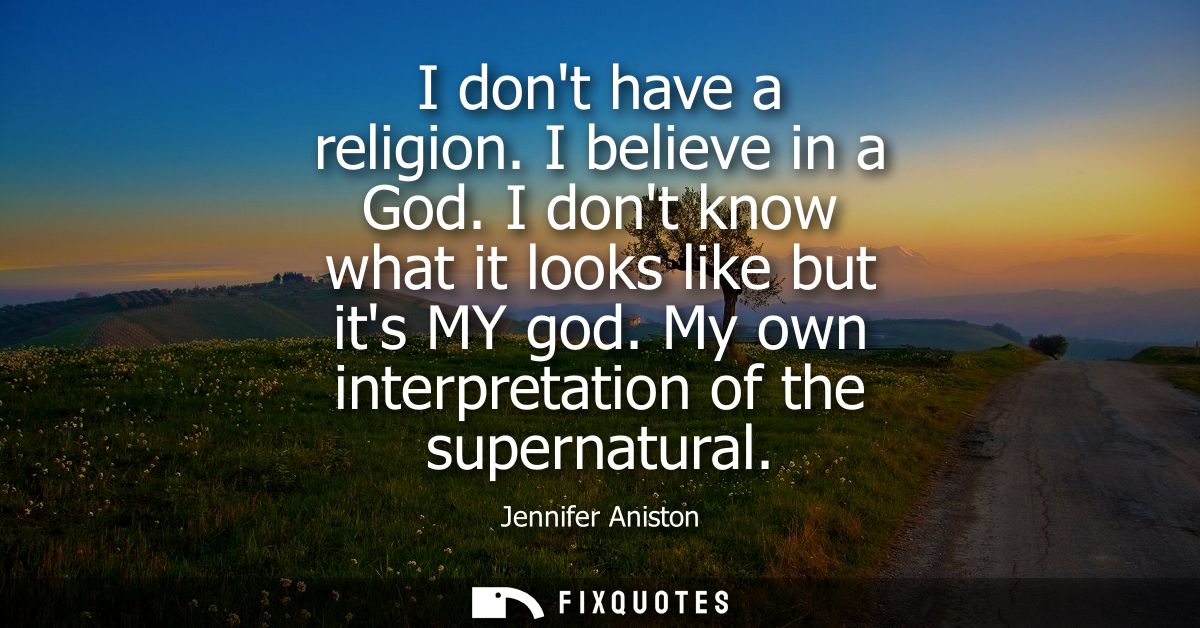
"I don't have a religion. I believe in a God. I don't know what it looks like but it's my god. My own interpretation of the supernatural"
About this Quote
The insistence in “MY god” is doing heavy cultural work. It’s ownership language in a space usually defined by inheritance and authority. For an actress whose public image has been relentlessly curated, scrutinized, and projected onto, the statement doubles as an autonomy claim: not just about theology, but about narrative control. She’s choosing a God that can’t be audited by a church or debated by pundits.
“My own interpretation of the supernatural” frames belief like a personal aesthetic - curated, intimate, self-authored. That’s very late-20th/early-21st century: privatized faith shaped by therapy culture, individualism, and suspicion of institutions. The subtext isn’t “I’m deep”; it’s “don’t recruit me.” She offers enough conviction to sound grounded, and enough ambiguity to stay unpinned - a pragmatic creed for life under the spotlight.
Quote Details
| Topic | God |
|---|---|
| Source | Help us find the source |
| Cite |
Citation Formats
APA Style (7th ed.)
Aniston, Jennifer. (2026, February 18). I don't have a religion. I believe in a God. I don't know what it looks like but it's my god. My own interpretation of the supernatural. FixQuotes. https://fixquotes.com/quotes/i-dont-have-a-religion-i-believe-in-a-god-i-dont-83142/
Chicago Style
Aniston, Jennifer. "I don't have a religion. I believe in a God. I don't know what it looks like but it's my god. My own interpretation of the supernatural." FixQuotes. February 18, 2026. https://fixquotes.com/quotes/i-dont-have-a-religion-i-believe-in-a-god-i-dont-83142/.
MLA Style (9th ed.)
"I don't have a religion. I believe in a God. I don't know what it looks like but it's my god. My own interpretation of the supernatural." FixQuotes, 18 Feb. 2026, https://fixquotes.com/quotes/i-dont-have-a-religion-i-believe-in-a-god-i-dont-83142/. Accessed 13 Mar. 2026.