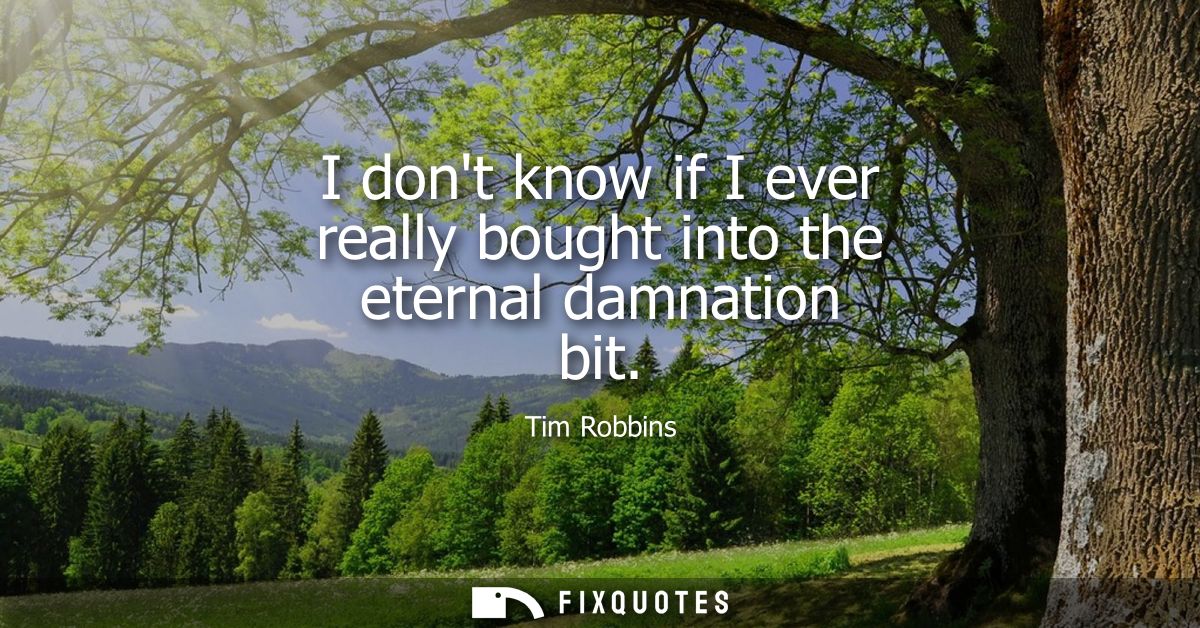
"I don't know if I ever really bought into the eternal damnation bit"
About this Quote
A throwaway shrug that quietly detonates a whole moral architecture. When Tim Robbins says, "I don't know if I ever really bought into the eternal damnation bit", the key word isn't "damnation" - it's "bought". He frames a cornerstone of certain religious worldviews as a transaction, a product pitched hard enough that people mistake fear for truth. The line lands because it treats the doctrine of hell not as sacred mystery but as marketing: a narrative designed to close the sale.
As an actor with a public persona shaped by humanist, politically engaged roles, Robbins is also telegraphing a life posture: skepticism as self-respect. The sentence is casual, even polite ("I don't know if..."), but the subtext is blunt. He isn't announcing a dramatic break with faith; he's implying the threat never had leverage over him in the first place. That matters culturally because so many people describe deconversion as escape from fear. Robbins skips the trauma plot and offers something more quietly subversive: the possibility that the fear-based part of religion simply failed to stick.
The phrase "eternal damnation bit" further deflates the concept by treating it as a routine in a larger act - a bit, a segment, a scripted scare beat. In an era when institutions are increasingly evaluated like brands and belief competes with mental health language, the quote works as a soft refusal of coercion. It's not a manifesto; it's a boundary.
As an actor with a public persona shaped by humanist, politically engaged roles, Robbins is also telegraphing a life posture: skepticism as self-respect. The sentence is casual, even polite ("I don't know if..."), but the subtext is blunt. He isn't announcing a dramatic break with faith; he's implying the threat never had leverage over him in the first place. That matters culturally because so many people describe deconversion as escape from fear. Robbins skips the trauma plot and offers something more quietly subversive: the possibility that the fear-based part of religion simply failed to stick.
The phrase "eternal damnation bit" further deflates the concept by treating it as a routine in a larger act - a bit, a segment, a scripted scare beat. In an era when institutions are increasingly evaluated like brands and belief competes with mental health language, the quote works as a soft refusal of coercion. It's not a manifesto; it's a boundary.
Quote Details
| Topic | Faith |
|---|---|
| Source | Help us find the source |
| Cite |
Citation Formats
APA Style (7th ed.)
Robbins, Tim. (2026, January 16). I don't know if I ever really bought into the eternal damnation bit. FixQuotes. https://fixquotes.com/quotes/i-dont-know-if-i-ever-really-bought-into-the-96693/
Chicago Style
Robbins, Tim. "I don't know if I ever really bought into the eternal damnation bit." FixQuotes. January 16, 2026. https://fixquotes.com/quotes/i-dont-know-if-i-ever-really-bought-into-the-96693/.
MLA Style (9th ed.)
"I don't know if I ever really bought into the eternal damnation bit." FixQuotes, 16 Jan. 2026, https://fixquotes.com/quotes/i-dont-know-if-i-ever-really-bought-into-the-96693/. Accessed 31 Mar. 2026.
More Quotes by Tim
Add to List