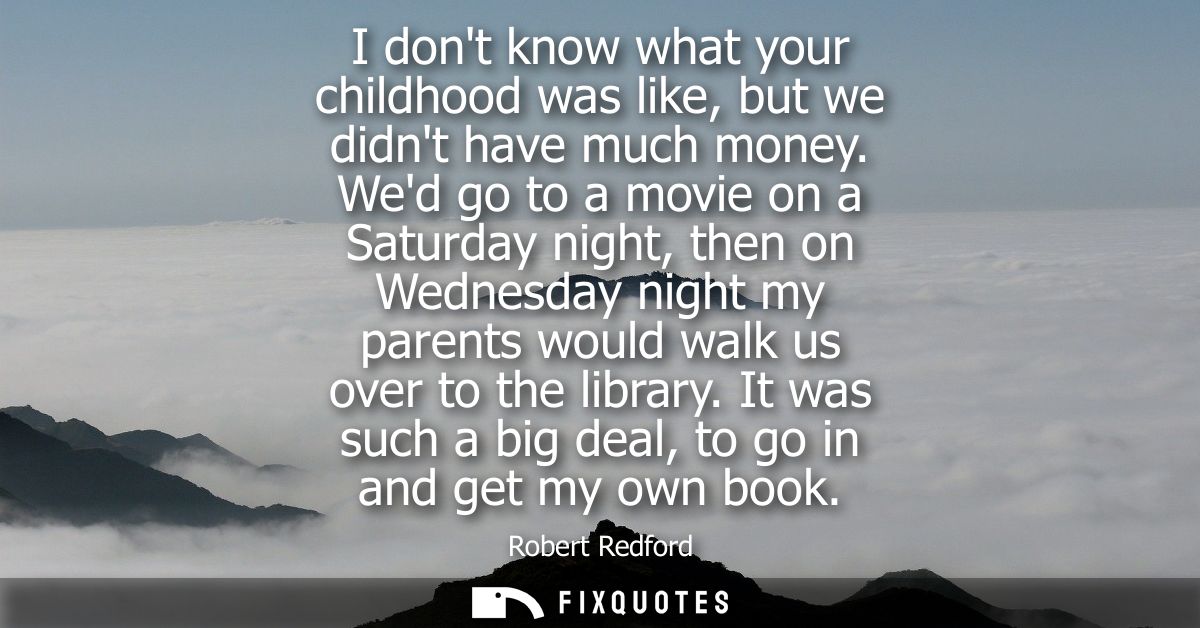
"I don't know what your childhood was like, but we didn't have much money. We'd go to a movie on a Saturday night, then on Wednesday night my parents would walk us over to the library. It was such a big deal, to go in and get my own book"
About this Quote
The subtext is almost suspiciously simple: aspiration doesn’t always arrive as a grand speech about education. It arrives as parents walking you somewhere. Redford’s emphasis on being “walked over” signals effort and intention, a kind of working-class choreography. And the detail “get my own book” does a lot of emotional work. Ownership, in a household where money is tight, becomes symbolic rather than literal. The library lets a child feel proprietary about ideas even when everything else is shared, hand-me-down, or out of reach.
In cultural context, it’s also a quiet argument for public institutions at a time when we treat them as optional or nostalgic. Redford isn’t romanticizing poverty; he’s highlighting the infrastructure that made it survivable, even fruitful. Coming from an actor-director whose life depends on storytelling, the origin story lands with extra bite: the library isn’t just where he learned to read a book, it’s where he learned that stories could belong to him, too.
Quote Details
| Topic | Book |
|---|---|
| Source | Help us find the source |
| Cite |
Citation Formats
APA Style (7th ed.)
Redford, Robert. (2026, January 16). I don't know what your childhood was like, but we didn't have much money. We'd go to a movie on a Saturday night, then on Wednesday night my parents would walk us over to the library. It was such a big deal, to go in and get my own book. FixQuotes. https://fixquotes.com/quotes/i-dont-know-what-your-childhood-was-like-but-we-85514/
Chicago Style
Redford, Robert. "I don't know what your childhood was like, but we didn't have much money. We'd go to a movie on a Saturday night, then on Wednesday night my parents would walk us over to the library. It was such a big deal, to go in and get my own book." FixQuotes. January 16, 2026. https://fixquotes.com/quotes/i-dont-know-what-your-childhood-was-like-but-we-85514/.
MLA Style (9th ed.)
"I don't know what your childhood was like, but we didn't have much money. We'd go to a movie on a Saturday night, then on Wednesday night my parents would walk us over to the library. It was such a big deal, to go in and get my own book." FixQuotes, 16 Jan. 2026, https://fixquotes.com/quotes/i-dont-know-what-your-childhood-was-like-but-we-85514/. Accessed 3 Apr. 2026.