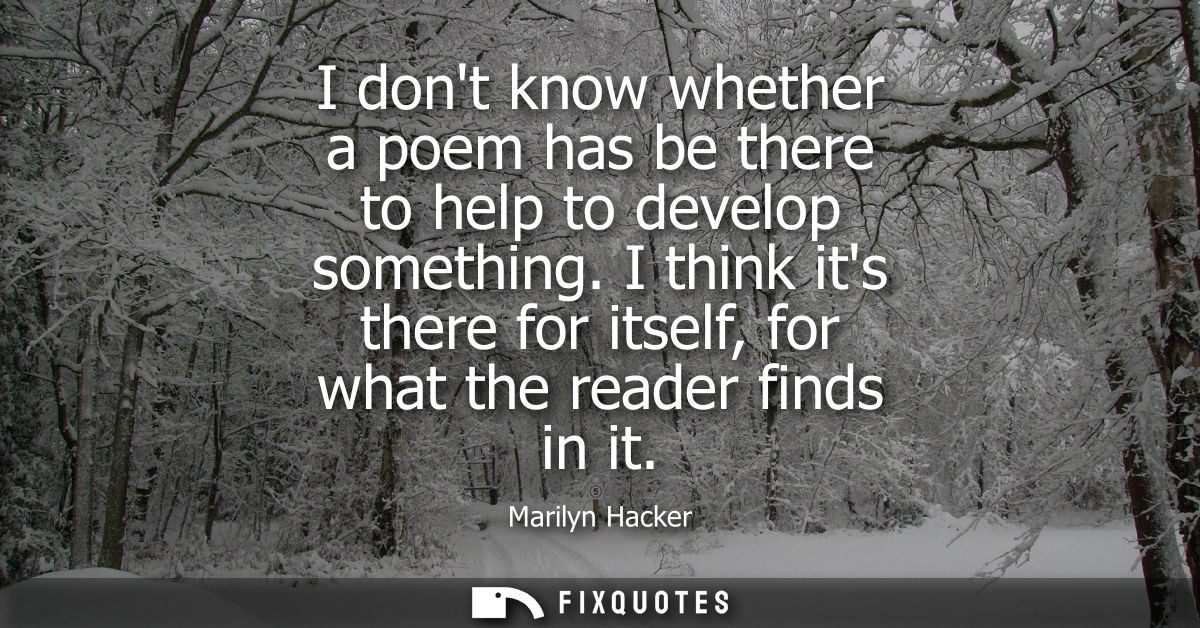
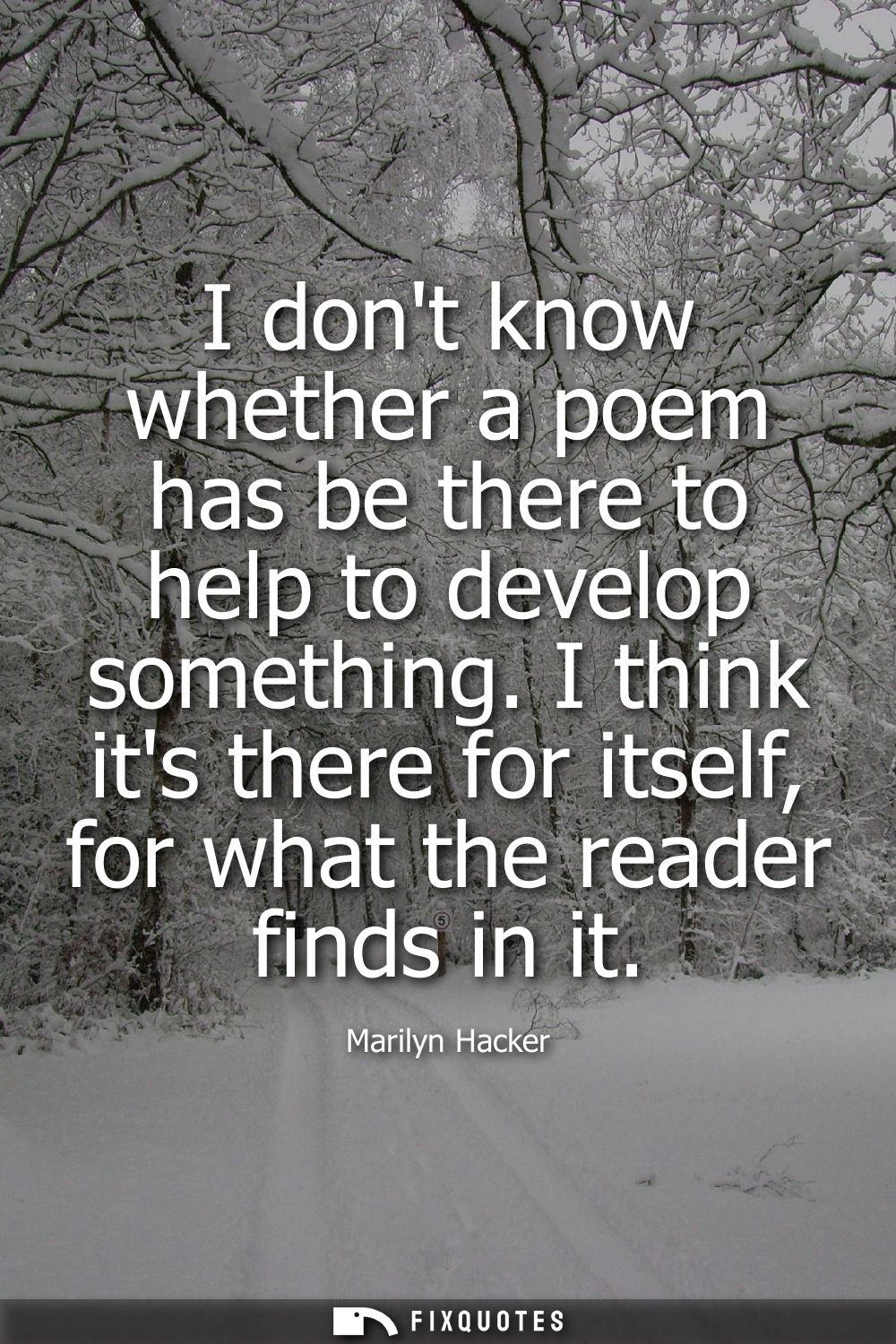
"I don't know whether a poem has be there to help to develop something. I think it's there for itself, for what the reader finds in it"
About this Quote
The pivot is her emphasis on “there for itself.” Hacker, known for formal rigor and intellectual range, isn’t arguing for airy aestheticism; she’s staking out a boundary. If a poem is built to deliver a predetermined takeaway, the reader becomes a consumer of conclusions. Hacker wants the opposite: the reader as co-maker. “For what the reader finds in it” shifts authority away from the author’s intent and toward encounter, interpretation, and lived context. Meaning isn’t extracted like a nugget; it’s produced in the friction between text and reader.
The subtext is quietly democratic and quietly demanding. The poem doesn’t have to justify its existence, but the reader has to show up with attention. In an era that prizes “impact,” Hacker defends a different kind of value: not utility, but depth; not instruction, but discovery.
Quote Details
| Topic | Poetry |
|---|---|
| Source | Help us find the source |
| Cite |
Citation Formats
APA Style (7th ed.)
Hacker, Marilyn. (2026, January 17). I don't know whether a poem has be there to help to develop something. I think it's there for itself, for what the reader finds in it. FixQuotes. https://fixquotes.com/quotes/i-dont-know-whether-a-poem-has-be-there-to-help-81647/
Chicago Style
Hacker, Marilyn. "I don't know whether a poem has be there to help to develop something. I think it's there for itself, for what the reader finds in it." FixQuotes. January 17, 2026. https://fixquotes.com/quotes/i-dont-know-whether-a-poem-has-be-there-to-help-81647/.
MLA Style (9th ed.)
"I don't know whether a poem has be there to help to develop something. I think it's there for itself, for what the reader finds in it." FixQuotes, 17 Jan. 2026, https://fixquotes.com/quotes/i-dont-know-whether-a-poem-has-be-there-to-help-81647/. Accessed 13 Feb. 2026.